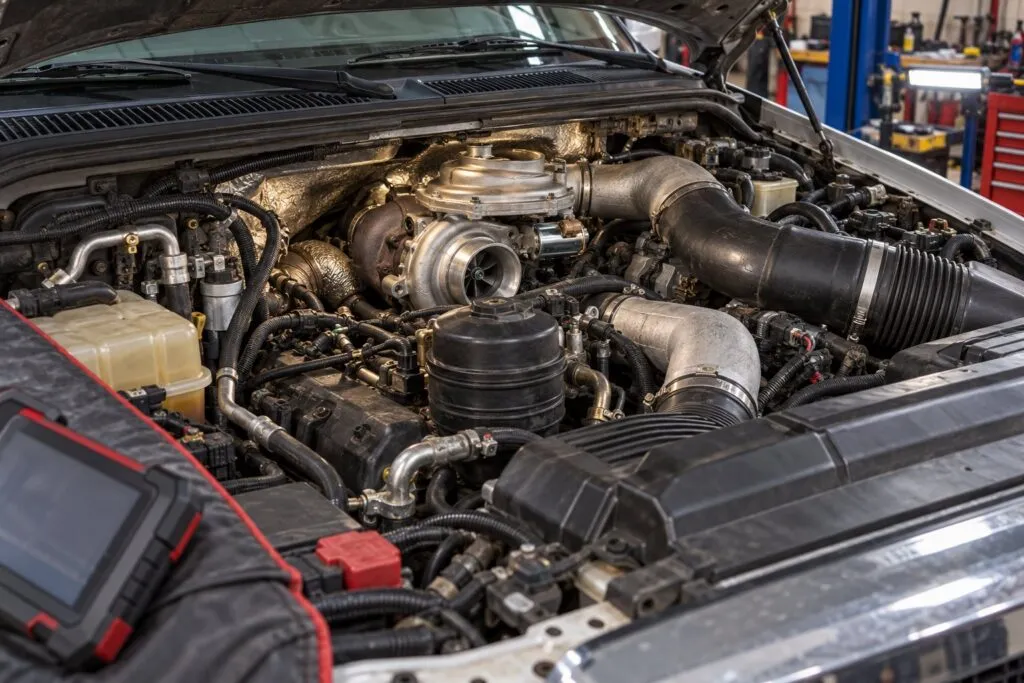
This page lists the turbocharger fault codes a scan tool can show for the boost system: the generic OBD-II codes for boost pressure, boost control, the wastegate solenoid, the position sensor and the boost pressure sensor. Each line gives the code, its standard definition and what kind of fault it points to. Where we have a full diagnosis guide for a code, it is linked.
Two things decide how you read any of them. First, the kind of code: a circuit code (open, low, high) is an electrical fault in wiring, a connector, a sensor, a solenoid or an actuator, while a performance code means everything is connected but the result is not what the engine computer asked for. Second, the turbo itself: a code for a part your turbo does not have cannot be the answer, so know whether yours is wastegated or variable geometry, and how it is moved.
How to Read a Boost Code
Generic OBD-II “P” codes exist on light road vehicles from model year 1996. Heavy trucks report most faults as SPN and FMI numbers instead, and mechanical engines, marine engines and most industrial engines store no P codes at all. The definitions below are the generic ones; a vehicle maker can add its own codes and its own conditions for setting them.
- The letter A or B in a definition names which control or sensor is meant. Most single-turbo engines only have A.
- Circuit, circuit low, circuit high: the electrical signal is missing, too low or too high. Start with the connector, the harness and the part’s own resistance, not with the turbo.
- Range/performance: the signal is present but does not match what was commanded or what other sensors report. This is where sticking mechanisms, leaks and worn parts show up.
- Underboost and overboost are results, not parts. They tell you what the manifold pressure did, and the cause still has to be found.
Boost Pressure Codes
| Code | Generic definition | What it tells you | Guide |
|---|---|---|---|
| P0299 | Turbocharger/Supercharger A Underboost Condition | Boost is lower than the computer expects for the load | P0299 diagnosis guide |
| P0234 | Turbocharger/Supercharger A Overboost Condition | Boost is higher than the computer allows | P0234 causes and fix |
| P2263 | Turbo/Supercharger Boost System Performance | The boost system as a whole is not responding as commanded | P2263 diagnosis |
| P0049 | Turbocharger/Supercharger Turbine Overspeed | Turbo speed, measured or calculated, is above its limit | No separate guide |
P0299 has two guides on this site: the complete P0299 guide and a shorter step-by-step P0299 diagnosis for diesel trucks. If the truck is simply down on power with no code, start with low boost pressure on a diesel.
Boost Control Codes: Actuator, Vanes and Control Solenoid
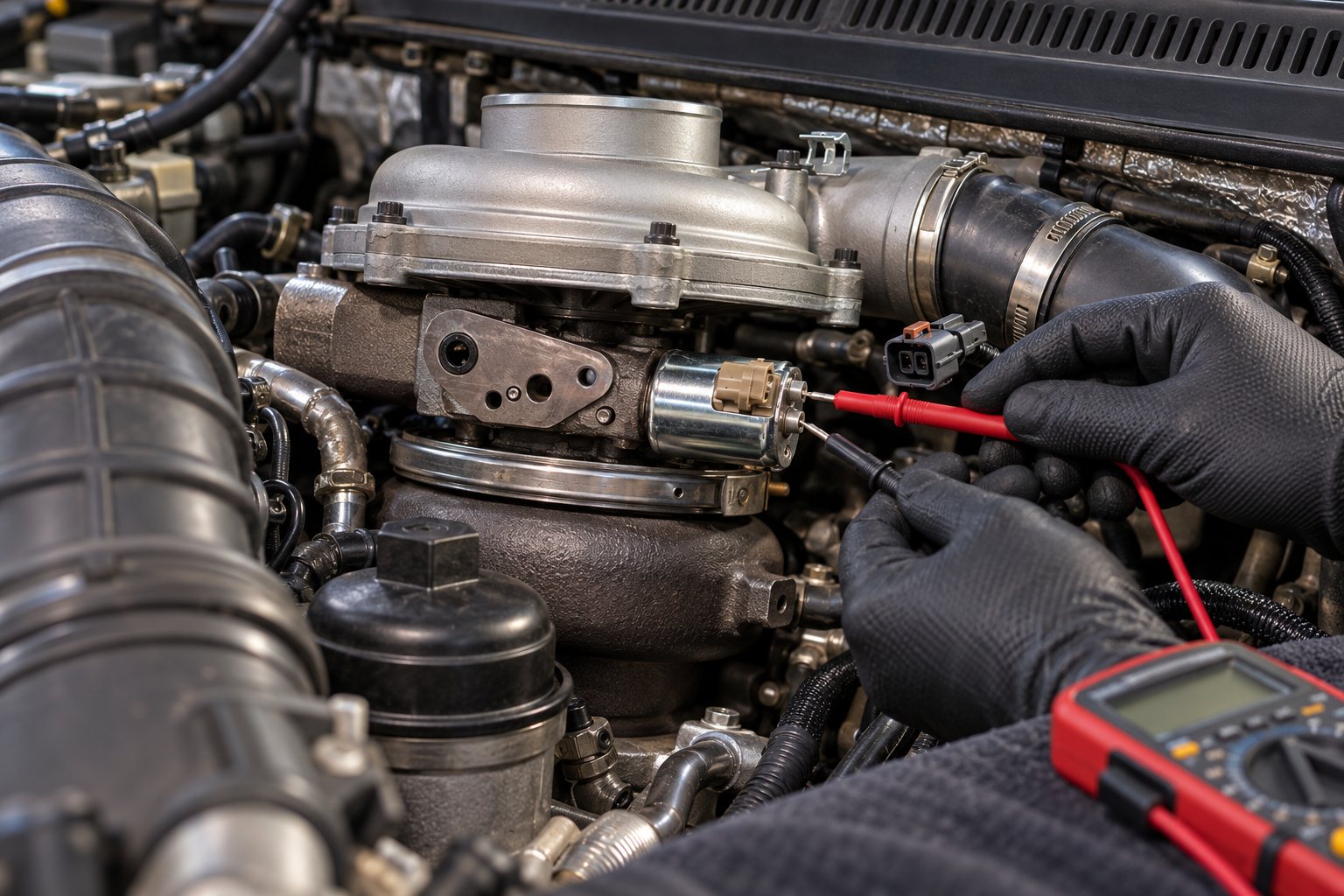
“Boost control” is whatever the computer uses to regulate boost: the electronic actuator of a variable geometry turbo, the oil control solenoid of an oil-operated one, or a boost control solenoid on a wastegated turbo.
| Code | Generic definition | What it tells you | Guide |
|---|---|---|---|
| P0045 | Turbocharger/Supercharger Boost Control A Circuit/Open | Electrical: the control circuit is open | P0045 guide |
| P0046 | Boost Control A Circuit Range/Performance | The control responds, but outside the range the computer expects | P0046 guide |
| P0047 | Boost Control A Circuit Low | Electrical: signal below the valid range | See the P0045 guide |
| P0048 | Boost Control A Circuit High | Electrical: signal above the valid range | See the P0045 guide |
| P003A | Boost Control A Position Exceeded Learning Limit | The learned travel of the actuator or vanes is outside its limits | P003A guide |
| P003B | Boost Control B Position Exceeded Learning Limit | The same fault on a second boost control | See the P003A guide |
Boost Control Position Sensor Codes
These belong to the sensor that reports where the actuator or the vanes really are. They only exist on turbos that have such a sensor.
| Code | Generic definition | What it tells you | Guide |
|---|---|---|---|
| P2563 | Boost Control Position Sensor A Circuit Range/Performance | Reported position does not match the commanded position | See the P2564 guide |
| P2564 | Boost Control Position Sensor A Circuit Low | Electrical: the sensor signal is too low | P2564 guide |
| P2565 | Boost Control Position Sensor A Circuit High | Electrical: the sensor signal is too high | See the P2564 guide |
A stuck mechanism does not set the low or high circuit codes by itself. A nozzle or vane ring that will not move sets the range/performance code, or shows up as underboost or overboost. More on that in VGT vanes stuck open or closed.
Wastegate Solenoid Codes
| Code | Generic definition | What it tells you | Guide |
|---|---|---|---|
| P0243 | Turbocharger Wastegate Solenoid A Malfunction | Electrical fault in the solenoid or its circuit | P0243 guide |
| P0244 | Wastegate Solenoid A Range/Performance | The solenoid’s response is out of range; the cause can be electrical or mechanical | See the P0243 guide |
| P0245 | Wastegate Solenoid A Low | Electrical: circuit signal too low | See the P0243 guide |
| P0246 | Wastegate Solenoid A High | Electrical: circuit signal too high | See the P0243 guide |
A wastegate that is seized, or a linkage that has worn loose, is a mechanical fault. It does not set P0243, P0245 or P0246; it shows up as overboost (P0234) or underboost (P0299).
Boost Pressure Sensor Codes
| Code | Generic definition | What it tells you |
|---|---|---|
| P0235 | Turbocharger Boost Sensor A Circuit Malfunction | Electrical fault in the boost pressure sensor circuit |
| P0236 | Turbocharger Boost Sensor A Range/Performance | The sensor reading does not fit the engine’s other readings |
| P0237 | Turbocharger/Supercharger Boost Sensor A Circuit Low | Electrical: sensor signal too low |
| P0238 | Turbocharger/Supercharger Boost Sensor A Circuit High | Electrical: sensor signal too high |
| P0069 | Manifold Absolute Pressure – Barometric Pressure Correlation | Manifold and barometric pressure readings disagree |
A boost sensor that reads wrong makes a healthy turbo look guilty: the computer acts on the reading, not on the real pressure. Compare the scan tool value with a mechanical gauge before judging the turbo.
Bypass Valve Codes
| Code | Generic definition | What it tells you |
|---|---|---|
| P0033 | Turbo Charger Bypass Valve Control Circuit | Electrical fault in the bypass valve control circuit |
| P0034 | Turbo Charger Bypass Valve Control Circuit Low | Electrical: circuit signal too low |
| P0035 | Turbo Charger Bypass Valve Control Circuit High | Electrical: circuit signal too high |
Codes That Are Not Turbo Codes but Often Come With Them
| Code | Generic definition | Why it matters for the turbo | Guide |
|---|---|---|---|
| P0101 | Mass Air Flow Circuit Range/Performance | A boost leak or a restricted intake changes measured airflow | P0101 and the turbo |
| P0401 | Insufficient EGR Flow | Our guide explains what low EGR flow does to the turbo over time | P0401 guide |
| P046C | EGR Sensor A Circuit Range/Performance | An EGR sensor code, not a turbo code | No separate guide |
| P0478 | Exhaust Pressure Control Valve A High | Electrical fault, stuck valve or restricted exhaust; turbo overboost can also set it | No separate guide |
Which Codes Can Your Turbo Set?
- Wastegated turbo: underboost and overboost (P0299, P0234), the wastegate solenoid codes (P0243 to P0246) or the boost control codes (P0045 to P0048) where the wastegate is computer controlled, and the boost sensor codes.
- Variable geometry turbo with an electronic actuator: the boost control codes (P0045 to P0048, P003A) and the position sensor codes (P2563 to P2565), besides underboost and overboost. Background: how a variable geometry turbocharger works and electronic actuator failure on diesel trucks.
- Oil-operated variable geometry turbo: there is no electric actuator, but its oil control solenoid can still set the boost control codes (P0045 to P0048). Read the codes against the parts that are there: the Ford 6.0L, for example, has no vane position sensor, so P003A and P2563 to P2565 do not apply to it.
Before You Replace the Turbo
- Write down every code and the freeze-frame data before clearing anything.
- With a circuit code, check the connector, the harness and the part’s electrical values first. A new turbo does not fix a broken wire.
- With a performance code, pressure-test the intake tract for leaks and command the actuator or vanes through their travel with the scan tool.
- Compare the boost reading on the scan tool with a mechanical gauge.
- After an electronic actuator is replaced, run the calibration the engine maker prescribes. See how to calibrate a VGT actuator after replacement.
If the checks lead back to the turbo itself, our turbocharger rebuild service covers both wastegated and variable geometry units, and you can reach the shop at (909) 824-1020 with the code and the turbo’s part number.
Frequently Asked Questions
What does the P0299 code mean?
P0299 is the underboost code: boost was lower than the engine computer expected. It does not say which part caused it. Boost leaks, a stuck wastegate or vane mechanism, a failed actuator and a faulty boost sensor can all set it.
Does a turbo fault code mean the turbocharger is bad?
No. Circuit codes point to wiring, a connector, a sensor, a solenoid or an actuator, and performance codes are often caused by leaks or sensors. Test the control side and the intake tract before replacing the turbo.
What is the difference between P0299 and P0234?
P0299 is underboost: manifold pressure stayed below what the engine computer expected. P0234 is overboost: pressure went above what the computer allows.
Do heavy trucks use these P codes?
Mostly not. Generic OBD-II P codes exist on light road vehicles from model year 1996. Heavy trucks report most faults as SPN and FMI numbers, and mechanical, marine and most industrial engines store no P codes.
Need a Turbocharger?
PT Turbo has rebuilt and sold turbochargers since 1978. We stock remanufactured units for Cummins, Duramax, Power Stroke, Detroit Diesel, and more — backed by a 12-month unlimited mileage warranty and same-week shipping from San Bernardino, CA.
📞 (909) 824-1020 · 346 S I St. #3, San Bernardino, CA 92410 · [email protected]