Low Boost Pressure on a Diesel: Diagnosing Every Possible Cause
Low boost pressure on a diesel is one of the most common complaints that lands a truck in the shop, and it is also one of the most misdiagnosed. A soft, sluggish engine that won’t build boost can point to a dozen different failures, and swapping the turbo before you’ve confirmed the actual cause is an expensive way to guess wrong.
At PT Turbo we’ve spent more than 45 years diagnosing and rebuilding turbochargers for every diesel platform on the road. This guide walks through every realistic cause of low boost, in the order a smart mechanic should check them, so you fix the problem the first time.
What “Low Boost” Actually Means
Boost pressure is the intake manifold pressure the turbocharger generates above atmospheric. Most modern diesels run anywhere from 15 to 40+ psi of boost under load, depending on the engine, tune, and turbo sizing.
Before you chase a fault, confirm you actually have a problem. A scan tool showing commanded boost versus actual boost is the fastest way to separate a real mechanical fault from a driver perception issue. If actual boost tracks within a couple psi of commanded across the RPM range, the turbo is doing its job.
When actual boost falls well short of commanded, you have a genuine low-boost condition. Here’s how the causes break down by how often we see them.
| Cause | Frequency | Typical Fix Cost |
|---|---|---|
| Boost leak (hose, clamp, intercooler) | Very common | $0 to $300 |
| Failed or sticking actuator / wastegate | Common | see actuator prices |
| Clogged air filter or restricted intake | Common | $40 to $120 |
| VGT vanes stuck (carbon/soot) | Common | $200 to $1,500 |
| Restricted exhaust / plugged DPF | Moderate | $300 to $2,500 |
| Worn turbo (bearings, wheel damage) | Moderate | Rebuild or replace |
| Sensor / electronic fault | Moderate | $50 to $400 |
Price ranges in this article are general estimates to help with budgeting, not PT Turbo quotes. Our current prices are on each product listing, and our rebuild prices are on the turbo rebuild price list.
Start With the Air Path: Boost Leaks First
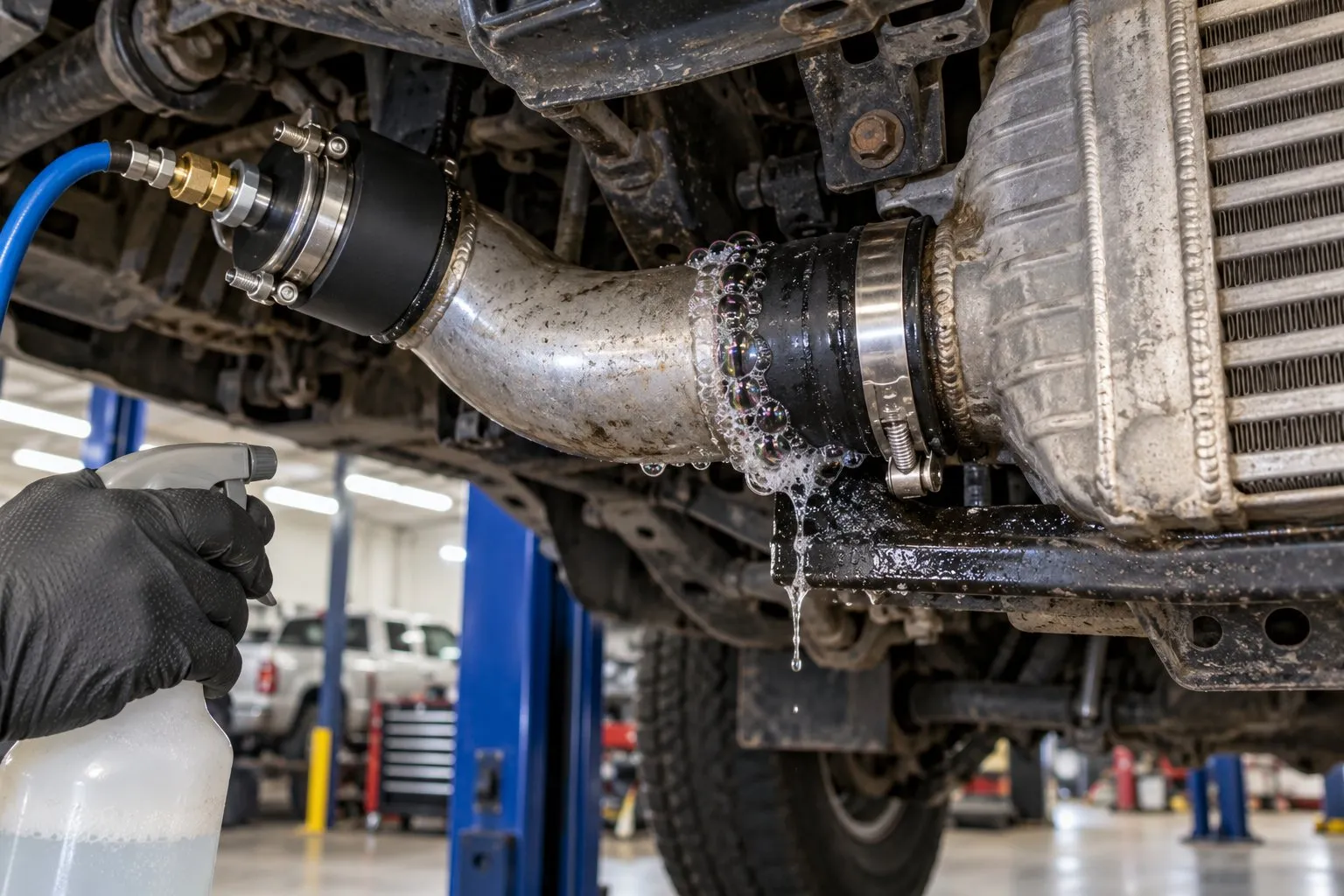
The number one cause of low boost has nothing to do with the turbo itself. It’s a leak somewhere between the compressor outlet and the intake valves. A cracked charge pipe, a slipped coupler, a blown intercooler end tank, or a loose clamp will dump pressurized air before it ever reaches the cylinders.
Even a small leak becomes huge under boost. A pinhole that seems minor at idle can bleed off several psi at 30 psi of manifold pressure. The turbo spins harder to compensate, EGTs climb, and fuel economy tanks.
The right way to find these is a pressurized test. Our full walkthrough on the boost leak test procedure shows how to pressurize the intake tract with shop air and hunt down every leak with soapy water. Do this before you touch anything else.
Also inspect the intake side. A clogged air filter or a collapsed intake hose starves the compressor and mimics a turbo problem. Pull the filter, hold it to the light, and check for a dark or oil-soaked element.
The Actuator and Wastegate: Where Boost Control Lives
Once the air path is confirmed tight, the actuator is the next suspect. On wastegated turbos, a pneumatic actuator uses boost pressure against a spring to open a valve that bleeds exhaust away from the turbine. If that actuator is weak, leaking, or sticking, boost control goes haywire.
A seized or corroded rod can hold the wastegate open (chronic low boost). A ruptured diaphragm does the opposite on a gate that boost pressure opens: the gate stays shut and boost overshoots. You can bench-test many actuators with a hand vacuum/pressure pump, watching for smooth rod travel and no pressure bleed-down.
When an actuator fails, replace it with the correct calibrated unit. A mismatched actuator spring rate will throw your boost curve off even if everything else is perfect.
Matching the Right Replacement Actuator
If you’re not sure which unit matches your turbo part number, contact PT Turbo with your turbo tag and we’ll cross-reference it.
Diagnosing Low Boost Pressure on a Diesel With a VGT Turbo
Variable-geometry turbos changed the low-boost game. Instead of a wastegate, a VGT uses movable vanes (on Holset turbos, a sliding nozzle) in the turbine housing to control exhaust flow across the whole RPM range. When that mechanism gums up with soot, boost control falls apart.
Stuck-closed vanes cause overboost and hard, jerky power delivery. Stuck-open or sticking vanes cause the classic low-boost, no-power complaint, especially off idle. This is extremely common on Ford 6.0L and 6.4L Powerstroke, Duramax LMM/LML, and Cummins engines with the Holset VGT.
Before condemning the turbo, command the vanes with a scan tool and watch the actuator sweep (on oil-moved Duramax turbos, watch the vane position reading instead; the oil-moved Ford 6.0L has no vane position sensor, so watch boost respond as you command the vanes). On electronic VGTs, a sticking unison ring often throws a specific actuator or overboost/underboost code. Sometimes a good cleaning and exercise cycle restores movement; sometimes the cartridge is done.
If you run a 6.4L, understand the twin-turbo arrangement before you diagnose. Our breakdown of the 6.4L high-pressure vs low-pressure turbo explains how a failure in one stage shows up as low boost across the whole system. For Cummins owners, the complete Holset model guide covers the HE351VE and HE300VG VGT units that give trouble.
Exhaust Restriction and the Backpressure Trap
A turbo is only as good as the exhaust flowing through it. A plugged diesel particulate filter, a collapsed catalyst, or a crushed exhaust pipe creates backpressure that stalls the turbine wheel and kills boost.
Check for active regen faults and DPF differential pressure on your scan tool. A DPF loaded past its threshold will choke the engine and produce low boost along with reduced power and poor fuel economy.
Don’t forget the EGR system. A stuck-open EGR valve floods the intake with inert exhaust gas, displaces fresh air, and lowers measured boost and power. A leaking EGR cooler does the same while adding coolant loss into the mix.
When the Turbo Itself Is the Problem
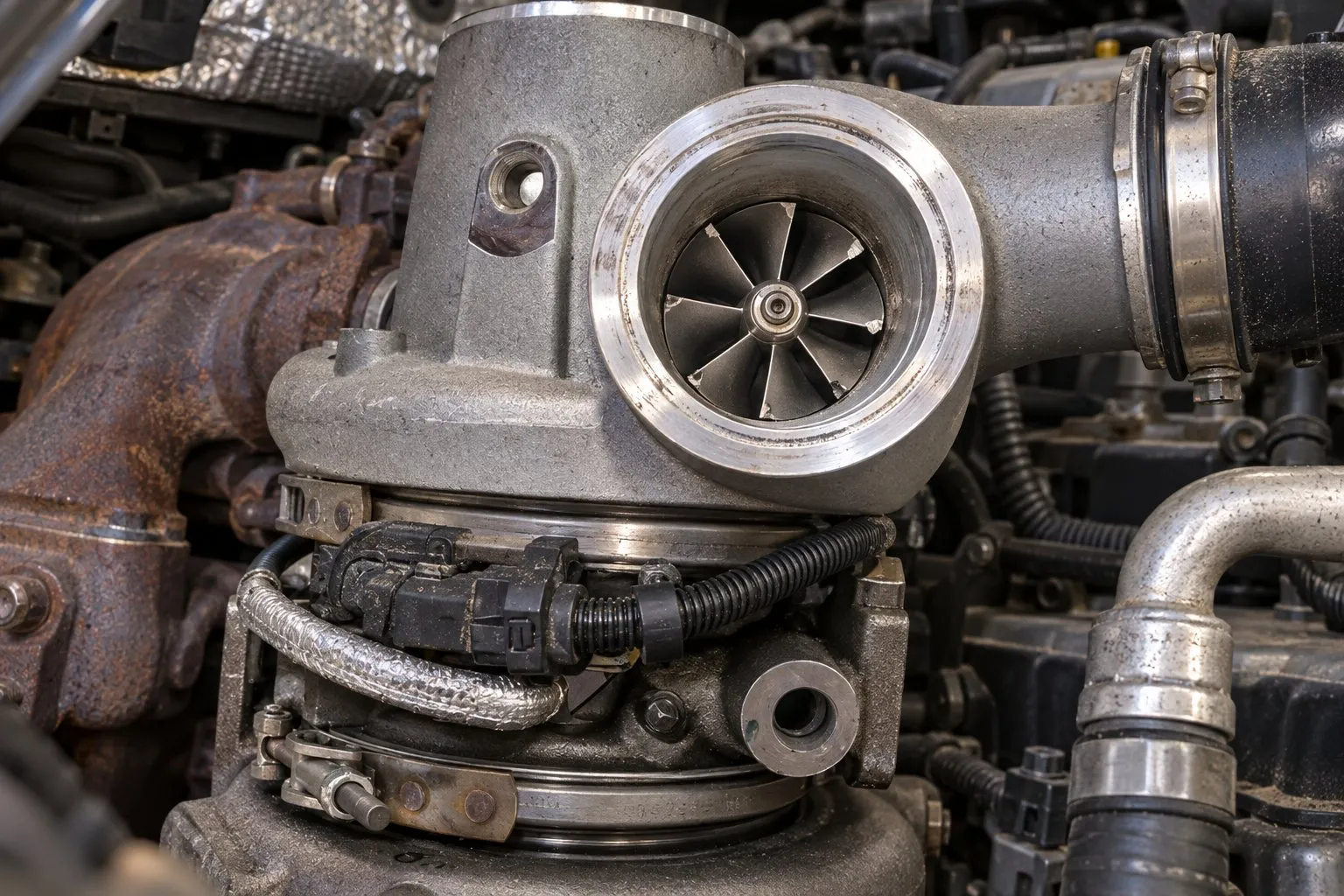
If the air path is sealed, the actuator tests good, the vanes move freely, and the exhaust flows, then the turbo hardware becomes the suspect. Worn journal bearings let the shaft wobble, which drops compressor efficiency and lets oil past the seals.
Pull the intake pipe and check the compressor wheel. Look for excessive shaft play, rubbing marks on the housing, chipped or bent blades, and oil pooling in the compressor cover. Any of these will cost you boost and get worse fast.
Oil in the compressor housing often points back to crankcase issues, not the turbo seal. High crankcase pressure pushes oil past the seals and mimics a failed turbo. We cover this trap in detail in our article on crankcase pressure and turbocharger failure, and it’s worth reading before you condemn a good unit.
New vs Remanufactured: Making the Call
When the turbo is genuinely worn out, you have three solid paths: a new unit, a quality remanufactured unit, or a professional rebuild of your original core.
| Option | Cost Range | Best For |
|---|---|---|
| New OEM turbo | Highest | Warranty jobs, latest revisions |
| Remanufactured turbo | Moderate | Fast turnaround, proven value |
The third path, a professional rebuild of your original core, keeps your exact housing and part number while renewing the rotating assembly, bearings, and seals. For hard-to-source or discontinued units, this is often the smartest move, and it sidesteps the fitment guesswork that comes with a substitute casting. A properly rebuilt core performs like new because the parts that wear out are the parts that get replaced.
Whichever route you take, only put a turbo on an engine you’ve already proven clean. A fresh unit bolted to a plugged DPF, a leaking charge pipe, or an engine with high crankcase pressure will fail the same way the last one did. Fix the cause first, confirm your air path and exhaust flow, then install the turbo last. That order is what separates a one-time repair from a comeback.
If boost is normal around town and only falls away at speed, see Boost Pressure Drops at Highway Speed.
Frequently Asked Questions
What causes low boost pressure on a diesel engine?
Low boost can result from boost leaks, a failing turbocharger, clogged air filters, faulty wastegate or VGT actuators, exhaust restrictions, or sensor and vacuum issues. Confirming the exact cause is essential before replacing any parts.
Should I replace the turbo if my diesel has low boost?
Not immediately—replacing the turbo before confirming the actual cause is an expensive way to guess wrong. Many low boost problems come from leaks, actuators, or restrictions rather than the turbo itself.
How do you diagnose a boost leak on a diesel?
A boost leak is typically found using a pressure test on the intake system to listen for escaping air, along with inspecting hoses, clamps, and intercooler connections for cracks or loose fittings.
If a worn turbo is the cause, PT Turbo’s turbo rebuild service can restore full boost.
Need a Turbocharger?
PT Turbo has rebuilt and sold turbochargers since 1978. We stock remanufactured units for Cummins, Duramax, Power Stroke, Detroit Diesel, and more — backed by a 12-month unlimited mileage warranty. Units in stock at our shop in San Bernardino, CA ship the same day when ordered before 2 PM Pacific, Monday through Friday.
📞 (909) 824-1020 · 346 S I St. #3, San Bernardino, CA 92410 · [email protected]