Yanmar Marine Diesel Turbocharger Guide: 4JH, 6LP & 6CX Applications
This Yanmar Marine Diesel Turbocharger Guide covers the IHI and Holset turbochargers that Yanmar factory-fitted across its popular pleasure-craft and light commercial diesels, with a focus on the 4JH, 6LP, and 6CX families. Yanmar builds the engine, but it does not build the turbo: the marine blocks run IHI units for most of the range and a Holset on the larger 6CX. Knowing which cartridge belongs on your block, and how a marine turbo fails differently from an on-highway one, is the difference between a clean repair and a second failure.
PT Turbo has been rebuilding turbochargers since 1978, more than 45 years of hands-on experience, and we stock both new and remanufactured units for marine applications. The guidance below is written for boatyard techs, repower shops, and owners who maintain their own running gear.
Yanmar Turbo Applications by Engine Family
Yanmar spreads several IHI frame sizes across its sail-drive and shaft-drive diesels, stepping up in frame as displacement and rated power climb. The 6CX is the outlier in the lineup because it carries a Holset rather than an IHI.
The key point on any of these engines: the model name on the engine is not the part number on the turbo. Yanmar uses different internal specs by rating and build year, so always read the data plate on the turbo’s compressor housing and match that number, not the engine model.
| Yanmar Engine | Factory Turbo | Turbo Maker |
|---|---|---|
| 4JH series | RHB52 | IHI |
| 4LH / 4LHA | RHC61W | IHI |
| 6LP / 6LPA | RHE62W | IHI |
| 6LY series | RHC7W | IHI |
| 6CX | Holset HX50 | Holset |
| 4TNV industrial | RHF4 / RHF5 | IHI |
4JH Series: The IHI RHB52
The 4JH is Yanmar’s workhorse four-cylinder sail-drive and shaft diesel, and turbocharged versions are commonly listed with an IHI RHB52. It is a compact frame sized to the engine’s modest airflow, which is exactly what you want: a turbo matched to the displacement spools cleanly off idle and does not fight the engine at cruise RPM.
Because the RHB52 is small and lives in a hot, salt-laden engine space, its failures usually trace back to the oil supply and to heat soak after shutdown, not to the compressor being too small. A turbo matched to the engine does not surge from being undersized; surge happens when airflow is too low for the boost pressure at that moment, crossing the surge line on the compressor map, and an oversized compressor is one common way to get there.
When you pull one of these, inspect the turbine inlet for exhaust leaks at the elbow and manifold. A leak upstream of the turbine lets exhaust escape before it reaches the wheel, which shows up as low boost, lazy spool, and higher exhaust temperature. That is a gasket and fastener problem, not a reason to condemn the cartridge.
4LH, 6LP, and 6LY: Stepping Up in Frame
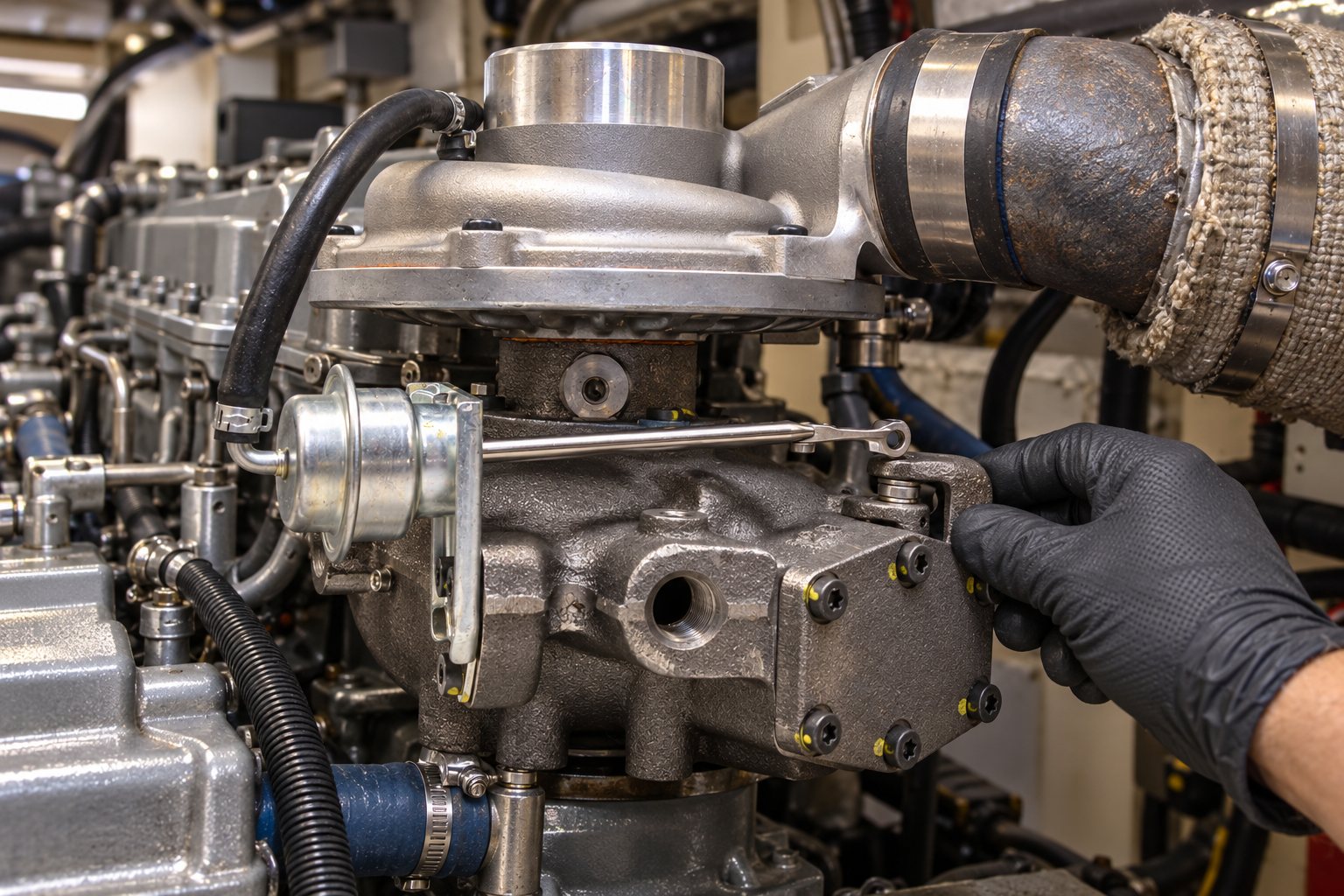
As you move up the Yanmar range, IHI steps up the frame size. In the IHI naming convention the letter after “RH” marks the series and the number is the frame size, so an RHC is a larger series than an RHB, and an RHF is newer again. The number tells you relative frame: an RHF5 is larger than an RHF4.
The 4LH and 4LHA four-cylinder engines run an IHI RHC61W. The 6LP and 6LPA inline-six engines use the RHE62W, and the higher-output 6LY series carries an IHI RHC7W. The “W” in these names marks water cooling (Yanmar lists the RHE62W with a water-cooled turbine housing); it does not tell you whether a wastegate is fitted.
If you are chasing a boost problem on a marine six with a wastegate, confirm the wastegate flapper seats before you blame the cartridge. A flapper that does not seat lets exhaust slip past the turbine, giving low boost and slow spool, not boost creep. A sticking or seized wastegate is a separate repair from a worn center section.
Industrial 4TNV Engines
Yanmar’s 4TNV industrial fours, found in gensets, compact equipment, and some auxiliary applications, are listed with an IHI RHF4 or IHI RHF5 depending on the rating. The right one is set by the part number on the turbo, so send us the number off the tag rather than ordering by engine model alone.
The 6CX: A Holset HX50
The 6CX is the exception in the Yanmar marine lineup. Instead of an IHI, it carries a Holset HX50, the same frame family Cummins and others use on larger displacement diesels. Holset, now Cummins Turbo Technologies, builds this as a robust fixed-frame charger sized for a bigger six.
The HX50 data plate sits on the compressor housing and shows the Holset assembly number alongside the engine maker’s number as separate fields. Casting numbers on the housings are not part numbers, since one casting serves many turbos, so read the tag and let wheel sizes and housing A/R confirm the match. If the tag is painted over or gone, send us the turbo and we will identify it off the wheels and housings.
How Marine Turbos Fail Differently
A marine turbo lives a harder life than a highway one in a few specific ways, and understanding them keeps a rebuilt unit alive. The biggest killer is heat soak at shutdown with no cooldown, and the second is oil quality in an engine that may sit for weeks between runs.
Most turbo failures trace back to the oil supply, so before condemning any cartridge, check the oil feed line, the drain, the oil level, and the service interval. A blocked or kinked oil drain backs oil up past the seals and pushes it into the intake or exhaust; a restricted feed starves the bearings. These are two different faults with two different fixes.
- Cooldown idle: let the engine idle a few minutes after a hard run before shutdown so the center section does not coke the oil around the bearing.
- Oil drain routing: the drain is a gravity return that must run downhill into the sump above the oil level; it cannot be kinked or run uphill.
- Oil feed line: after any bearing failure or coked oil, fit a new feed line rather than cleaning and reusing the old one.
- Charge-air path: some oil film in the charge piping is normal from crankcase ventilation; pooled oil is the warning sign, not a light film.
Shaft play on these is read the same as any journal-bearing turbo. Some side-to-side rock is normal with no oil pressure on the bench; condemn a turbo for in-and-out play you can feel, for wheel contact with the housing, or for play beyond the maker’s limit, never for any movement at all. For general turbocharger theory, the turbocharger overview on Wikipedia is a solid primer.
New vs Remanufactured for a Marine Repower
For a marine turbo you have two sound paths: a new unit, or a professionally remanufactured one built on a balanced cartridge. Both work; the right call depends on availability for your exact number and how fast you need the boat back in the water.
| Consideration | New Turbo | Remanufactured Turbo |
|---|---|---|
| Core required | No | Yes, return within 30 days |
| Cartridge | Factory new | Rebuilt and VSR balanced |
| Availability | By model and number | Often in stock as a core |
| Warranty | 12 months, unlimited | 12 months, unlimited |
Our remanufactured turbochargers run on cartridges that are rebuilt in-house with new bearings, seal rings, and thrust parts, then balanced on a vibration sorting rig before they ship. If you would rather we rebuild your own numbered unit, our turbo rebuild service keeps your original housings and tag; most rebuilds ship in three days or less. For pricing on your exact model, see the turbo rebuild price list rather than relying on a quoted ballpark.
Whichever route you take, follow the maker’s first-start steps before you load the engine: fill the oil inlet with clean engine oil, turn the wheel by hand, then crank or idle a few minutes before putting it under load. That one habit protects the bearing in the critical first seconds.
Turbos we list for the HX50, RHB52 and RHF4
Listings for the turbo models named in this guide that can be ordered online today. Several part numbers can fit one engine by year and rating, so match the number on your turbo’s tag, or call (909) 824-1020 and we will match it for you.
Frequently Asked Questions
How do I identify the exact turbo on my Yanmar?
Read the data plate on the turbo’s compressor housing and match that part number. The engine model, such as 4JH or 6LY, points you to a frame family, but Yanmar uses different internal specs by rating and build year, so the tag number is what orders the correct unit. If the tag is missing, send us the turbo and we will identify it by the wheels and housings.
Is the Yanmar 6CX turbo an IHI like the rest of the range?
No. Most Yanmar marine diesels run IHI turbochargers, but the 6CX carries a Holset HX50. It uses a Holset data plate on the compressor housing with the assembly number and the engine maker’s number shown as separate fields, so order by that number rather than by the engine model alone.
Can I rebuild a marine turbo or should I replace it?
Both are valid. A rebuild on a journal-bearing marine turbo replaces the bearings, seal rings, and thrust parts, and the cartridge is rebalanced, which addresses the usual oil-related and heat-soak wear. If a wheel has blade damage or a housing is cracked, replacement of those parts or a new unit is the better call. Call PT Turbo at (909) 824-1020 and we will tell you which makes sense for your exact number.
Need a Turbocharger?
PT Turbo has rebuilt and sold turbochargers since 1978. We stock remanufactured units for Cummins, Duramax, Power Stroke, Detroit Diesel, and more — backed by a 12-month unlimited mileage warranty. Units in stock at our shop in San Bernardino, CA ship the same day when ordered before 2 PM Pacific, Monday through Friday.
📞 (909) 824-1020 · 346 S I St. #3, San Bernardino, CA 92410 · [email protected]