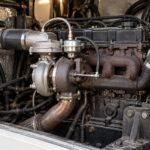
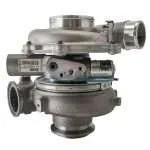
If you’ve spun a wrench on Japanese and European diesels, you already know the IHI turbocharger by feel. The RHF and RHB series bolt to everything from Subaru boxers to Isuzu 4-cylinder trucks, the VF series runs boost on Subaru WRX and STI platforms, and IHI’s marine turbos push commercial fishing boats and workboats hard for tens of thousands of hours. IHI (Ishikawajima-Harima Heavy Industries) has been building forced-induction hardware since the 1950s, and their naming logic actually makes sense once you break it down. This guide maps the full IHI lineup by series, gives you the compressor sizing and applications that matter, and shows you exactly what to check before you condemn a unit.
How to Read IHI Turbocharger Model Numbers
IHI codes are compact but readable. The prefix tells you the family and frame size, and everything after that describes the trim, actuator, and application. Here’s the shorthand that keeps you from ordering the wrong casting:
- RH = the base turbocharger series (Ishikawajima-Harima).
- The third letter = the series, or design generation. RHB is the older family and RHF the newer one; RHC and RHE are used mostly on larger engines.
- The number after it = the frame size within the series, so an RHF5 is larger than an RHF4.
- V (VF series) = IHI’s designation used heavily on Subaru and other performance/OEM gasoline and diesel applications, often with variable or wastegated hot sides.
- Numeric suffixes = compressor and turbine trim, wastegate setup, and OEM part revisions.
The RHF series is by far the most common family that lands on a rebuild bench. RHF3, RHF4, RHF5, and RHF55 cover a massive spread of engine sizes, and they’re the units most fleet mechanics and owner-operators deal with day to day.
RHF Series: The Diesel Workhorse
The RHF family is IHI’s bread and butter for light and medium diesel duty. If you run Isuzu NPR/NQR box trucks, Kubota industrial engines, or smaller Cummins and international applications, there’s a good chance an RHF is hanging off the manifold. The frame scales cleanly, so the same design language carries from a 1.5L compact diesel up to a 5L medium-duty motor.
| Model | Typical Engine Range | Common Applications | Boost Control |
|---|---|---|---|
| RHF3 / RHF4 | 1.5L – 3.0L | Subaru, small Isuzu, compact industrial diesel | Internal wastegate |
| RHF5 / RHF55 | 2.5L – 5.2L | Isuzu 4JB1/4HK1, Holden, medium industrial | Wastegate or VGT (VIDW variants) |
| RHF6 / RHF65 | 4.0L – 5.5L | Nissan, Hino, medium-duty truck | Wastegate / actuator controlled |
The RHF5 and RHF55 are the units you’ll rebuild most often. On the Isuzu 4HK1 and similar engines, the VGT-equipped RHF55V uses a variable nozzle ring that carbons up and sticks, which is the number one cause of “no power under load” complaints. Before you order a replacement cartridge, pull the actuator, verify the vanes still sweep freely, and check the actuator rod travel against spec.
On wastegated RHF units, a lazy pneumatic actuator will mimic a dead turbo, and a leaking one will overboost. A weak spring or a worn rod end lets the wastegate crack early and you lose top-end; a leaking diaphragm does the opposite and the engine overboosts.
RHB Series: The Older Family, Big Job History
The RHB series predates and overlaps the RHF line and shows up on older Isuzu, Subaru, and industrial applications. RHB5 and RHB52 units are compact, journal-bearing turbos built for small displacement diesels and gasoline turbo engines. You’ll find them on legacy equipment that’s still earning its keep, which is exactly why keeping them serviceable matters more than chasing a new casting that may be discontinued.
The RHB’s weak points are predictable: shaft play from oil coking on hard-shutdown applications, and seal wear that shows up as oil in the intake tract. If you’re seeing blue smoke on startup and a filmy compressor housing, don’t assume the turbo is scrap. A journal-bearing RHB is one of the easier IHI units to rebuild, and a fresh bearing and seal kit brings it back to spec at a fraction of new-unit cost. PT Turbo’s turbocharger rebuild service handles these small frames routinely, with balancing done to OEM shaft-motion tolerances.
VF Series: Subaru and Performance Applications
The VF designation is where a lot of mechanics get tripped up, because VF numbers don’t follow the RHF frame logic. VF is IHI’s serial-style naming for factory-fitted turbos, most famous on the Subaru WRX and STI (VF39, VF48 and VF52). Under the skin, many VF units share hardware with RHF frames, but the compressor trims and wastegate actuator calibrations are application-specific.
Two things matter on VF units. First, the wastegate actuator preload is calibrated per model, so swapping actuators blind will throw your boost curve off. Second, the twin-scroll hot sides on the VF turbos that have them (the Japan-market 2.0L cars; the US VF48 is single-scroll) are unforgiving of exhaust manifold cracks and gasket leaks, which show up as boost that won’t hold at high RPM. When you’re diagnosing a VF that overboosts or spikes, the actuator is the first suspect.
IHI Marine Turbochargers: Built for Continuous Duty
IHI’s marine and industrial turbos are a different animal from the automotive frames. These are large-frame, continuous-duty units running on commercial marine diesels, gensets, and stationary power. Where a truck turbo sees intermittent load, a marine turbo runs at high, sustained boost for thousands of hours, so the bearing systems, cooling passages, and materials are built for it.
The critical difference for anyone servicing marine IHI units is that runtime, not mileage, drives the maintenance interval. Salt-air corrosion on the compressor and turbine housings, plus oil-quality degradation on long runs, are the failure drivers. If you run marine diesels, the same discipline applies to your Cummins-based rigs, and our Cummins QSB turbocharger guide for marine, industrial and construction applications covers the continuous-duty logic in depth.
Larger IHI and Garrett-style marine and industrial units often use higher-force pneumatic actuators to drive their wastegates and VGT mechanisms.
New vs Remanufactured IHI Turbos: What Makes Sense
The honest answer depends on the frame and the application. For common RHF5/RHF55 diesel units, a properly remanufactured turbo delivers OEM performance for meaningfully less money, and it’s often faster to source than a discontinued OEM casting. For high-RPM VF performance units and continuous-duty marine turbos, the quality of the rebuild balancing is what determines whether the unit survives, so buy reman only from a shop that balances to spec.
| Factor | New OEM IHI | Quality Remanufactured | Actuator/Seal Repair |
|---|---|---|---|
| Relative cost | Highest | 40–60% of new | Lowest |
| Lead time | Often long/discontinued | In stock, fast | Same-day parts |
| Best for | Warranty-critical fleets | Most diesel & industrial | Actuator or seal-only failures |
| Restores full spec | Yes | Yes, if balanced properly | Only if core is healthy |
PT Turbo has been in business since 1978, that’s 45-plus years of building and balancing turbos, and we stock both new and remanufactured turbochargers across IHI, Garrett, BorgWarner, and Mitsubishi lines. If you’re not sure whether your core is worth rebuilding, send us the numbers off the nameplate and we’ll tell you straight. If you run BorgWarner units alongside your IHI equipment, our BorgWarner S400 fitment reference and Detroit Series 60 turbocharger guide cover the high-flow side of the shop.
Common IHI Failure Modes and How to Diagnose Them
Before you condemn any IHI turbo, run through this. Most “bad turbo” calls come down to a stuck VGT ring, a tired actuator, or an oil-supply problem that killed the bearings early.
- Stuck VGT nozzle ring: If you’ve got low power under load with no smoke, pull the actuator and work the vane mechanism by hand. Carbon buildup locks the ring in one position, so clean and free it before you order a cartridge.
- Tired or leaking actuator: A soft diaphragm or sloppy rod travel throws off boost control on both wastegated and VGT units. Verify rod movement against spec before you blame the center section.
- Oil-starvation bearing damage: Excessive shaft play, scored journals, or metal in the oil feed point to a supply problem, not a turbo problem. Check the feed line and drain for coking or restriction, because a fresh unit will fail the same way if you don’t fix the cause.
- Seal failure and oil carryover: Blue smoke and an oily compressor housing usually trace back to coked seals or a blocked drain, not worn-out hardware. Confirm the drain is clear before you write off the core.
Work these in order and you’ll catch the cheap fixes before you spend on a replacement. A few minutes checking vane sweep, actuator travel, and oil supply tells you whether the core is healthy or genuinely done. Read the nameplate numbers, confirm the frame, and diagnose the actual failure mode rather than swapping parts and hoping.
Frequently Asked Questions
What vehicles use IHI RHF and RHB turbochargers?
The RHF and RHB series fit a wide range of applications, from Subaru boxer engines to Isuzu 4-cylinder trucks. They are common across many Japanese and European diesels.
Which IHI turbocharger is used on the Subaru WRX and STI?
The IHI VF series is the turbocharger used on Subaru WRX and STI platforms. These models are designed to deliver boost for high-performance applications.
Are IHI marine turbochargers durable for commercial use?
Yes, IHI marine turbos are built to push commercial fishing boats and workboats hard for tens of thousands of hours. They are engineered for demanding, long-duration marine operation.
Further reading: Learn more about turbocharger technology.
Need a Turbocharger?
PT Turbo has rebuilt and sold turbochargers since 1978. We stock remanufactured units for Cummins, Duramax, Power Stroke, Detroit Diesel, and more — backed by a 12-month unlimited mileage warranty and same-week shipping from San Bernardino, CA.
📞 (909) 824-1020 · 346 S I St. #3, San Bernardino, CA 92410 · [email protected]
More From PT Turbo
 Holset HX30 Turbocharger: Small Block Cummins B-Series Application Guide
- IHI RHF5 Turbocharger: Isuzu & Light Commercial Applications Guide
- Garrett GT3788VA Turbocharger: Duramax LBZ & LMM Application & Replacement Guide
- BMW B57 Turbocharger Guide: 530d, 730d & X5 40d Single, Twin and Quad Turbo Explained