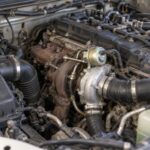
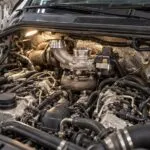
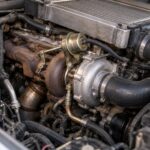
The BorgWarner S400 turbocharger is the workhorse behind more high-flow diesel builds than almost any other frame on the market. If you’re pushing a Cummins, Duramax, Powerstroke, or a Class 8 truck engine past its factory power ceiling, chances are an S400 is either already bolted on or on your short list. This is the turbo that bridges the gap between reliable OEM boost and serious 700-plus horsepower territory, and it does it with a T4 or T6 mount, a big compressor wheel, and airflow numbers that make smaller frames look like toys. Here’s the technical breakdown fleet mechanics and owner-operators actually need: what the S400 flows, where it fits, and how to spec one right the first time.
What Makes the S400 a High-Flow Frame
The S400 series is BorgWarner’s large-frame turbo with a T4 or T6 turbine flange, depending on the version. It’s designed for engines in the 5.9L to 15L displacement range, which is why you’ll see it on everything from heavily modified 24-valve Cummins pickups to Detroit, Caterpillar, and Cummins ISX over-the-road trucks.
What separates the S400 from smaller S300 units is raw airflow capacity. Compressor wheels in the S400 family range from about 67mm inducer up to 88mm, supporting anywhere from roughly 55 lb/min to over 110 lb/min of airflow depending on the specific spec. That range covers a single-turbo street truck all the way to the atmosphere charger in a compound setup.
Common S400 designations you’ll run into:
- S400SX3 – sold with inducers of about 71mm and 75mm (the 67mm unit is an S400SX), a popular single-turbo choice for 6.7L Cummins and Duramax builds
- S400SX4 – 71mm to 80mm inducers with the T6 flange, higher flow, common in compound top-mount and big single applications
- S475 / S480 / S483 – shorthand naming based on inducer size, all sitting on the S400 frame
- S400 with SXE billet wheels – extended-tip billet compressor wheels for improved efficiency and spool
For a broader look at how BorgWarner positions this frame against its other lines, our Borg Warner Turbochargers Performance, Reliability and Fitment Guide covers the full lineup.
S400 Compressor Specs and Airflow Reference
Picking the right S400 comes down to matching the compressor wheel and turbine A/R to your target power and RPM band. Undersize it and you’ll choke top-end. Oversize it and you’ll lag badly and drown low-end torque. Here’s a practical reference for the most common single-turbo specs.
| Spec | Inducer | Approx. Max Airflow | HP range (BorgWarner’s rating) | Best Fit |
|---|---|---|---|---|
| S472 | 72mm | ~110 lb/min (SX-E) | 500-1,100 hp by BorgWarner’s rating | Daily-driven 5.9/6.7 Cummins |
| S475 | 75mm | ~104 lb/min | 500-1,050 hp by BorgWarner’s rating | Sled pull / heavy tow street truck |
| S480 | 80mm | ~104-121 lb/min | 750-1,250 hp by BorgWarner’s rating | Race / large single builds |
| S483 | 83mm | Above the S480 | Above the S480 | Competition, high-RPM |
Turbine housing A/R matters just as much. On the S400 you’ll commonly see 0.90, 1.00, 1.10 and 1.25 A/R housings with the T4 flange, and 1.15, 1.32, 1.45 and 1.58 with the T6 flange. A tighter 0.90 spools quicker and suits towing and street use, while a 1.10 or 1.25 opens up top-end for high-RPM competition engines at the cost of low-end response. For a tow rig, err tighter. For a dyno queen, go bigger.
S400 Fitment Across Diesel Platforms
Because most S400 versions use a T4 or T6 turbine foot and V-band housings, the S400 drops into a huge range of applications with the right manifold or mounting kit. Here’s where mechanics are running them:
Cummins 5.9L and 6.7L
The S400 is a favorite single-turbo swap for both the 12-valve and 24-valve 5.9L, and the 6.7L. It typically requires a T4 exhaust manifold and a 4-inch downpipe. On stock-appearing compound setups, the S400 serves as the atmosphere charger feeding a smaller high-pressure unit like an HX35 or Holset primary. If you’re weighing the smaller Cummins options first, our Cummins ISB 5.9L Turbocharger Guide: HX35 vs HE351CW is worth a read before you jump frames.
Duramax LB7 through L5P
S400 single-turbo kits are widely available for the Duramax, usually paired with a new up-pipe and downpipe setup. The 75mm to 80mm range hits the sweet spot for these engines when built for 700 to 850 horsepower.
Powerstroke 6.0L, 6.4L, and 6.7L
On the 6.4L, the S400 shows up frequently as a compound upgrade or single-turbo conversion. The factory 6.4L runs a sequential two-turbo arrangement, and understanding how that works before you swap is important. See our breakdown on the Ford 6.4L Powerstroke High-Pressure vs Low-Pressure Turbo difference.
Class 8 and Medium-Duty
Mack E7, Detroit Series 60 and large Caterpillar engines use S400-frame turbos from the factory in many configurations; on the Cummins ISX an S400 is an aftermarket upgrade. When these come as wastegated or actuator-controlled units, the actuator becomes a critical wear item. For medium-duty and bus applications running related Cummins hardware, our Cummins ISL turbocharger guide covers the wastegated side of that world.
Actuators and Wear Parts You’ll Need
Not every S400 is a free-floating open turbo. Many OEM S400-frame and closely related large-frame turbos use pneumatic actuators to control wastegates or variable geometry. When an actuator fails, you get overboost, underboost, or erratic boost control that throws codes and kills fuel economy. Swapping the actuator is far cheaper than replacing the entire turbo, and PT Turbo stocks the correct units.
New vs Remanufactured S400: What’s Right for Your Build
A brand-new BorgWarner S400 is the obvious call for a competition build where you want the latest billet wheel technology and zero unknowns. But for a fleet truck, a work rig, or a replacement on a proven combination, a quality remanufactured unit saves real money and delivers the same reliability when it’s done right. PT Turbo has been rebuilding turbos to OEM tolerances for over 45 years, and every reman unit is balanced, tested, and backed.
| Factor | New S400 | Remanufactured S400 |
|---|---|---|
| Typical cost | $1,041 to $2,924 (37 listings) at PT Turbo | 30-50% less than new |
| Lead time | Often in stock | Often in stock or fast rebuild |
| Latest billet wheel tech | Yes | Depends on core |
| Best for | Race, max power, new builds | Fleet, work trucks, replacements |
| Warranty backing | Manufacturer | PT Turbo tested and warranted |
Price ranges in this article are general estimates to help with budgeting, not PT Turbo quotes. Our current prices are on each product listing, and our rebuild prices are on the turbo rebuild price list.
Browse available options on our remanufactured turbochargers page, or if you’ve got a good core, our turbocharger rebuild service can restore your existing S400 to spec with new bearings, seals, and a balanced CHRA.
Installation and Setup Tips That Save Turbos
An S400 will outlive the truck if you install it right. The failures we see on the bench almost always trace back to a handful of avoidable mistakes.
- Prime the bearings. Before first start, pre-fill the oil inlet and spin the shaft by hand. Dry startups kill journal bearings fast.
- Check your oil drain. The S400 needs a large, unrestricted, downhill oil return to the pan above the oil level. Restricted drains push oil past the seals every time.
- Clock the housings correctly. With V-band housings you have freedom to clock the compressor and turbine. Get the oil drain vertical and clear your other components before final torque.
- Feed it clean air. A big compressor wheel is unforgiving of debris. Make sure the intake tract is spotless and the filter is sealed before you spool it for the first time.
- Match the downpipe and charge piping. Necking down the exhaust or running undersized boost tubes will choke the airflow you just paid for and spike drive pressure. Size the plumbing to the frame, not the old turbo.
- Verify boost control after install. Watch your first few runs on a gauge or datalogger. Catching an overboost condition or a leaking actuator signal early saves head gaskets and the turbo itself.
Get these basics right and the S400 rewards you with years of hard service. Most of the bench failures we trace back are setup problems, not turbo problems, so spend the extra hour on oil feed, drain, and clocking before you button it up.
Not sure the S400 is the right frame? See BorgWarner S300 vs S400 vs S480.
Frequently Asked Questions
What engines is the BorgWarner S400 turbocharger compatible with?
The S400 fits a wide range of diesel platforms including Cummins, Duramax, and Powerstroke engines, as well as Class 8 truck applications. Its versatile frame makes it a popular choice for high-flow builds.
How much horsepower can a BorgWarner S400 support?
The S400 is designed to support serious power goals, easily handling 700-plus horsepower depending on the specific configuration. It bridges the gap between reliable OEM boost and high-performance output.
Why is the S400 popular for high-flow diesel builds?
The S400 is one of the most widely used turbo frames because of its reliability, broad fitment, and ability to push engines well past factory power ceilings. It’s a go-to option for both truck and performance applications.
Further reading: Learn more about BorgWarner.
Shopping by part number?
Every part number we stock for the BorgWarner S400 is on one page, with live prices and stock: BorgWarner S400 turbos and parts.
Need a Turbocharger?
PT Turbo has rebuilt and sold turbochargers since 1978. We stock remanufactured units for Cummins, Duramax, Power Stroke, Detroit Diesel, and more — backed by a 12-month unlimited mileage warranty and same-week shipping from San Bernardino, CA.
📞 (909) 824-1020 · 346 S I St. #3, San Bernardino, CA 92410 · [email protected]
More From PT Turbo
 Toyota 2KD-FTV 2.5L Turbocharger Guide: Hiace, Hilux & Fortuner Replacement
- Mercedes OM642 Turbocharger Guide: Sprinter, E350d, ML350 & GL350 Replacement
- Nissan ZD30 3.0L Diesel Turbocharger Guide: Patrol & Navara D22 Common Failures
- BorgWarner S300 Turbocharger: Complete Application Guide for Cummins, CAT & Detroit