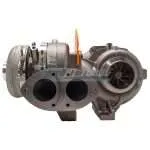
The Ford 6.4L Powerstroke is the only Powerstroke pickup engine that left the factory with a compound, sequential twin-turbocharger setup, and that design confuses more mechanics than any other turbo system Ford ever built. When a 6.4L comes into the shop with a boost complaint, the first thing you have to nail down is which turbo you’re dealing with: the high-pressure turbo or the low-pressure turbo. They look like one assembly, they bolt together, and they share oil and air paths, but they do completely different jobs. Get the diagnosis wrong and you’ll throw thousands of dollars of parts at a problem that lives on the other side of the casting.
At PT Turbo we’ve been rebuilding and supplying diesel turbochargers since 1978, and the 6.4L compound system is one we know cold. Here’s exactly how the high-pressure and low-pressure turbos differ, how to tell which one failed, and what it takes to fix it right.
How the 6.4L Powerstroke Compound Turbo System Works
The 2008 to 2010 6.4L Powerstroke runs a BorgWarner sequential compound turbocharger system. Unlike the single VGT on the 6.0L, the 6.4L stacks two turbochargers in series so they feed each other. Air gets compressed twice before it ever reaches the intercooler and intake.
The sequence works like this:
- Low-pressure (large) turbo: The large compressor pulls in fresh, ambient air and gives it the first stage of compression. On the exhaust side it comes second: its turbine is driven by gas that has already passed through the small turbo.
- High-pressure (small) turbo: That partially compressed air is then routed into the smaller high-pressure compressor, which compresses it a second time before sending it to the charge air cooler.
The small high-pressure turbo spools almost instantly off idle for crisp low-RPM throttle response, while the large low-pressure turbo carries the load up top where the engine moves serious air. The handoff between them is what makes the 6.4L feel strong across the band when everything is healthy. If you want the full breakdown of the twin-turbo unit as a complete assembly, our Ford 6.4L Powerstroke Twin Turbo Guide covers common problems and replacement parts in detail.
High-Pressure vs Low-Pressure Turbo: The Core Differences
The two turbos are physically different sizes, serve different stages of the compression cycle, and fail in different ways. The high-pressure unit is the variable geometry turbo (VGT), so it carries the electronic actuator and the moving vane mechanism. The low-pressure unit is a larger fixed-geometry turbo with no actuator. Understanding which is which saves you a misdiagnosis every time.
| Feature | High-Pressure Turbo | Low-Pressure Turbo |
|---|---|---|
| Size | Small | Large |
| Compression stage | Second (final) stage | First stage |
| Type | Variable geometry (VGT) with electronic actuator | Fixed geometry, no actuator |
| Primary job | Low-end response and spool | Top-end airflow under load |
| Exhaust flow | Sees exhaust first, highest heat | Receives gas after the high-pressure turbine |
| Common failure mode | Stuck vanes, actuator fault, soot buildup | Shaft play, bearing wear, oil leaks |
Because the high-pressure turbo carries the VGT vanes, it is the one most affected by soot and incomplete regeneration. Carbon packs into the vane mechanism and the unison ring, and the vanes seize. The low-pressure turbo, the big one that carries most of the airflow under load, tends to fail mechanically through bearing wear and shaft play.
Symptoms: How to Tell Which Turbo Failed
Both turbos can throw similar drivability complaints, but the details point you to the right side of the assembly. Use the symptom severity as your guide.
| Symptom | Likely High-Pressure | Likely Low-Pressure |
|---|---|---|
| Sluggish off-idle, poor low-end response | Yes | No |
| Falls flat up top, no high-RPM power | No | Yes |
| VGT control codes (P132B, P003A, P0045) | Yes | No |
| Loud whine or grinding under boost | Possible | Yes |
| Excess oil in charge piping | Possible | Yes |
| Visible shaft play when you wiggle the wheel | Either | Either |
A few field checks that don’t lie:
- Spin both wheels by hand. They should spin freely with no grinding and no contact against the housing. Check for excessive in-and-out and radial play on each shaft.
- Watch the actuator. The high-pressure VGT actuator should sweep smoothly during a key-on cycle. Sticky or no movement points to a soot-bound vane mechanism on the high-pressure side.
- Inspect for oil. Heavy oil in the cold-side piping usually traces to a low-pressure turbo seal that has given up under sustained heat and shaft wear.
If you’ve worked the older 6.0L platform, the diagnostic mindset carries over. Our guides on 6.0L turbo failure warning signs and 6.0L turbocharger failure symptoms and replacement options walk through VGT diagnostics that apply directly to the high-pressure unit on the 6.4L.
Can You Replace Just One Turbo?
Technically yes. The high-pressure and low-pressure turbos can be serviced individually, and that’s why isolating the failure matters. But there’s a catch experienced techs respect: the two turbos share oil feed, share the exhaust path, and run as a balanced pair. If the low-pressure turbo failed and dumped debris downstream, the high-pressure unit may have ingested contamination. Likewise, a seized high-pressure VGT raises backpressure ahead of it and chokes the exhaust flow that the low-pressure turbine depends on.
Our shop recommendation is straightforward. If the failure is clean and caught early, such as a soot-bound VGT with no metal in the system, replacing the affected turbo alone is reasonable. If you found metal, oil contamination, or significant shaft play on either unit, plan on servicing the full compound assembly. The labor to pull the turbos out of a 6.4L is the expensive part, and you do not want to be back in there in six months.
For a full assembly job, a remanufactured turbocharger from PT Turbo gives you OEM-spec performance at a fraction of new cost. If you’d rather refresh your original BorgWarner units, our turbocharger rebuild service restores the cores to spec with new bearings, seals, and balancing.
New vs Remanufactured: Cost and What You Get
The compound turbo system is one of the pricier replacements in the Powerstroke lineup, so the new-versus-reman decision has real money behind it.
| Option | Typical Cost | Best For |
|---|---|---|
| New OEM compound assembly | Quoted by part number | Warranty-sensitive fleet trucks, fresh builds |
| Quality remanufactured assembly | Quoted by part number | Most owner-operators and shops |
| Rebuild your existing cores | Service cost only | Trucks with good housings, budget jobs |
A properly remanufactured 6.4L compound turbo is rebuilt to factory tolerances, balanced on modern equipment, and tested before it ships. With 45-plus years building turbos, PT Turbo stocks both new and remanufactured 6.4L units, so you can match the part to the job and the budget. Browse the full lineup at our turbo shop, or contact our team if you need help confirming the right part for your VIN and build year.
Don’t Forget the Install Hardware
Every 6.4L turbo job should go back together with fresh gaskets, seals, and fastener hardware. Reusing crushed exhaust gaskets and worn oil line seals is the fastest way to a comeback. The right installation kit covers the gaskets and seals you disturb pulling the compound assembly, and it costs a tiny fraction of the turbo itself.
While you’re in there, prime the new turbos with clean oil before startup and inspect the oil feed and drain lines for restriction or carbon. A compound turbo that runs dry on first start can wipe a bearing in seconds, and no gasket kit will save it. Cracked or sludged oil lines are cheap to replace while everything is already apart.
Take the extra half hour to replace what you touch. New up-pipe and exhaust gaskets, oil line seals, and clamps seal the system right the first time and keep boost and oil where they belong. On a job where the labor dwarfs the parts, skimping on hardware is the one shortcut that always costs more in the end.
Frequently Asked Questions
What is the difference between the high-pressure and low-pressure turbo on a 6.4L Powerstroke?
The low-pressure turbo is the larger turbo that draws in fresh air first, while the smaller high-pressure turbo further compresses that air for quick spool-up at lower RPM. Together they form a compound, sequential twin-turbo system.
Why does the 6.4L Powerstroke use a compound turbo setup?
The compound sequential design pairs a small high-pressure turbo for fast low-end response with a large low-pressure turbo for top-end airflow. This delivers strong boost across the entire RPM range.
How do I know which turbo is failing on my 6.4L Powerstroke?
Diagnosing a boost complaint starts with identifying whether the high-pressure or low-pressure turbo is involved, since each behaves differently under load. Checking spool-up timing, boost levels, and shaft play helps pinpoint the faulty unit.
Further reading: Learn more about turbocharger technology.
Need a Turbocharger?
PT Turbo has rebuilt and sold turbochargers since 1978. We stock remanufactured units for Cummins, Duramax, Power Stroke, Detroit Diesel, and more — backed by a 12-month unlimited mileage warranty and same-week shipping from San Bernardino, CA.
📞 (909) 824-1020 · 346 S I St. #3, San Bernardino, CA 92410 · [email protected]