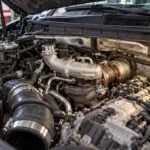
If you wrench on late-model Super Duty trucks, the Ford 6.4L Powerstroke twin turbo system is either your best friend or your worst headache, and there is rarely an in-between. Ford’s compound turbocharger setup, built around a small high-pressure turbo and a larger low-pressure turbo working in series, made the 6.4L a torque monster when it was healthy. But these 2008 to 2010 engines are now well past 100,000 miles, and the sequential turbo arrangement has plenty of failure points that put trucks on the lift. This guide breaks down how the system works, the real-world problems you will see, and the exact parts you need to do the job right.
How the 6.4L Powerstroke Compound Turbo System Works
The 6.4L doesn’t run a single variable geometry turbo like the 6.0L before it. Instead, Navistar (which built the engine for Ford) and BorgWarner built a sequential compound system that stacks two turbos together. Exhaust gas hits the small high-pressure (HP) turbo first, spooling it almost instantly for low-end response. As boost and exhaust volume climb, the larger low-pressure (LP) turbo takes over to feed serious airflow up top.
The HP turbo uses variable geometry vanes to manage spool, while the LP turbo is a fixed-geometry unit handling the heavy lifting at higher RPM. The two turbos have separate center sections but are joined into one assembly bolted into the engine valley. That packaging is part of the problem: heat is trapped, soot loads up the VGT mechanism, and a failure in one turbo often takes out the other.
If you’ve worked on the older 6.0L setup, you already know how variable geometry units behave when they get sooted up. Our Ford 6.0L Powerstroke turbocharger guide covers that platform in detail, and a lot of the diagnostic logic carries straight over to the 6.4L.
Common 6.4L Twin Turbo Problems
After 45-plus years of rebuilding turbochargers, we’ve seen the 6.4L fail in predictable ways. Here are the issues that show up most often on the bench and in the bay.
Stuck or Sticking VGT Vanes on the High-Pressure Turbo
Soot and carbon build up inside the high-pressure unison ring, causing the variable vanes to bind. You’ll feel it as laggy spool, surging boost, or a hard limp mode. This is the single most common 6.4L turbo complaint, and it gets worse on trucks that idle a lot or do short city runs that never burn the soot off.
Bearing Failure and Shaft Play
Both the HP and LP turbos ride on journal bearings fed by engine oil. Stretched oil change intervals, coked oil, or a failing oil supply line leads to bearing wear. Once the bearings wear far enough for shaft play to let the wheels contact the housings, the turbo is done. Excessive end play also opens up the seals and starts pushing oil.
Oil in the Intake and Blue Smoke
When the LP turbo seals let go, oil migrates into the intercooler and intake tract. You’ll find pooled oil at the cold side, see blue smoke under load, and chase a slow oil consumption problem. A leaking turbo is usually the culprit, not the engine.
Boost Leaks and Cracked Up-Pipes
The 6.4L runs a maze of charge pipes, clamps, and gaskets between the two turbos and the intercooler. Cracked boost tubes, blown couplers, and failed gaskets bleed pressure and trip low-boost codes. A proper installation kit with fresh gaskets and seals prevents the comeback.
| Symptom | Likely Cause | Severity |
|---|---|---|
| Laggy spool, boost surge, limp mode | Stuck VGT vanes (HP turbo) | Moderate to High |
| Whining or grinding from the valley | Bearing wear, shaft play | High |
| Blue smoke, oil in intercooler | Failed turbo seals (LP turbo) | High |
| Low boost codes, hissing under load | Cracked charge pipe or gasket | Low to Moderate |
| Sudden power loss with metallic debris | Wheel contact / catastrophic failure | Critical |
Diagnosing Before You Condemn the Turbos
Don’t yank a compound turbo set on a code alone. Walk through the basics first so you don’t replace good hardware.
- Check shaft play. Pull the intake tube and check the LP compressor wheel for in-and-out and radial play. Any wheel-to-housing contact means replacement.
- Scan for VGT actuator faults. Pull live data and watch commanded vs actual vane position. Sticking vanes throw boost desired vs actual mismatches.
- Pressure test the charge system. Most 6.4L “turbo” complaints are actually boost leaks at couplers and gaskets.
- Inspect the oil feed and drain lines. A restricted feed or clogged drain destroys a fresh turbo in short order.
- Verify oil quality and change history. Coked oil tells you why the bearings failed and warns you to fix the root cause.
If your diagnosis points to bearing or seal failure, the turbo needs to come off. If the vanes are just sooted, a thorough cleaning sometimes buys time, but on a high-mileage truck most shops opt to replace or rebuild while it’s apart.
Replacement Options: New, Remanufactured, or Rebuild
You’ve got three real paths once a 6.4L turbo is condemned. Each makes sense in different situations.
| Option | Typical Cost Range | Best For |
|---|---|---|
| Brand-new OEM compound set | $$$$ (highest) | Warranty work, low-mileage trucks, fleets wanting max service life |
| Remanufactured turbocharger | $$ to $$$ | Best value for most owner-operators and shops |
| Rebuild your existing core | $ to $$ | Cost-conscious repairs where the housings are still good |
For most 6.4L trucks, a quality remanufactured turbocharger hits the sweet spot. You get new bearings, seals, and a balanced cartridge at a fraction of new-OEM pricing. PT Turbo has been remanufacturing diesel turbos since 1978, and every unit is built to spec and balanced before it ships.
If your housings and major castings are still solid, our turbocharger rebuild service restores your original unit with new internals. That’s often the most economical route when the core is clean. Not sure which way to go? Contact PT Turbo with your VIN and mileage and we’ll point you to the right part.
Installation Kits and Gaskets You Need for the Job
Reusing old gaskets, clamps, and seals on a 6.4L is how you create a comeback. The valley traps heat, gaskets get brittle, and a single leaking seal can push oil or kill boost. Always install with a complete kit. Match the kit to the turbo numbers:
- BorgWarner Installation Kit 179618, listed for the Ford Power Stroke and matched to BorgWarner turbo hardware, is available for $115.33. View the BorgWarner 179618 kit here.
- Send us the numbers on your two turbos and we will confirm the kit before you order.
When you replace a 6.4L turbo, also flush the oil supply line, replace the oil feed and drain gaskets, and pre-lube the new cartridge before the first start. Dry starts are the fastest way to spin a bearing on a fresh unit.
Other Powerstroke and HP-Rated Turbos We Cover
The 6.4L compound system is one part of the diesel turbo world. If you also service medium-duty trucks and equipment with horsepower-rated cartridges, these guides break down symptoms and best-fit replacement parts:
No matter which platform you’re working on, the fundamentals carry across the whole diesel lineup. A clean oil supply, a proper pre-lube before the first start, and fresh gaskets on every sealing surface keep a replacement turbo alive long past the warranty. Skip those steps and you’ll be back under the truck before the invoice ink dries.
The 6.4L compound setup punishes shortcuts harder than most, so treat the root cause before you bolt on new hardware. Fix the soot loading, the oil contamination, or the boost leak that killed the last unit, and the replacement will do its job.
Frequently Asked Questions
What are the most common 6.4L Powerstroke twin turbo problems?
Common issues include high-pressure turbo failure, worn bearings, clogged oil feed lines, and sticking variable geometry vanes. Carbon buildup and cracked turbo housings are also frequent on 2008-2010 engines.
How does the 6.4L Powerstroke compound turbo system work?
The 6.4L uses a small high-pressure turbo and a larger low-pressure turbo working in series. This compound setup delivers strong low-end torque while supporting high-RPM airflow.
When should I replace the turbos on my 6.4L Powerstroke?
Replace the turbos if you notice excessive smoke, loss of power, whining noises, or oil consumption. Many high-mileage 2008-2010 trucks benefit from a full turbo rebuild or upgraded replacement units.
Need a Turbocharger?
PT Turbo has rebuilt and sold turbochargers since 1978. We stock remanufactured units for Cummins, Duramax, Power Stroke, Detroit Diesel, and more — backed by a 12-month unlimited mileage warranty and same-week shipping from San Bernardino, CA.
📞 (909) 824-1020 · 346 S I St. #3, San Bernardino, CA 92410 · [email protected]