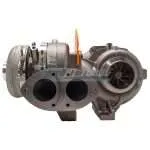
The Ford 6.7L Powerstroke turbocharger is one of the most sophisticated factory diesel turbos ever bolted to a pickup, and when it fails it takes your truck down hard. The 2011-2014 trucks run the Garrett GT32 SST, a single-sequential unit with a double-sided compressor wheel that does the work of two turbos in one housing. That design is brilliant on paper and brutal on your wallet when the bearings, the vane control, or the unison ring let go. If you turn wrenches on Super Duties for a living, you already know the GT32 is not a “wait and see” part. Here is exactly how it fails, what the symptoms look like, and what replacement actually costs.
How the GT32 SST Turbo Works (and Why It Fails)
Ford and Garrett built the GT32 SST as a single-sequential turbocharger. Instead of two separate units like the 6.4L Powerstroke twin-turbo setup, the GT32 uses one turbine wheel and a compressor wheel that is machined on both sides. Each side takes in its own stream of air, and the two streams join at a common outlet: two compressors working in parallel on one shaft. That gives you fast spool down low and big airflow up top.
The variable geometry turbine (VGT) controls boost with a movable vane ring (the unison ring) moved by engine oil through a PCM-controlled VGT solenoid on 2011 to 2019 trucks (2020 and later trucks have an electronic actuator). This is where most of the trouble starts. Soot and carbon build up between the vanes, the ring sticks, and the oil-driven piston can no longer move parts that have stopped moving freely. Combine that with the high shaft speeds this turbo runs and you get a part that is sensitive to oil quality, EGR-laden exhaust, and short-trip idling.
For 2015 and newer 6.7L pickups, Ford switched to the larger Garrett GT37 single turbo (cab and chassis trucks carry different turbos with their own part numbers), which addressed some of the spool and durability complaints but kept the VGT architecture and many of the same failure modes.
Common 6.7L Powerstroke Turbo Failures
After four-plus decades rebuilding diesel turbos, we see the same handful of GT32 failure patterns come across the bench again and again:
- Bearing failure and shaft play. Excessive end play or radial play lets the compressor or turbine wheel contact the housing. Once you hear the grind, the turbo is done.
- Stuck VGT / unison ring. Carbon binds the variable vanes. You get overboost, underboost, or limp mode codes because the vanes can’t reach the commanded position.
- VGT control faults. On 2011 to 2019 trucks the VGT solenoid or its wiring fails, or the oil-driven piston sticks; on 2020 and later trucks the electronic actuator fails. Either way the truck sets boost control codes and loses boost control.
- Oil seal leaks. Worn seals push oil into the intake or exhaust, showing up as blue smoke and a fouled charge air system.
- Coolant line and feed line issues. The GT32 is oil- and coolant-cooled. Clogged or leaking lines starve the center section and accelerate bearing death.
Symptoms of a Failing 6.7L Powerstroke Turbo
Catching a turbo before it grenades saves your intake, intercooler, and sometimes your engine. Here is how the symptoms stack up by severity.
| Severity | Symptom | Likely Cause |
|---|---|---|
| Early | Sluggish throttle response, slow spool | Sticking VGT vanes, soot buildup |
| Early | Whistle or whine that changes pitch | Boost leak or early bearing wear |
| Moderate | Check engine light, P0299 / P132B / P2563 codes | VGT control or boost control fault |
| Moderate | Blue or black smoke under load | Oil seal leak or incomplete combustion |
| Severe | Limp mode, hard power loss | Stuck VGT or VGT control fault |
| Severe | Grinding, screeching, metal-on-metal noise | Failed bearings, wheel contact |
| Severe | Excessive oil consumption, oil in intercooler | Blown center section seals |
If you are also working on older Powerstrokes, the warning signs overlap. Our breakdown of 6.0L Powerstroke turbo failure warning signs covers the sticking-vane symptoms, which look the same on the 6.7L (both move their vanes with oil pressure through a VGT solenoid; the 6.7L has an electronic actuator only from 2020).
Diagnosing Before You Condemn the Turbo
Do not throw a $2,000-plus turbo at a problem that might be a $200 line or sensor. Run through this before you pull the unit:
- Scan and record live data. Watch commanded vs actual VGT position and boost pressure. A wide gap between commanded and actual points to a sticking ring or a VGT control fault.
- Check shaft play by hand. With the inlet off, feel for axial and radial movement on the compressor wheel. Any contact with the housing condemns it.
- Inspect the charge air system. Oil pooling in the intercooler or boost tubes confirms seal failure.
- Verify oil and coolant feed. Restricted oil supply is the number one killer of replacement turbos. Flush the feed line or replace it on every install.
- Pull intake and look at the EGR soot load. Heavy carbon means your replacement will fail the same way if you do not address the root cause.
If you are unsure whether your VGT is recoverable or truly dead, the team at PT Turbo has been doing this since 1978. Reach out to our techs with your codes and live data and we will help you make the call.
Replacement Options and Cost
You have three real paths on a 6.7L turbo: brand-new OEM, a quality remanufactured unit, or rebuilding your original core. Each has a place depending on budget, downtime, and how long you plan to keep the truck.
| Option | Typical Cost (Part Only) | Best For |
|---|---|---|
| New OEM Garrett turbo | $1,481 to $2,817 (5 listings) at PT Turbo | Late-model trucks, warranty work, no core hassle |
| Remanufactured turbo | $1,435 to $1,681 (3 listings) at PT Turbo | Best value, OEM performance, faster turnaround |
| Rebuild your core | $575 at PT Turbo for a journal-bearing turbo; ball-bearing units such as the GT32 SST are quoted after inspection (turbo rebuild price list) | Keeping your original matched unit, lowest cost |
Price ranges in this article are general estimates to help with budgeting, not PT Turbo quotes. Our current prices are on each product listing, and our rebuild prices are on the turbo rebuild price list.
A quality remanufactured turbocharger is the sweet spot for most owner-operators and fleets. You get new bearings, balanced wheels, a cleaned and tested vane mechanism, and tested boost control at a fraction of OEM list price. If your core is still good and you want to keep your exact unit, our turbo rebuild service restores it to spec on the bench with the right tooling and balancing equipment. You can also shop our full turbo catalog to match your exact build year.
Add roughly 6 to 10 hours of labor for a 6.7L turbo replacement depending on whether you are dropping the cab or working through the wheel wells, so plan your total accordingly.
Installation Kits and Gaskets You Need
Never reuse exhaust gaskets, oil feed seals, or coolant line crush washers on a turbo install. A $30 gasket leak will ruin a $2,000 turbo or send you back in for a redo. PT Turbo stocks the install hardware to do the job once:
- Installation kits are listed by turbo part number: send us the number on your turbo and we will match the gaskets and seals for it.
Match the kit to the actual turbo and engine code before you order so you are not short a seal on install day. The feed line seals and crush washers are the ones that get overlooked, and they are exactly what causes an oil leak that cooks a fresh center section.
Do the gaskets, flush the oil feed, and clear the root-cause soot in one shot. A turbo that goes in clean against fresh sealing surfaces is the difference between a unit that lasts the life of the truck and one that comes back across the bench in a year.
Frequently Asked Questions
What causes the 6.7L Powerstroke GT32 turbocharger to fail?
The GT32 SST turbo commonly fails due to bearing wear and its complex double-sided compressor wheel design. Oil contamination, lack of maintenance, and high mileage stress accelerate the failure.
What are the symptoms of a failing 6.7L Powerstroke turbocharger?
Common symptoms include loss of power, excessive smoke, whining or grinding noises, boost issues, and illuminated check engine lights. Oil leaks around the turbo can also indicate failure.
How much does it cost to replace a 6.7L Powerstroke turbocharger?
Replacement costs typically range from $2,500 to $4,500 including parts and labor. The GT32 SST’s sophisticated design makes it one of the more expensive factory diesel turbos to replace.
Further reading: Learn more about turbocharger technology.
Need a Turbocharger?
PT Turbo has rebuilt and sold turbochargers since 1978. We stock remanufactured units for Cummins, Duramax, Power Stroke, Detroit Diesel, and more — backed by a 12-month unlimited mileage warranty and same-week shipping from San Bernardino, CA.
📞 (909) 824-1020 · 346 S I St. #3, San Bernardino, CA 92410 · [email protected]
More From PT Turbo
 Ford F-250/F-350 Super Duty Turbocharger Guide: 6.0L, 6.4L & 6.7L Powerstroke Compared
- Detroit Diesel Series 60 Turbocharger Guide: Garrett & BorgWarner S400 Replacement & Cost
- Detroit DD16 Turbocharger Guide: Turbo-Compound System, Failure Symptoms & How It Differs from the Mack MP10
- Isuzu 4HK1 Turbocharger Guide: NPR, NQR & Construction Equipment Applications