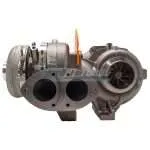
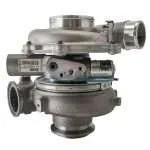
If you’re chasing down boost problems on a VW or Audi 1.6 or 1.9 TDI, the turbocharger is one of the most common units to land on a workbench. These engines (the BXE, BLS, and later CAYC 1.6 TDI) pushed serious mileage out of small displacement, and the turbo is the part doing the heavy lifting. When it starts to fail, the symptoms are unmistakable to anyone who’s been under the hood before. This guide breaks down exactly what to look for, how to replace the unit correctly, and which parts are worth your money.
The Turbo on the 105 HP TDI
Volkswagen Group 1.9L and 1.6L TDI engines rated at 105 horsepower use variable geometry turbochargers (VGT/VNT). The 1.9 TDI BXE and BLS engines run a Garrett GT1646MV (part number 751851; we list it new and remanufactured) or, depending on the car and build year, a BorgWarner BV39, while the newer 1.6 TDI CAYC uses a smaller variable nozzle unit. Both are Garrett Motion and BorgWarner designs depending on production year and plant.
These are variable-vane turbos, meaning a ring of adjustable vanes inside the turbine housing controls exhaust flow against the wheel. That gives you strong low-end response and clean spool, but it’s also the part that fails most often. Carbon buildup and sticking vanes are the number one killer of these turbos, not bearing wear.
Symptoms of a Failing 1.9 TDI Turbocharger
A dying VNT turbo rarely goes quietly. It throws codes, dumps oil, and robs power long before it physically seizes. Here’s how the symptoms stack up by severity so you know whether you’re looking at a clean-and-reset or a full replacement.
| Symptom | Likely Cause | Severity |
|---|---|---|
| Limp mode / power loss above 2,500 RPM | Sticking VNT vanes (carbon) | Moderate |
| P0299 underboost or P0234 overboost | Vane actuator / stuck geometry | Moderate |
| Whistling or siren-like whine | Boost leak or worn bearings | Moderate to High |
| Blue/gray smoke on acceleration | Oil seal failure, shaft play | High |
| Oil in intercooler or intake piping | Failed turbo oil seals | High |
| Metallic grinding or rattle | Bearing/shaft failure | Critical, stop driving |
Confirming the Diagnosis
Before you condemn the turbo, rule out the cheap stuff. A cracked intercooler hose, a leaking boost pipe clamp, or a faulty MAP sensor will mimic turbo failure and throw the same P0299. Pull the intake elbow and check the compressor wheel for shaft play by hand: in-and-out play you can feel, or a wheel that touches the housing, means the bearings are gone (a little side-to-side movement is normal). Axial movement of more than about 0.1 mm (0.004 in) is failure territory.
For the vane sticking problem, an actuator test is the giveaway. With the engine off, watch the actuator rod cycle when commanded through a scan tool. If it’s lazy, sticky, or won’t move full travel, the vanes are carboned up inside the turbine housing. On high-mileage examples this is far more common than mechanical bearing failure.
How to Replace the Turbocharger
This is a half-day job for an experienced diesel tech and a full day for a first-timer. The turbo sits on the exhaust manifold side, and access varies by chassis (Golf, Passat, Octavia, A3 all share the platform but route things differently). Here’s the proven sequence.
- Let it cool completely. These manifolds hold heat and the studs are unforgiving.
- Disconnect the battery and remove the engine cover and air intake assembly.
- Drain coolant if equipped with a water-cooled center housing, and have fresh coolant ready.
- Remove the oil feed and return lines. Inspect the banjo bolt mesh filter, this is a frequent clog point that kills the new turbo if you reuse it dirty.
- Disconnect the VNT actuator linkage and electrical connector (on electronically actuated units).
- Unbolt the turbo from the manifold and the downpipe. Penetrating oil and patience save snapped studs.
- Clean every mating surface and replace all gaskets, seals, and the oil feed line. Never reuse old gaskets on a VNT install.
The single most important step: prime the new turbo with clean engine oil through the feed port and crank with the fuel cut until you see oil pressure before the first start. A dry start will spin a fresh turbo at 100,000+ RPM with no lubrication and wipe the bearings in seconds.
Get the Gaskets Right the First Time
You cannot reuse exhaust manifold gaskets, oil line seals, or copper crush washers on a turbo job. A complete installation kit saves you from chasing a slow oil weep three days after the truck leaves. The Ajusa Volkswagen-Audi Installation Kit (JTC11378) at $21.26 bundles the gaskets and seals you need for these VW Group TDI applications, so you’re not piecing together part numbers from three suppliers the morning of the install.
New vs. Remanufactured: What to Buy
For a 105HP TDI, both new and quality remanufactured turbos are widely available, and the right choice depends on the vehicle’s remaining life and your budget. PT Turbo has stocked both new and remanufactured units for 45+ years, so here’s the honest breakdown.
| Factor | New OEM/Aftermarket | Remanufactured |
|---|---|---|
| Typical price range | $629 to $1,478 (18 listings) at PT Turbo | $600 (1 listing) at PT Turbo |
| Core charge | None | Usually applies, refundable |
| VNT mechanism | New vanes, fresh calibration | Rebuilt/cleaned, recalibrated |
| Best for | Low-mileage engines, long-term keepers | High-mileage daily drivers, fleet budget |
| Warranty | Longest coverage | Solid coverage from quality remanufacturers |
Price ranges in this article are general estimates to help with budgeting, not PT Turbo quotes. Our current prices are on each product listing, and our rebuild prices are on the turbo rebuild price list.
A properly remanufactured turbo built with new bearings, seals, a balanced CHRA, and a recalibrated VNT actuator will perform like new at a meaningful discount. The key word is “properly.” Avoid cheap unbranded rebuilds that skip vane replacement, because you’ll be back in limp mode within a few thousand miles. Reman quality is exactly why buying from a specialist who’s been doing this since 1978 matters.
Why These Turbos Fail Early (and How to Prevent It)
Most of these turbos don’t die of old age. They die of maintenance neglect and short-trip driving. Carbon-laden exhaust gas coats the vanes during low-load city driving, and the vanes seize in position. Combine that with extended oil change intervals and you’ve coked the oil feed line too.
- Change oil on time with the correct VW 507.00 spec low-ash diesel oil. Coked oil is another leading cause of premature turbo death on these engines.
- Replace the banjo bolt oil filter screen whenever the turbo is off. A blocked screen starves the new unit.
- Run an Italian tune-up occasionally. A hard, sustained run at highway RPM helps keep the VNT vanes clean.
- Let it idle 30 to 60 seconds after hard driving before shutdown so the center housing cools and oil doesn’t coke in the bearing.
- Fix EGR and intake carbon problems. A clogged intake starves the engine of air, which makes more soot and fouls the vanes faster.
Frequently Asked Questions
Which turbo does the 105 hp 1.9 TDI BXE or BLS engine use?
A Garrett GT1646MV (part number 751851) or a BorgWarner BV39, depending on the car and build year, so go by the number on the turbo. Either one is a variable nozzle turbo with a ring of adjustable vanes in the turbine housing. The newer 1.6 TDI CAYC uses a smaller variable nozzle unit.
How long does it take to change the turbo on a 1.9 TDI?
About half a day for an experienced diesel technician and a full day for a first-timer. The turbo sits on the exhaust manifold side, and access varies by chassis, since the Golf, Passat, Octavia and A3 route things differently.
Can old gaskets and oil lines be reused when fitting a new TDI turbo?
No. Exhaust manifold gaskets, oil line seals and copper crush washers cannot be reused, and the oil feed line should be replaced as well. The banjo bolt filter screen is a frequent clog point that starves a new turbo if it goes back in dirty.
Rather than replace a failed turbo outright, consider PT Turbo’s turbo rebuild service, which restores the original unit to specification.
Need a Turbocharger?
PT Turbo has rebuilt and sold turbochargers since 1978. We stock remanufactured units for Cummins, Duramax, Power Stroke, Detroit Diesel, and more — backed by a 12-month unlimited mileage warranty and same-week shipping from San Bernardino, CA.
📞 (909) 824-1020 · 346 S I St. #3, San Bernardino, CA 92410 · [email protected]
More From PT Turbo
- John Deere 6068 Turbocharger Guide: PowerTech Agricultural & Construction Applications
 Ford 6.7L Powerstroke Turbocharger Guide: GT32 Failures, Symptoms & Replacement Cost
- Duramax LML Turbocharger Guide: GT3788VA Problems & Replacement (2011-2016)
- International T444E Turbocharger Guide: Ford 7.3L Powerstroke Connection Explained