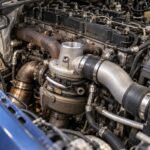
Knowing How to Test a Turbocharger Without Removing It can save you hours of labor and prevent you from throwing parts at a problem that may not even be the turbo. At PT Turbo, we have spent more than 45 years diagnosing, rebuilding, and stocking turbochargers, and one thing is certain: most turbos that get pulled off an engine were never actually bad. The fault was a leaking hose, a stuck actuator, or a plugged oil feed line.
Before you break a single exhaust bolt, run these five diagnostic checks. They are the same methods our techs use on the bench and in the field, and every one of them can be done with the turbo still bolted to the engine.
Why On-Vehicle Testing Matters
A turbocharger is a simple machine wrapped in a complex system. It has one moving assembly: a shaft with a compressor wheel on one end and a turbine wheel on the other, spinning on a thin film of oil at speeds up to 200,000 RPM. When boost drops or smoke appears, the turbo often gets blamed first.
The reality is that boost loss usually comes from the plumbing around the turbo, not the cartridge itself. Testing on the vehicle lets you rule out cheap, common failures before you commit to removal, gaskets, and downtime. For background on how the whole system works, the turbocharger overview on Wikipedia is a solid primer.
Method 1: Visual and Shaft Play Inspection
Start with your eyes and your hands. Pull the intake hose off the compressor inlet so you can see the compressor wheel. Look for oil pooling in the housing, damaged or clipped blades, and contact marks where the wheel has kissed the housing.
Next, check shaft play by hand. Grip the compressor nut or the wheel and try to move it.
- Radial play (side to side): A small amount is normal. The wheel should not touch the housing when you push it.
- Axial play (in and out): This should be minimal, roughly 0.001 to 0.004 inches. Noticeable in-and-out movement means worn thrust bearings.
If the wheel contacts the housing or you feel gritty, grinding movement, the bearings are shot. Oil in the compressor housing points to a failed seal, though it can also be caused by a restricted air filter or a plugged crankcase breather pulling oil through the system.
Method 2: Boost Pressure Test
Low or slow boost is the most common complaint we hear. The fastest way to confirm whether the turbo is actually producing pressure is to measure it directly with a mechanical gauge teed into the intake manifold or by reading boost through your scan tool.
Compare your reading against the engine’s spec. Most modern diesels run 20 to 40 PSI of boost under load depending on displacement and application. If you are seeing significantly less than spec under full throttle, you have confirmed a boost problem, but you have not yet confirmed a turbo problem.
We walk through the entire procedure in How to Test Turbocharger Boost Pressure with a Gauge. Do this test early, because it tells you whether to keep digging or move on.
Method 3: Boost Leak Test
If boost is low but the turbo spins freely and looks clean, the problem is almost always a leak in the charge air system. Cracked intercooler end tanks, split boots, loose clamps, and blown couplers all bleed off pressure before it reaches the cylinders.
A boost leak test pressurizes the intake tract with shop air so you can hear and find the leak while the engine is off. It is one of the highest-value diagnostics you can run, and it takes about 15 minutes with a homemade or store-bought test kit.
We cover the setup two ways: Boost Leak Test: How to Find and Fix Boost Leaks on Diesel Trucks and a more detailed step-by-step boost leak test procedure. Between the boost gauge and the leak test, you will catch the majority of “bad turbo” complaints.
How to Test a Turbocharger Without Removing It: The Actuator Check
Learning How to Test a Turbocharger Without Removing It comes down to one component more than any other: the actuator. On wastegated turbos it controls boost by opening a valve to bypass exhaust. On variable geometry turbos, it moves the vanes that change exhaust flow across the turbine.
Testing a Pneumatic Wastegate Actuator
Disconnect the boost reference line and apply regulated shop air, or use a hand vacuum/pressure pump, to the actuator. Watch the rod. It should begin to move at the rated pressure and travel its full stroke smoothly, then return when pressure is released.
A rod that does not move, moves late, or sticks partway is a failed actuator. This alone causes overboost, underboost, and limp-mode codes, and it is frequently mistaken for a bad turbo. Replacing the actuator is far cheaper than replacing the whole unit.
Testing a Variable Geometry Turbo
On a variable geometry turbocharger, sticking vanes are a top failure, usually from soot and carbon buildup. Command the actuator through its range with a scan tool bidirectional test and watch the actuator arm or the reported position follow: the vanes themselves sit inside the turbine housing and cannot be seen with the turbo assembled.
Vanes that stick, bind, or move unevenly cause the same symptoms as a bad cartridge. Soot loading from a failing EGR system or a plugged DPF accelerates this, so review EGR operation if you find heavy carbon.
Method 5: Oil Feed and Drain Inspection
Bearing failures almost always trace back to oil. Before condemning any turbo, check the oil supply and return.
Inspect the oil feed line for kinks, carbon coking, and restriction. A partially blocked feed line starves the bearings and destroys a turbo quickly. Check the drain line for restriction or backup, because a blocked drain pressurizes the center housing and pushes oil past the seals into the intake or exhaust.
Also confirm the crankcase breather is not plugged. High crankcase pressure forces oil out through the turbo seals and mimics a seal failure. Fixing the breather can save a perfectly good turbo.
Symptom-to-Cause Quick Reference
Use this table to match what you are seeing to the most likely root cause and the right on-vehicle test.
| Symptom | Most Likely Cause | Test to Run |
|---|---|---|
| Low boost, no smoke | Boost leak or stuck actuator | Boost leak test, actuator check |
| Overboost / limp mode | Stuck wastegate or VGT vanes | Actuator and vane movement test |
| Blue smoke, oil consumption | Failed seals or blocked oil drain | Compressor inspection, drain line check |
| Whining or grinding noise | Worn shaft bearings | Shaft play inspection |
| Slow throttle response | Carbon-loaded VGT vanes | Bidirectional vane test |
New vs Remanufactured: What to Do When the Turbo Is Actually Bad
If you have confirmed worn bearings, damaged wheels, or a housing crack, the turbo needs to come off. When it does, you have three real options.
| Option | Typical Cost | Best For |
|---|---|---|
| New OEM turbo | Highest | Warranty jobs, newest platforms |
| Remanufactured turbo | 30 to 50% less than new | Most fleet and owner-operator repairs |
| Rebuild your existing unit | Lowest for rare or discontinued units | Hard-to-find or original-fitment cores |
Our remanufactured turbochargers are built to OEM tolerances with new bearings, seals, and balanced rotating assemblies, and they carry a warranty. If your core is rare or discontinued, our turbocharger rebuild service restores the exact unit you already have.
Frequently Asked Questions
Can you test a turbocharger without removing it from the engine?
Yes, you can test a turbocharger in place using methods like checking for boost leaks, inspecting shaft play, and monitoring boost pressure. These diagnostics help confirm whether the turbo is truly faulty before pulling it off.
What are the signs of a failing turbocharger?
Common signs include loss of power, excessive exhaust smoke, whining or whistling noises, and increased oil consumption. However, many of these symptoms can be caused by leaking hoses or other issues rather than the turbo itself.
How do you check for turbo shaft play without removing the turbo?
Remove the intake or intercooler pipe to access the compressor wheel, then gently wiggle the shaft to feel for excessive axial or radial movement. Slight play is normal, but significant wobble or contact with the housing indicates worn bearings.
Need a Turbocharger?
PT Turbo has rebuilt and sold turbochargers since 1978. We stock remanufactured units for Cummins, Duramax, Power Stroke, Detroit Diesel, and more — backed by a 12-month unlimited mileage warranty and same-week shipping from San Bernardino, CA.
📞 (909) 824-1020 · 346 S I St. #3, San Bernardino, CA 92410 · [email protected]