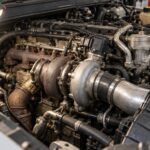
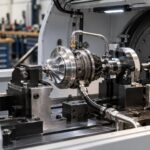
Learning how to check turbocharger shaft play with a dial indicator is one of the most valuable diagnostic skills a diesel technician can master, because it tells you the condition of your bearing system without splitting the housings apart. A worn center section will chew through oil, drop boost, and eventually let the compressor or turbine wheel contact the housing. Catching that wear early with a simple $30 tool saves you from a grenaded turbo and a scored engine.
At PT Turbo we have been rebuilding and testing turbochargers since 1978, more than 45 years, and shaft play measurement is the first thing that goes on the bench when a unit comes in. Here is exactly how we do it, what the numbers mean, and when a reading tells you the unit is finished.
Why Shaft Play Matters
The turbine and compressor wheels spin on a common shaft supported by either journal bearings or ball bearings. That shaft can run north of 150,000 RPM under load. The clearances holding it in place are measured in thousandths of an inch.
When the bearings wear, the shaft develops excess movement in two directions: radial (side to side) and axial (in and out along the shaft centerline). Too much radial play lets the wheels touch the housings. Too much axial play means the thrust bearing is failing. Either one ends the same way, with metal shavings in your oil and a turbo on the scrap bench.
If you want the full breakdown of tolerances and replacement thresholds, our companion guide on turbocharger shaft play and how much is too much digs deeper into the numbers by turbo family.
Tools You Need Before You Start
You do not need a fully equipped machine shop for this check, but you do need the right gear to get a repeatable reading. Guessing with your thumb tells you nothing useful.
- A dial indicator reading in 0.001 in (or 0.01 mm) increments
- A magnetic base or clamp stand to hold the indicator steady
- A dial bore gauge or the same dial indicator for radial checks
- A clean shop rag and brake cleaner to degrease the wheels
- Feeler gauges as a backup reference
- The manufacturer spec sheet for your specific turbo model
Mount the turbo securely in a soft-jaw vise or holding fixture. Any movement in the mount shows up as false play in your reading, so clamp it down solid before you touch the indicator.
How to Check Turbocharger Shaft Play with a Dial Indicator: Step by Step
There are two measurements that matter, and you should take both. Axial play is the easiest and the most telling for thrust bearing condition. Radial play tells you about the journal bearings and wheel-to-housing clearance.
Measuring Axial (End) Play
Axial play is movement along the length of the shaft, in and out. This is your thrust bearing indicator.
- Position the dial indicator so the plunger contacts the exposed end of the shaft, typically the compressor nut or the turbine shaft tip.
- Push the shaft firmly toward the indicator and zero the gauge.
- Pull the shaft the opposite direction with steady, even pressure.
- Read the total travel on the dial. That number is your axial play.
Most modern journal bearing turbos want axial play in the range of 0.001 to 0.004 in (0.025 to 0.10 mm). Anything past 0.004 in on a standard passenger or light truck turbo signals a worn thrust bearing that needs attention. Ball bearing cartridges run tighter, often under 0.002 in.
Measuring Radial (Side) Play
Radial play is side to side movement, and it is the reading that predicts wheel contact. Set your indicator plunger against the shaft through the oil drain port or against the shaft nut depending on access.
- Grip both wheels and push them up together, then zero the gauge.
- Push both wheels down together with equal force and read the travel.
- Repeat several times to confirm a consistent number.
Important: on journal bearing turbos, some radial play is normal and expected because the shaft floats on an oil film. A reading of 0.003 to 0.006 in taken at the shaft through the drain port is often within spec. Taken at the shaft nut, where the movement is magnified, the reading on a healthy journal bearing turbo can be roughly 0.012 to 0.024 in, so compare with the maker’s figure for the unit. The real test is whether the wheels contact the housing. Spin the shaft by hand and feel for scraping or rubbing at the extremes of travel. Any contact means the unit is done.
Reading the Numbers: What Passes and What Fails
Numbers alone do not condemn a turbo. Context matters. A journal bearing turbo naturally shows more radial float than a ball bearing unit, and that is by design. Use the table below as a general field reference, then confirm against your specific model spec.
| Measurement | Journal Bearing (typical) | Ball Bearing (typical) | Action if Exceeded |
|---|---|---|---|
| Axial play | 0.001 to 0.004 in | 0.0003 to 0.002 in | Rebuild or replace thrust bearing |
| Radial play | 0.003 to 0.006 in at the shaft | 0.001 to 0.003 in | Inspect for wheel contact, rebuild if touching |
| Wheel-to-housing contact | None allowed | None allowed | Replace immediately |
If the shaft will not spin freely at all, or binds and grinds, you are past a shaft play issue and into a seizure situation. Our guide on a seized turbocharger and what to check first walks through that decision.
Don’t Forget the Actuator and VGT Mechanism
Shaft play is only half the diagnosis. A turbo with perfect bearings can still make zero boost if the wastegate or variable geometry actuator has failed. When you have the unit on the bench, check that the actuator rod moves smoothly through its full stroke and holds its calibrated position.
A sticking or leaking pneumatic actuator throws boost codes that mimic bearing wear, so rule it out.
Matching the correct actuator to your turbo is critical because the spring rate and stroke length are calibrated to that specific unit. Garrett and BorgWarner both publish application data if you need to confirm, see Garrett Motion for reference.
Rebuild, Reman, or Replace
Once your dial indicator confirms the bearings are worn, you have three paths. Which one makes sense depends on the turbo, the availability of parts, and how many hours the core has on it.
| Option | Typical Cost | Best For |
|---|---|---|
| Professional rebuild | $450 to $975 for most turbos at PT Turbo (price list) | Good core, common turbo, verified balanced result |
| Remanufactured unit | $525 to $8,461 (259 listings) | Fast turnaround, warranty coverage, no core wait |
| Brand new OEM | $442 to $13,412 (1904 listings) | Warranty-critical or unavailable cores |
Price ranges in this article are general estimates to help with budgeting, not PT Turbo quotes. Our current prices are on each product listing, and our rebuild prices are on the turbo rebuild price list.
A quality rebuild restores the turbo to spec by installing a new bearing set, thrust assembly, seals, and a balanced center cartridge. Our turbo rebuild service returns your unit balanced on a VSR machine with verified shaft play, not just a bag of parts thrown in.
If you need a truck back on the road today, a remanufactured turbocharger ships ready to bolt on. As a family-owned shop stocking both new and remanufactured parts, we can usually match your part number the same day. Browse everything in our full turbo catalog or contact PT Turbo with your casting numbers and we will confirm the right fit.
For background on how the whole system works, the Wikipedia turbocharger overview is a solid primer for anyone training new techs.
Frequently Asked Questions
How much axial shaft play is acceptable in a turbocharger?
Acceptable axial (end) play is typically between 0.001 and 0.004 inches, though you should always verify the exact specification for your specific turbo model. Readings beyond spec indicate worn thrust bearings.
What tools do I need to check turbocharger shaft play?
You need a dial indicator with a magnetic base or clamp, and access to the turbo shaft through the compressor or turbine housing. A repair manual with the correct clearance specs is also essential.
Can I check turbo shaft play without removing the turbocharger?
Yes, you can often measure radial play by hand-feeling the wheel, but an accurate dial indicator check of axial play usually requires removing the turbo or at least accessing the shaft directly. Proper mounting of the indicator is key to reliable readings.
Need a Turbocharger?
PT Turbo has rebuilt and sold turbochargers since 1978. We stock remanufactured units for Cummins, Duramax, Power Stroke, Detroit Diesel, and more — backed by a 12-month unlimited mileage warranty and same-week shipping from San Bernardino, CA.
📞 (909) 824-1020 · 346 S I St. #3, San Bernardino, CA 92410 · [email protected]