5.9L vs 6.7L Cummins Turbocharger Comparison: Which Is More Reliable?
This 5.9L vs 6.7L Cummins turbocharger comparison answers the question every Ram owner eventually asks when a charger starts whining, smoking, or throwing boost codes: is the older fixed geometry turbo really more dependable than the newer variable geometry unit? The honest answer is that each design fails in different ways, and knowing which one you have changes how you diagnose it, what it costs to fix, and how long it lasts. At PT Turbo we have been rebuilding turbochargers since 1978, and the Holset units on both of these engines cross our bench regularly.
Below we break down the two engine families, the exact turbos Cummins fitted, how each one is controlled, and where the real-world weak points are. Match whatever we say here against the number stamped on your turbo’s data plate before you order anything.
Which Turbos Came on the 5.9L and the 6.7L Cummins
The 5.9L Cummins used fixed geometry Holset turbos its entire production run: the 1989-1993 trucks had the Holset H1C with no wastegate, and the trucks from 1995 on had wastegated turbos. There was never a variable geometry turbo on a 5.9L Ram.
- 1995-1998 12-valve and early 24-valve trucks: Holset HX35W turbochargers.
- Later 24-valve trucks to 2002: HX35W with the manual transmission and HY35W with the automatic. The HY35W is an HX-family turbo with a smaller turbine housing.
- 2003 to early 2004: HY35W (some sellers list it as the HE341CW; that is one turbo with two names, not two different factory parts).
- 2004.5-2007: Holset HE351CW, wastegated with an electronically controlled wastegate.
The 6.7L Cummins went variable geometry from the start. From 2007.5-2012 it carried the Holset HE351VE; from 2013 on it carried the Holset HE300VG, including the 2019-2024 trucks with new turbo and actuator part numbers. Both are variable geometry with an electronic actuator in every year, and neither swaps directly for the other because the actuators and wiring differ. For the full story on those two, see our HE351VE vs HE300VG comparison.
How Each Turbo Is Controlled
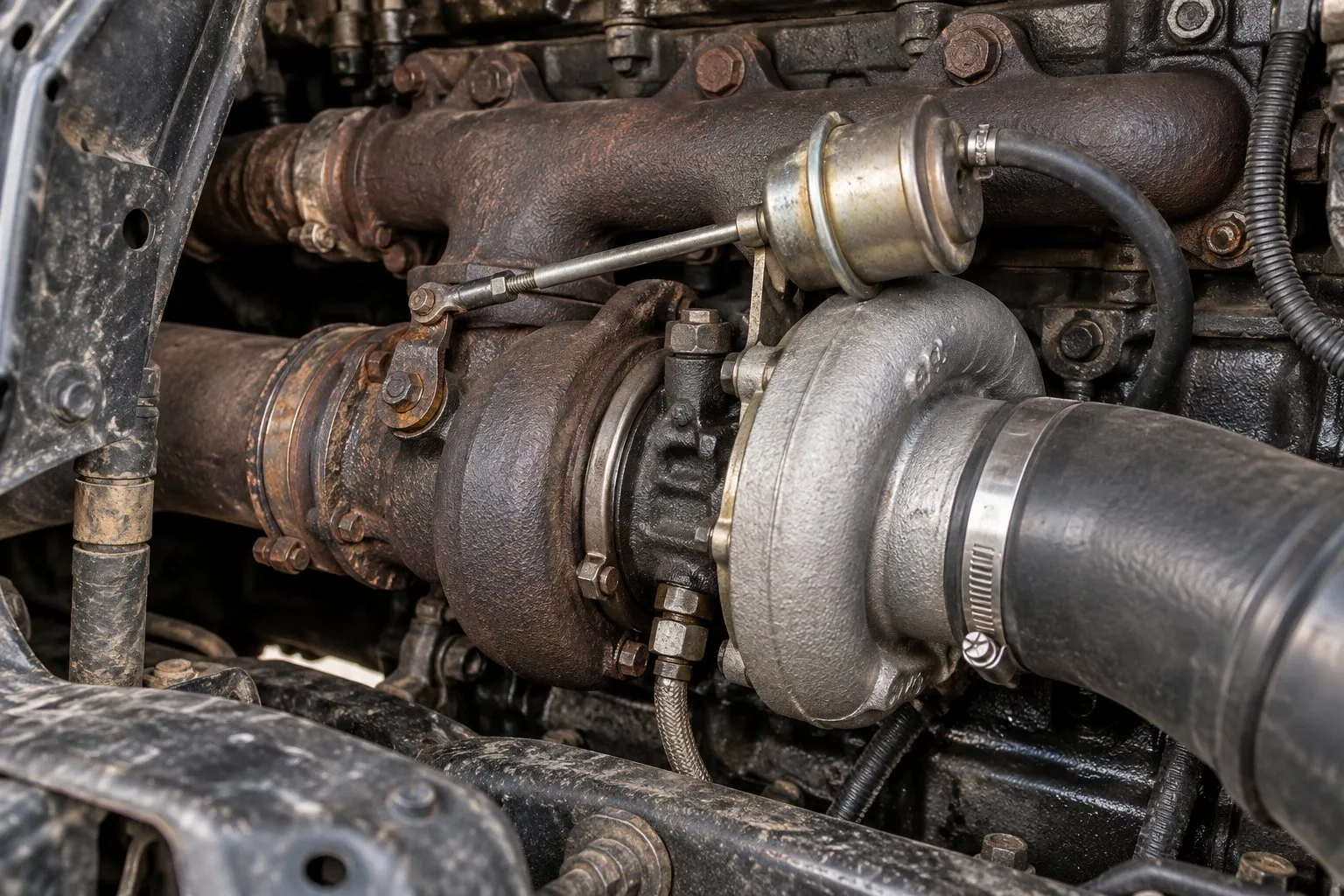
This is the heart of the reliability question. The 5.9L turbos are mechanically simple: a fixed turbine, a fixed nozzle, and a wastegate that bleeds exhaust past the wheel once boost reaches a set point. There is no actuator to calibrate, no vane pack, and on the HX35W, HY35W, and HE351CW no coolant lines; these are oil-cooled only.
The 6.7L turbos use a Holset sliding nozzle, not pivoting vanes on a unison ring, driven by an electronic variable geometry actuator. The nozzle moves to change effective exhaust velocity, giving quick spool down low and controlled flow up top, which is how the 6.7L meets emissions and tows without a wastegate. The HE351VE and HE300VG also carry coolant lines to the actuator, which the 5.9L units do not have.
The trade is clear. The VGT delivers better drivability, faster spool, and engine braking, but it adds an electronic actuator, a nozzle that lives in the soot stream, and a calibration step at replacement. Replacing a Cummins actuator means running the INSITE install routine with the new actuator plugged in but not yet bolted to the turbo, then mounting it and calibrating without cycling the key.
5.9L vs 6.7L Cummins Turbocharger Comparison: Reliability Side by Side
Neither design is fragile when the oil supply is clean and the turbo is sized correctly. Most turbo failures on either engine trace back to the oil supply, not the turbo type. That said, the failure modes are genuinely different.
| Attribute | 5.9L (HX35W / HY35W / HE351CW) | 6.7L (HE351VE / HE300VG) |
|---|---|---|
| Geometry | Fixed, wastegated | Variable, sliding nozzle |
| Boost control | Wastegate | Electronic actuator |
| Actuator to calibrate | None | Yes, electronic, calibrated to the turbo |
| Coolant lines | No (oil-cooled) | Yes (to the actuator) |
| Main wear points | Bearings, wastegate linkage, seals | Nozzle soot buildup, actuator, bearings, seals |
| Engine braking | No | Yes |
| Diagnostic complexity | Lower | Higher (position, actuator, soot) |
On the 5.9L the common complaints are worn bearings from age or oil issues, a wastegate flapper that does not seat, and seal leaks. A wastegate that will not close lets exhaust slip past the turbine, so you see low boost and slow spool, not boost creep. Because there is no variable nozzle in the soot path and no electronic vane actuator (only the wastegate actuator on the wastegated turbos), there is simply less to go wrong, which is why these turbos have the reputation they do.
On the 6.7L the nozzle lives in the exhaust and can collect soot, especially on trucks that idle long and tow little. A nozzle stuck closed gives overboost and high drive pressure; stuck open gives low boost. The electronic actuator is a wear item as well. Those are real, but they are maintenance and emissions-era realities, not a design flaw, and the VGT does work the 5.9L cannot.
Reading the Symptoms and Codes
How you diagnose a problem depends entirely on which turbo you have. On the fixed geometry 5.9L you are looking at mechanical boost control and shaft condition. On the 6.7L you add actuator position, nozzle movement, and the electronics.
- Low boost, slow spool: on the 5.9L suspect the wastegate not seating or a leak before the turbine; on the 6.7L suspect a nozzle stuck open or an actuator fault.
- Overboost: on the 6.7L a nozzle stuck closed will drive boost and drive pressure up.
- P0299 underboost / P0234 overboost: generic boost codes that can appear on either when control is off target, on electronically controlled trucks; the mechanical 12-valve 5.9L does not report OBD-II codes.
- P003A: on the 6.7L, turbocharger boost control A position exceeded learning limit, often pointing at the actuator or a bound nozzle (position not learned is P226C).
Note that P132B is a Ford 6.7L Power Stroke code, not a Cummins code, so ignore it on a Ram. For a deeper walk through the variable geometry side, read our Cummins ISB 6.7L turbocharger guide. The turbocharger fault code index is a handy reference when the scanner lights up.
Checking a Turbo Before You Condemn It
Both turbos run journal bearings, so some side-to-side shaft play is normal, especially with no oil pressure on the shaft. Condemn a turbo for in-and-out play you can feel, for the wheel contacting the housing, or for play beyond the maker’s limit, never for any movement at all.
A light oil film in the charge pipes is normal on any engine with closed crankcase ventilation. Before you blame a seal, check the breather, the air filter, the oil level, and the oil drain. Pooled oil is a different story and worth chasing down.
On the 6.7L, never move the electronic actuator arm by hand; the gears are self-locking and break. If the nozzle is suspect, work from the vane lever with the actuator off, not from the actuator output.
Replacement, Rebuild, and Parts
When it is time to fix one, you have options on both engines. PT Turbo stocks new turbos, offers in-house turbocharger rebuild service, and carries remanufactured turbochargers for the Holset units on both the 5.9L and the 6.7L. Rebuild pricing is confirmed after inspection and before any work starts; our current numbers are on the turbo rebuild price list.
Most rebuilds ship in 3 days or less, and every rebuilt or replacement unit carries a 12 month, unlimited mileage warranty. Core returns on remanufactured turbos are within 30 days with the customer paying return shipping. For the exact turbo numbers by year and transmission, our model-specific guides for the 5.9L and the 6.7L lay them out.
For first start after any turbo install, follow the maker’s steps: fill the oil inlet with clean engine oil, turn the wheel by hand, then crank or idle a few minutes before you put it under load. On the common-rail 6.7L, keep the engine from starting using the service manual’s procedure while you prime; do not try to disconnect fuel on a common-rail diesel.
Turbos we list for the HX35W, HY35W and HE351VE
Listings for the turbo models named in this guide that can be ordered online today. Several part numbers can fit one engine by year and rating, so match the number on your turbo’s tag, or call (909) 824-1020 and we will match it for you.
All HX35W listings · All HY35W listings · All HE351VE listings
Frequently Asked Questions
Is the 5.9L fixed geometry turbo really more reliable than the 6.7L VGT?
The 5.9L turbo is mechanically simpler, with no electronic actuator and no nozzle in the soot stream, so there is less to fail. The 6.7L VGT does more work and needs more attention, but with clean oil and reasonable duty it holds up well. On both engines, most failures trace back to the oil supply, not the turbo type.
Can I put a 5.9L HX35 on a 6.7L to avoid the VGT?
Swaps like that change boost control, emissions behavior, drivability, and engine braking, and they require plumbing and tuning changes. If you want the factory setup to work right, stay with the correct Holset VGT for your year and have the actuator calibrated to the turbo. Call us at (909) 824-1020 and we can match the number on your tag.
Do the 6.7L turbos really need coolant lines when the 5.9L did not?
Yes. The HE351VE and HE300VG carry coolant lines to the electronic actuator, while the 5.9L HX35W, HY35W, and HE351CW are oil-cooled with no coolant lines. Confirm the lines and fittings match your truck before you order, using the part number on the turbo’s data plate.
Need a Turbocharger?
PT Turbo has rebuilt and sold turbochargers since 1978. We stock remanufactured units for Cummins, Duramax, Power Stroke, Detroit Diesel, and more — backed by a 12-month unlimited mileage warranty. Units in stock at our shop in San Bernardino, CA ship the same day when ordered before 2 PM Pacific, Monday through Friday.
📞 (909) 824-1020 · 346 S I St. #3, San Bernardino, CA 92410 · [email protected]
More From PT Turbo
 Volvo VNL Turbocharger Replacement Guide: D13 Applications by Model Year
- Detroit DD13 Turbocharger: Failure Symptoms, EGR Interaction & Replacement Options
- Mack Anthem Turbocharger Guide: MP8 Applications & Replacement Cost
- Ford F-250/F-350 Super Duty Turbocharger Guide: 6.0L, 6.4L & 6.7L Powerstroke Compared