

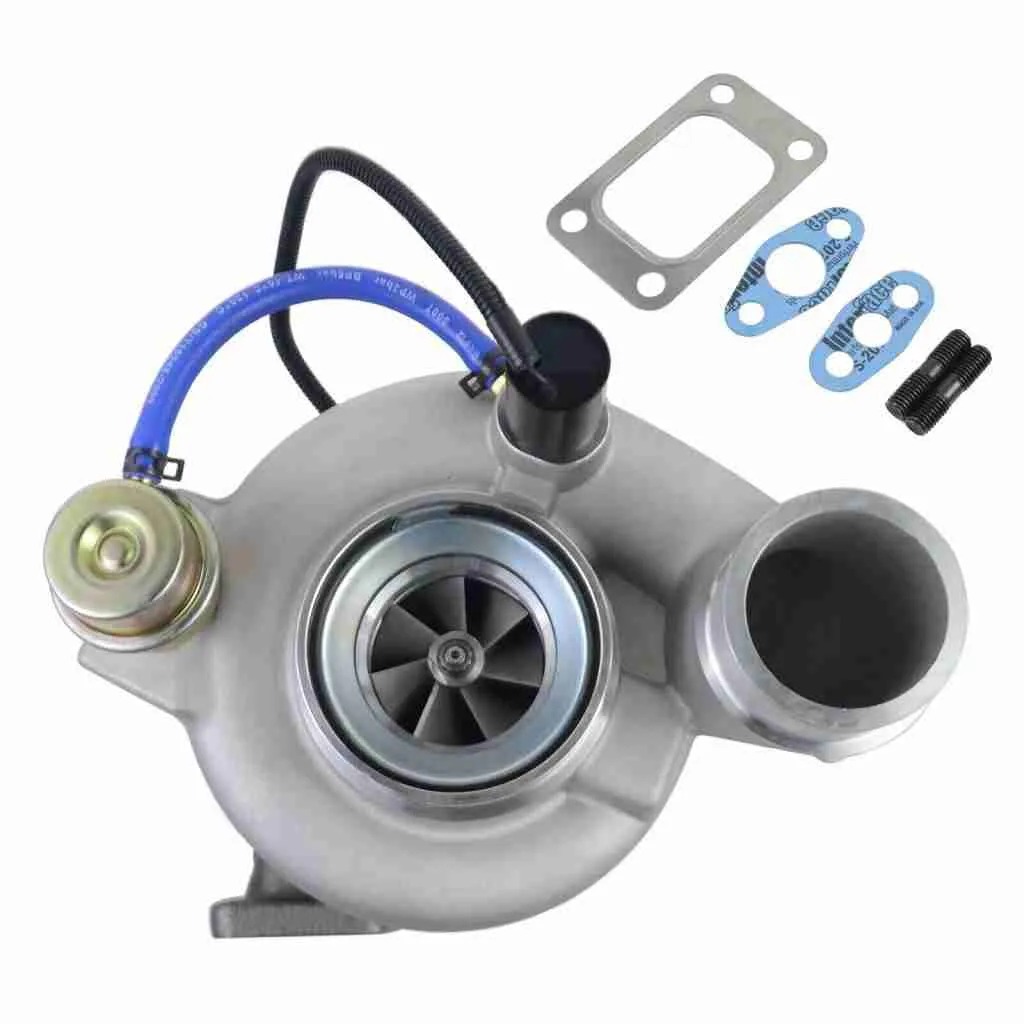
If you wrench on 5.9L Cummins trucks, you already know the Holset turbo bolted to that inline-six is half the reason these engines move freight for 400,000 miles without blinking. But the Ram 2500/3500 5.9L Cummins turbocharger lineup confuses a lot of owners and even some shops, because Dodge ran three different Holset units across the 1994 to 2007 production span: the HX35, the quick-spooling HY35, and the larger HE351CW. All three are wastegated; no 5.9L Ram left the factory with a variable-geometry turbo. Bolt the wrong one on, or feed it the wrong fueling, and you either choke the top end or lag off the line. This guide breaks down each turbo by year, specs, failure symptoms, and what it costs to do the job right.
HX35, HY35 and HE351CW: Which Turbo Came on Your 5.9L?
All three turbos are Holset units, but they were never interchangeable from the factory without supporting changes. Here is how Dodge and Cummins matched them to model years.
| Turbo | Years | Engine | Design | Stock HP Support |
|---|---|---|---|---|
| HX35 / HX35W | 1994–2002 | 12-valve & 24-valve (on the later trucks with a manual transmission only) | Fixed geometry, wastegated | ~160–245 hp (up to ~450 hp built) |
| HY35 / HY35W | Later 24-valve automatics (to 2002), 2003–early 2004 | 24-valve with automatic transmission; 5.9L common rail (305 hp) | Fixed geometry, wastegated | ~215–305 hp (up to ~500 hp built) |
| HE351CW | 2004.5–2007 | 5.9L common rail (325 hp) | Fixed geometry, wastegate controlled by the engine computer | ~325 hp |
The short version: 12-valve and 24-valve trucks (1994 to 2002) run the HX35, except the later 24-valve automatics, which carry the HY35. The 2003 to early 2004 common rail trucks run the HY35 or its close relative, the HE341CW. The 2004.5 to 2007 common rail trucks run the HE351CW, a larger wastegated Holset whose wastegate is controlled by the engine computer. Variable geometry did not reach the Ram until the 6.7L took over in 2007.5. If you are stepping up to the 6.7L platform, our 6.7L Cummins HE351VE vs HE300VG guide covers that generation in detail.
The HX35: The Workhorse That Built the Cummins Reputation
The HX35 is the turbo most people picture when they think “Cummins.” It is a fixed-geometry, wastegated charger with a roughly 54mm inducer compressor wheel and a 70mm turbine wheel, typically paired with a 12cm or 16cm turbine housing depending on application. The “W” suffix (HX35W) stands for wastegated, and every factory Ram HX35 from 1994 on is a W.
What makes the HX35 legendary is its simplicity. There is no electronic actuator, no sliding nozzle, no VGT solenoid to fail. The wastegate is moved by a boost-referenced diaphragm, and that is it. It spools by around 1,800 to 2,000 rpm under load and supports 35 to 40 psi all day. Built engines regularly push these to 450 horsepower before the turbine wheel becomes the bottleneck.
Common HX35 failure points:
- Wastegate actuator diaphragm rupture causing overboost or a stuck-open creep.
- Shaft play and oil seal leakage from worn journal bearings, often after extended idling and coked oil.
- Compressor wheel damage from ingested debris when the intake boot splits.
The HY35: Smaller, Faster, Tuned for the Common Rail
The HY35 first appeared on the later automatic-transmission 24-valve trucks. When Cummins introduced the high-pressure common rail in 2003, the HY35 and the closely related HE341CW took over across the range. The HY35 is physically similar to the HX35 but uses a smaller turbine A/R and revised wastegate calibration to spool faster and meet tighter emissions response targets. On a stock 305-horsepower truck, the HY35 lights quickly and gives that 2003 to 2004 truck its snappy throttle feel.
The tradeoff is top-end. The HY35 runs out of breath sooner than an HX35 once you add fuel, which is why a lot of owners of these trucks swap to an HX35 or an aftermarket charger when they tune. If you are keeping it stock or near-stock, the HY35 is a perfectly good turbo and a direct bolt-in replacement. Watch the same wastegate and bearing wear items as the HX35, plus check the exhaust manifold for cracks, which is a known weak point on the 2003 to 2004 trucks that puts uneven load on the turbine flange.
The HE351CW: The Last and Largest 5.9L Turbo
The HE351CW came with the 325-horsepower engine in the 2004.5 to 2007 trucks. It is still a fixed-geometry, wastegated turbo, just a bigger one than the HX35 and HY35, sized for the extra fuel of the later common rail. What changed is the control: instead of a wastegate that answers only to boost pressure, the engine computer commands the wastegate through an electronic control solenoid, so boost follows the engine’s calibration rather than a spring.
That gives the HE351CW one failure point the older turbos do not have. A wastegate that sticks, or a control solenoid or actuator that stops answering, shows up as underboost or overboost codes and a truck that feels flat or surges. The rest is the usual journal-bearing wear: shaft play and oil seepage after long idling and stretched oil changes. There are no vanes to soot up, because there are none.
One name causes confusion here. The HE341VE is a variable-geometry Holset fitted to medium-duty and bus versions of the Cummins ISB. It was not fitted to the Ram, and it does not interchange with the HE351CW.
A worn HE351CW with good housings is a straightforward rebuild. PT Turbo rebuilds 5.9L Cummins turbos for $475 (price list) through our turbo rebuild service, VSR balanced, with a 12-month unlimited-mileage warranty.
Symptoms of a Failing 5.9L Cummins Turbo
Catch a turbo before it grenades and sends metal downstream into the intercooler and intake. Use these symptoms to gauge severity.
| Severity | Symptom | Likely Cause |
|---|---|---|
| Early warning | Faint whistle or whine that changes pitch | Bearing wear, minor shaft play |
| Early warning | Blue/gray smoke at idle or on startup | Oil seal leakage past the seals |
| Moderate | Low boost, sluggish acceleration | Stuck wastegate or a boost leak |
| Moderate | Boost codes on 2004.5–2007 trucks (HE351CW) | Wastegate control solenoid or actuator fault |
| Severe | Loud grinding, oil in the charge pipe | Bearing failure, wheel contact |
| Severe | Sudden power loss with metal in intercooler | Compressor or turbine wheel failure |
The pattern to watch for is progression. A faint whistle you have lived with for a month is the turbo telling you the bearings are on their way out, and ignoring it is how an early-warning symptom turns into metal in the intercooler. Shaft play and oil seepage only get worse, never better.
Before you condemn the turbo outright, rule out the cheap stuff. A split intake boot, a cracked charge pipe, a leaking boot clamp, or a failed boost sensor can all mimic a dying turbo and cost a fraction to fix. Pull the inlet boot and check for shaft play by hand: in-and-out movement or wheel-to-housing contact confirms the bearings are gone.
If the diagnosis points to the cartridge, your decision comes down to whether the core is salvageable. A unit with worn bearings but intact wheels and housings is a rebuild candidate, while a turbo that has already thrown a blade or scored the housing needs replacement. Catch it at the whistle stage and you keep that choice open.
Frequently Asked Questions
Which turbos came on the Ram 2500/3500 5.9L Cummins?
Dodge used three sizes of Holset from 1994 to 2007: the HX35 (1994 to 2002, with the HY35 on later 24-valve automatics), the HY35 or its close relative the HE341CW (2003 to 2004) and the HE351CW (2004.5 to 2007). All three are wastegated, fixed-geometry turbos.
What is the difference between the HX35 and HY35 turbos?
The HX35 is the earlier wastegated fixed-geometry Holset, while the HY35 is a later revision with updated housing and flow characteristics. Both are reliable but designed for different model-year trucks.
Did the Ram 5.9L Cummins ever use a variable geometry turbo?
No. Every factory turbo on the 5.9L Ram (HX35, HY35 and HE351CW) is wastegated. Variable geometry arrived with the 6.7L in 2007.5. The HE341VE is a variable-geometry Holset used on medium-duty versions of the ISB, not on the Ram.
Further reading: Learn more about turbocharger technology.
Shopping by part number?
Every part number we stock for the Holset HX35, Holset HY35 and Holset HE351CW is on one page, with live prices and stock: Holset HX35 turbos and parts · Holset HY35 turbos and parts · Holset HE351CW turbos and parts.
Need a Turbocharger?
PT Turbo has rebuilt and sold turbochargers since 1978. We stock remanufactured units for Cummins, Duramax, Power Stroke, Detroit Diesel, and more — backed by a 12-month unlimited mileage warranty and same-week shipping from San Bernardino, CA.
📞 (909) 824-1020 · 346 S I St. #3, San Bernardino, CA 92410 · [email protected]