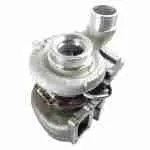
Mack Granite Turbocharger Guide: MP7 & MP8 Vocational Applications
This Mack Granite Turbocharger Guide covers the MP7 and MP8 engines that power most vocational Granite trucks, how their variable geometry turbos work, how they fail under dump, mixer, and refuse duty, and what you need to know before you order a replacement. The Granite is Mack’s workhorse construction and vocational platform, and the turbocharger on it earns its keep under high load, frequent idling, PTO use, and the heat that comes with all three.
Mack and Volvo share these powerplants. The Mack MP7 is the Volvo D11 and the Mack MP8 is the Volvo D13, so the turbos on a Granite carry Holset (Cummins Turbo Technologies) part numbers that also show up on Volvo VNL, VNR, and VHD trucks and on Mack Anthem and Pinnacle models. That matters when you cross-reference, because a tag number from a highway tractor can land on your vocational truck.
Which turbo fits the MP7 and MP8
The MP7 (Volvo D11), from the 2007 emissions engines on, uses a Holset HE431VE turbocharger with a sliding nozzle and an electronic actuator on most listings. Later emissions versions can carry a different Holset assembly, so check the number on the tag. That same HE431VE family also appears on the Cummins ISL and QSL 8.9L and later ISC 8.3L engines, which is why our Cummins ISL turbocharger guide is worth a read if you also run those.
The MP8 (Volvo D13) on-highway and vocational engines use a Holset variable geometry turbo that different sources name differently. Our supplier lists the Volvo and Mack number as an HE451VE turbocharger, while other sellers catalog the very same engine part as an HE400VG, and some list the earlier US07 MD13 as an HE431VE. Both the HE451VE and HE400VG names are correct for this engine. Do not pick a turbo by model name alone here. Go by the part number on the data plate.
| Engine | Volvo equivalent | Holset turbo | Geometry | Actuator |
|---|---|---|---|---|
| Mack MP7 | Volvo D11 | HE431VE | Variable, sliding nozzle | Electronic |
| Mack MP8 (highway/vocational) | Volvo D13 | Listed as HE451VE or HE400VG | Variable, sliding nozzle | Electronic |
| MP8 off-highway / marine variants | Volvo D13 industrial | HE500WG / HX55W (wastegated), HE500FG (fixed) | Fixed or wastegated | None (gate on wastegated versions) |
If your Granite is a straight on-highway vocational truck, you are dealing with the variable geometry Holset. The wastegated and fixed-geometry D13 turbos listed above belong to off-highway and marine builds, not to the standard vocational Granite. Match the tag, not the brochure.
How the Holset variable geometry turbo works
Unlike a Garrett variable nozzle turbo that pivots vanes on a unison ring, a Holset variable geometry unit moves a sliding nozzle ring. The ring slides to change the effective area at the turbine inlet, tightening it at low rpm for fast spool and drive pressure, and opening it up at high flow. If you want the general theory, the variable-geometry turbocharger overview covers it.
On the MP7 and MP8 the nozzle is positioned by an electronic actuator. This actuator is calibrated to its own turbo with the maker’s service tool after it is fitted. It is not a vacuum or air unit, there is no rod to set with a hand pump, and you never force the actuator arm by hand because the gear train inside is self-locking and breaks if you do.
The electronic actuator is also why these turbos carry coolant lines. That is normal for a Holset VGT with an electronic actuator and should not be mistaken for a problem.
Mack Granite Turbocharger Guide to vocational failures
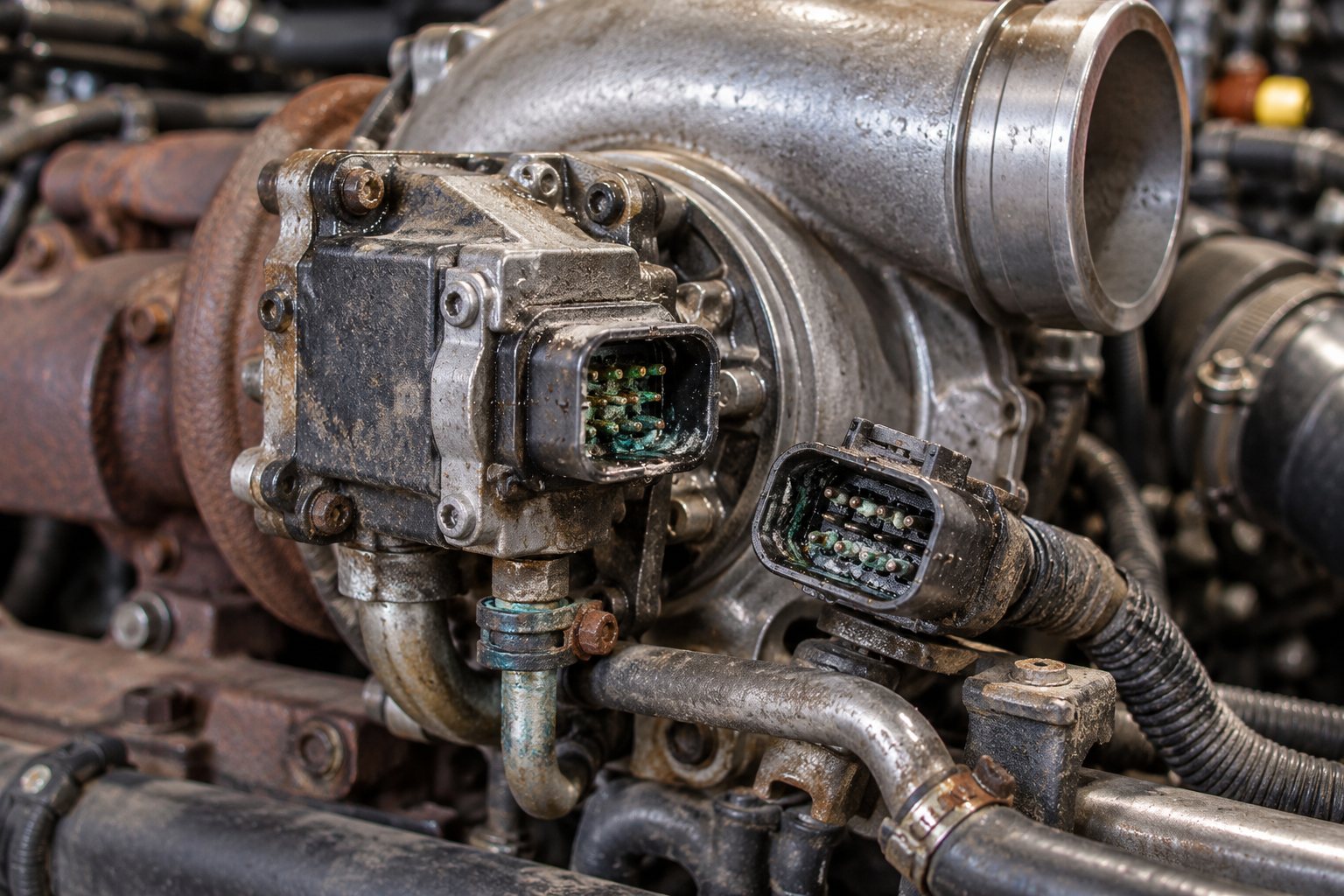
Vocational duty is harder on a turbo than linehaul. Granite trucks spend time at full fuel and low road speed, idle for long stretches on job sites, and cycle the throttle hard. That combination drives exhaust temperature up and keeps soot in play, and the nozzle mechanism is where you feel it first.
The most common failure we see on these Holset VGTs is a sticking or sluggish nozzle from soot and carbon buildup around the sliding ring. When the nozzle cannot move freely the engine reports a position or boost fault and can derate. A nozzle stuck toward closed gives overboost and high drive pressure, while a nozzle stuck toward open gives low boost and sluggish spool.
The electronic actuator is the second major failure point. Heat soak on a vocational chassis, connector corrosion, and internal gear wear all show up as position faults. Because the actuator is calibrated to the turbo, a used actuator off another unit is not a clean swap.
Bearing and seal failures trace back to the oil supply far more often than to anything else. Most turbo failures come down to oil: a restricted feed line, coked oil from hot shutdowns, extended drain intervals, or a blocked drain. Oil in the charge piping is not automatically a bad turbo seal, so check the breather, air filter, oil level, and the drain before you condemn the cartridge.
- Low boost, slow spool, black or gray smoke: nozzle stuck open, actuator not driving the ring, or an exhaust leak ahead of the turbine.
- Overboost and high drive pressure: nozzle stuck toward closed.
- Position or learning faults: failed actuator, wiring, or a mechanism that will not reach its stops.
- Blue-gray oil smoke: seal or bearing wear, but confirm crankcase ventilation and oil level first.
Fault codes and diagnosis on Mack and Volvo
Heavy trucks like the Granite report through SPN and FMI numbers and the engine maker’s codes, not the generic OBD-II P-codes you would read on a pickup. When you pull codes, you are working with the Mack or Volvo diagnostic set, so match the SPN and FMI to the turbo boost control and actuator circuits for that engine.
Heavy trucks report actuator faults as SPN / FMI codes, not the P codes used on pickups (on a Cummins 6.7L pickup, P003A means the actuator position exceeded its learning limit). On your Mack or Volvo tool, an actuator learning or position fault points to the same root cause, a nozzle that cannot complete its travel or an actuator that cannot find its stops.
Before you buy anything, rule out the cheap stuff. A leak in the up-pipes or exhaust manifold lets gas escape before the turbine and mimics a weak turbo with low boost, slow spool, and high exhaust temperature. That is an exhaust repair, not a turbo. Soot loading in the aftertreatment is a separate issue from the turbo itself, though both suffer under the same high-idle, high-soot vocational cycle that also challenges the diesel particulate filter.
Replacing and calibrating the turbo
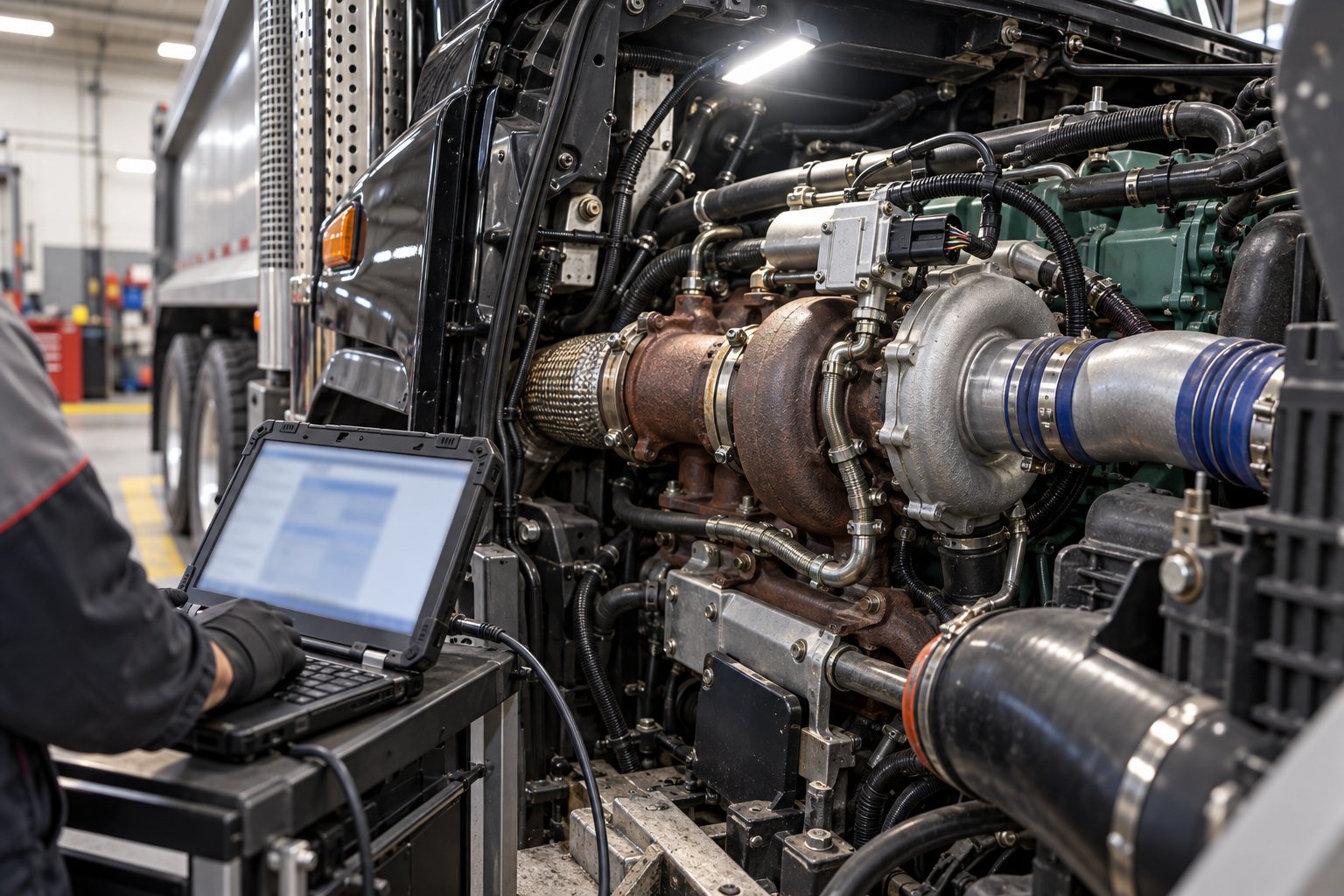
When the actuator is the failed part, follow the engine maker’s install routine with the service tool. The proven sequence on the Holset electronic actuators is to run the install routine with the new actuator plugged in but not yet bolted to the turbo, then mount it and calibrate to the turbo without cycling the key. Done out of order, the calibration will not take.
On a full turbo replacement, treat the oil system as part of the job. After a bearing failure or coked oil, replace the oil feed line rather than flush and reuse it, use new gaskets and clamps, and put no sealant on the oil inlet or drain. For first start, follow the maker’s steps: fill the oil inlet with clean engine oil, turn the wheel by hand, and crank or idle a few minutes before load. There is no break-in mileage schedule and no early oil change to chase.
Whenever a compressor wheel has shed metal, inspect the charge air cooler and piping. Debris in the cooler fins cannot be reliably flushed out and will feed straight into the engine, so the cooler gets replaced, not cleaned, even when it shows no visible damage.
New, remanufactured, or rebuild your core
PT Turbo has been rebuilding turbochargers since 1978, more than 45 years, and we stock both new and remanufactured turbochargers for these Holset units. For a vocational fleet the reman route is usually the fastest way to get a Granite back on the job without paying for a full new assembly.
If you have a good core, our in-house turbo rebuild service cleans the carbon off the nozzle, replaces bearings, seals, and thrust parts, and balances the cartridge. Most rebuilds ship in three days or less, and the rebuild price is confirmed after inspection and before any work starts. You can see what we charge by model on our turbo rebuild price list.
| Option | Best for | Core needed | Actuator calibration |
|---|---|---|---|
| New turbo | No usable core, longest service life | No | Required after fitting |
| Remanufactured | Fast turnaround, proven value | Core returned within 30 days | Required after fitting |
| Rebuild your core | Keeping your exact numbered unit | Yes, your own | Required after fitting |
Remanufactured units carry a 12-month, unlimited-mileage warranty with a 30-day core return. Fleet customers running multiple Granites can call for priority turnaround and have us stock their common cores. For current pricing on a specific part number, see the product page or call us at (909) 824-1020, and contact PT Turbo with the tag number if you are not sure which unit you have. You can also browse the full turbo catalog.
Turbos we list for the HE431VE, HE451VE and HE400VG
Listings for the turbo models named in this guide that can be ordered online today. Several part numbers can fit one engine by year and rating, so match the number on your turbo’s tag, or call (909) 824-1020 and we will match it for you.
All HE431VE listings · All HE451VE listings · All HE400VG listings
Frequently Asked Questions
How do I know if my Granite has an MP7 or MP8 turbo?
The MP7 is the Volvo D11 and the MP8 is the Volvo D13, and the surest way to tell them apart for parts is the number stamped on the turbo’s data plate on the compressor housing. The MP7 is usually listed with a Holset HE431VE, while the MP8 uses a Holset variable geometry unit listed as an HE451VE or an HE400VG depending on the seller. Read the tag and match the number.
Can I swap an actuator from another turbo onto my MP8?
No. The electronic actuator on these Holset variable geometry turbos is calibrated to its own turbo with the maker’s service tool, so a used actuator off another unit will not simply bolt on and work. Install the correct new actuator, run the maker’s install routine, and calibrate it to your turbo, and never move the actuator arm by hand because the internal gears break.
Why does my vocational Granite turbo fail faster than a highway truck’s?
Vocational duty keeps the engine at high fuel and low road speed, adds long idle periods on job sites, and cycles the throttle hard, all of which raise exhaust temperature and keep soot in play. That soot builds up around the sliding nozzle and stiffens its movement, which is the most common failure we see on these turbos. Staying on top of oil changes, hot shutdowns, and air filter condition is the best way to extend turbo life in that service.
Need a Turbocharger?
PT Turbo has rebuilt and sold turbochargers since 1978. We stock remanufactured units for Cummins, Duramax, Power Stroke, Detroit Diesel, and more — backed by a 12-month unlimited mileage warranty. Units in stock at our shop in San Bernardino, CA ship the same day when ordered before 2 PM Pacific, Monday through Friday.
📞 (909) 824-1020 · 346 S I St. #3, San Bernardino, CA 92410 · [email protected]
More From PT Turbo
- Cummins ISM Turbocharger Guide: HX55 & HE531V for On-Highway Trucks
 Ram 2500/3500 6.7L Cummins Turbocharger Guide: HE351VE vs HE300VG & Replacement Cost
- Ford 6.0L Powerstroke Turbocharger: Failure Symptoms, Replacement & Best Options
- Duramax LMM Turbocharger Guide: Variable Geometry Failure & Replacement