International DT466 Turbocharger Guide: School Bus & Medium Duty Applications
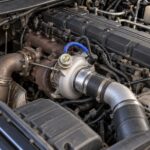
The International DT466 turbocharger is one of the most common failure points on a medium duty diesel that otherwise runs forever. If you wrench on school buses, dump trucks, or agricultural equipment, you already know the DT466 is a workhorse that racks up hundreds of thousands of miles between major repairs. But the turbo bolted to that engine, and the actuator that controls it, does not last forever. When boost drops off, smoke rolls out the stack, and your fleet manager starts asking questions, knowing exactly which turbo you have and how to fix it separates a two-hour job from a two-day headache.
PT Turbo has been rebuilding and supplying diesel turbochargers since 1978. Over 45 years in the business means we have seen every variant of the DT466 turbo, from the early Schwitzer units to the electronically controlled BorgWarner variable geometry units on the later engines. Here is what you actually need to know.
DT466 Engine Generations and Which Turbo You Have
The DT466 was built in one form or another from 1971 until the MaxxForce DT ended in 2015, and the turbo setup changed significantly across those decades. Identifying your generation is step one, because a turbo for a 1990 mechanical engine will not bolt onto a 2007 electronic one.
- DT466 (mechanical, to about 1995): Early inline pump engines ran simple fixed geometry Schwitzer or AiResearch (Garrett) units. Rugged, easy to rebuild, no electronics.
- DT466E (1994 to 2003): The “E” brought electronic HEUI fuel injection. These typically run BorgWarner and Garrett fixed-geometry turbos, some with a wastegate and some without, depending on the rating.
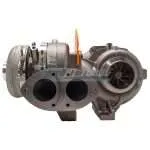
- DT466 (2004 to 2006): EGR engines use the EVRT, a BorgWarner S300V variable geometry turbo with an electronic actuator.
- MaxxForce DT (2007 and later): The 2007 to 2009 engines keep a single variable geometry turbo; from 2010 the engine uses two turbochargers in series.
Rated power on the DT466 typically falls between 175 and 300 horsepower depending on the year and application, with torque figures from 460 up past 860 lb-ft. That massive torque number is exactly why these engines are the backbone of school bus and vocational fleets.
Common DT466 Turbocharger Failure Symptoms
A DT466 turbo rarely fails all at once. It gives you warning signs. Catching them early can save the engine from oil contamination or a compressor wheel eating itself. Here is how the symptoms break down by severity.
| Severity | Symptom | Likely Cause |
|---|---|---|
| Early | Slight power loss, delayed throttle response | Sticking wastegate or actuator, minor boost leak |
| Early | Faint whistle or siren noise under load | Boot or clamp leak, early seal wear |
| Moderate | Blue or black smoke, rising oil consumption | Failing turbo oil seals, worn bearings |
| Moderate | Low boost codes, actuator not holding calibration | Failed pneumatic actuator or diaphragm |
| Severe | Grinding, shaft play, metal in the piping | Bearing failure, wheel contact with housing |
| Severe | No boost, hard start, heavy smoke | Complete turbo or actuator failure |
Before you condemn the turbo itself, always rule out the cheap stuff. Check your charge air cooler boots, clamps, and the intake for restriction. A clogged air filter or a cracked CAC boot mimics turbo failure and costs a fraction to fix.
The Boost Actuator: The DT466’s Weak Point
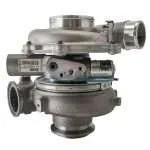
On wastegated DT466E engines, the pneumatic wastegate actuator is often the real culprit when you chase boost complaints. The actuator regulates wastegate position: a cracked diaphragm leaves the gate shut and the engine overboosts, while a gate that sticks open or a drifted rod setting leaves boost low. The turbo cartridge itself may be perfectly healthy while the truck runs down on power and throws boost pressure codes.
Replacing a failed actuator instead of the entire turbo is one of the smartest cost saves in the medium duty world. Swapping the actuator rather than the full charger can save you well over a thousand dollars if the turbine and compressor sides are still in good shape.
When you install a new actuator, verify the rod length and preload against factory spec. An improperly set actuator will either overboost, which can crack ring lands, or underboost, which leaves you down on power and smoking. If you are unsure of the calibration for your specific application, the team at PT Turbo can walk you through it. Contact PT Turbo with your engine serial and vehicle year.
New vs Remanufactured DT466 Turbochargers
When the cartridge is done, you face the classic decision: brand new, or remanufactured. For fleet operators watching a budget, a quality reman is almost always the better value, provided it is rebuilt to spec with new bearings, seals, and a balanced center section.
| Factor | New OEM Turbo | Remanufactured Turbo |
|---|---|---|
| Typical cost | $610 to $1,475 (6 listings) at PT Turbo | $1,448 to $2,353 (7 listings) at PT Turbo |
| Core charge | None | Refundable core deposit |
| Lead time | Varies, sometimes backordered | Often in stock and ready |
| Wear parts | All new | New bearings, seals, thrust components |
| Warranty | Manufacturer | Supplier backed |
Price ranges in this article are general estimates to help with budgeting, not PT Turbo quotes. Our current prices are on each product listing, and our rebuild prices are on the turbo rebuild price list.
PT Turbo stocks both new and remanufactured turbochargers for the DT466 and its medium duty siblings. Every reman unit is built in-house, balanced, and tested. If you have a good core and want it rebuilt to original specification, our turbocharger rebuild service turns your existing unit around fast, which matters when a bus is down and route coverage is on the line. You can also browse all turbos to match your part number directly.
DT466 Turbo Replacement Tips From the Bench
The DT466 is a friendly engine to work on compared to many modern diesels, but a few details will save you a comeback.
- Prime the oil feed. Before starting, prime the turbo center section with clean oil through the feed port. Dry starts kill new bearings in seconds.
- Replace the oil feed line. A partially clogged or coked feed line is the single most common cause of repeat turbo failure. If your old turbo failed on bearings, the line is suspect.
- Inspect the drain. A restricted oil drain builds crankcase pressure back into the turbo and blows seals. Make sure it is clear and not kinked.
- Torque the V-band and mounting hardware to spec. Uneven load warps housings and creates exhaust leaks that mimic boost problems.
- Clean the charge air system. If the old turbo shed metal, blow out the CAC and piping completely. Debris on restart destroys a new compressor wheel.
After the swap, do a careful first start. Idle for a few minutes to confirm oil pressure and check for leaks before you drive it. Verify boost against factory targets to confirm the actuator is doing its job.
Related Medium Duty and Bus Turbo Guides
The DT466 shares the medium duty and school bus space with several Cummins platforms, and many fleets run mixed equipment. If you also service Cummins-powered units, these guides are worth a read:
- Cummins ISC Turbocharger Guide: HX40 and Replacement Options for Medium Duty Trucks
- Cummins ISL Turbocharger Guide: HX40W, HE431V & HE400VG by Engine Version
- Cummins ISB 5.9L Turbocharger Guide: HX35 vs HE351CW
- Cummins QSB Turbocharger Guide: Marine, Industrial and Construction Applications
Turbos we list for the HX40W, HE431V and HE400VG
Listings for the turbo models named in this guide that can be ordered online today. Several part numbers can fit one engine by year and rating, so match the number on your turbo’s tag, or call (909) 824-1020 and we will match it for you.
All HX40W listings · All HE431V listings · All HE400VG listings
Frequently Asked Questions
What are the common signs of a failing DT466 turbocharger?
Common symptoms include loss of power, excessive black or blue smoke, whining or grinding noises, and boost pressure fault codes. Poor fuel economy and sluggish acceleration are also frequent indicators.
Why does the DT466 turbo actuator fail so often?
The actuator is exposed to constant heat cycling and soot buildup, which causes the internal mechanism to bind and lose calibration over time. Regular maintenance and monitoring boost pressure can help catch issues early.
How long does a DT466 turbocharger typically last?
A DT466 turbo generally lasts between 150,000 and 250,000 miles depending on maintenance and application. The actuator often wears out before the turbo itself, especially in stop-and-go school bus service.
Further reading: Learn more about turbocharger technology.
Need a Turbocharger?
PT Turbo has rebuilt and sold turbochargers since 1978. We stock remanufactured units for Cummins, Duramax, Power Stroke, Detroit Diesel, and more — backed by a 12-month unlimited mileage warranty. Units in stock at our shop in San Bernardino, CA ship the same day when ordered before 2 PM Pacific, Monday through Friday.
📞 (909) 824-1020 · 346 S I St. #3, San Bernardino, CA 92410 · [email protected]