If you run a medium duty Cummins ISC, the turbocharger bolted to that 8.3L block is most often a Holset HX40. It is one of the most proven fixed-geometry turbos ever built, but even a workhorse like the HX40 eventually loses a thrust bearing, cracks a turbine housing, or starts shaft-walking after 400,000 miles of duty cycles. This guide covers the Cummins ISC turbocharger inside and out: HX40 specs, failure symptoms by severity, replacement options, and exactly which gaskets and install kits you need to do the job right the first time.
PT Turbo has been rebuilding and supplying Holset turbos since 1978, more than 45 years of hands-on experience with the HX and HE families. We stock both new and remanufactured units, plus the install hardware most parts counters forget to order. Here is what you actually need to know.
The Cummins ISC 8.3L and the HX40 Turbocharger
The Cummins ISC is the electronic 8.3-liter inline-six that powered a huge swath of medium duty trucks, RVs, fire apparatus, and vocational chassis from the late 1990s through the 2000s. You will find it in Freightliner M2, International, Kenworth T300, and countless motorhome chassis. Depending on the rating, the ISC made between 240 and 380 horsepower and up to 1,050 lb-ft of torque.
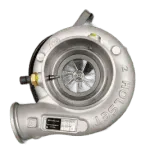
Most of these engines breathe through a Holset HX40 series turbocharger; later ISC engines were revised with a variable geometry Holset, so read the tag. The HX40 is a fixed-geometry turbo with a single-stage compressor, and the HX40W version adds a wastegate. Unlike the variable-geometry HE351VE and HE300VG units found on modern 6.7L Cummins pickups, the HX40 has no electronic actuator or sliding nozzle ring to fail. That simplicity is exactly why it lasts so long and why it remains one of the easiest big turbos to rebuild.
HX40 Core Specifications
| Specification | HX40 / HX40W |
|---|---|
| Type | Fixed geometry (wastegate on the HX40W) |
| Compressor wheel inducer | ~60 mm |
| Compressor wheel exducer | ~83 to 86 mm |
| Turbine wheel | ~67 mm / ~76 mm depending on housing |
| Turbine housing A/R | Commonly 0.90 (varies by application) |
| Bearing system | Journal bearing, oil cooled |
| Supported airflow | Roughly 450 to 600+ HP capable in performance trim |
| Wastegate | HX40W only: internal, actuator controlled |
| Engine application | Cummins ISC 8.3L, 6CT, some ISL |
| Compatible part numbers | HX40, HX40W, various Holset OEM numbers |
The “W” in HX40W means the turbo has a wastegate. An HX40 without the W has none, so the two are different parts: always match the model, the turbine housing A/R and the wastegate setup to the turbo that came off.
HX40 Failure Symptoms by Severity
A failing HX40 rarely dies all at once. It usually telegraphs trouble for weeks before it strands a truck. Catching it early can mean a simple rebuild instead of a destroyed compressor wheel and a downstream intercooler full of oil. Here is how the symptoms typically progress.
| Severity | Symptoms | Likely Cause |
|---|---|---|
| Early | Slight whistle or whine that changes pitch, minor oil film at compressor outlet | Seal wear, early bearing wear, loose clamp or boot |
| Moderate | Visible blue smoke under load, oil in charge piping, sluggish boost, higher EGT | Worn journal bearings, shaft play, restricted oil drain |
| Severe | Loud grinding or siren noise, no boost, fault codes, metal in intake | Bearing failure, shaft contact with housing, wheel damage |
| Catastrophic | Sudden power loss, smoke screen, debris in intercooler and intake | Compressor or turbine wheel separation, total shaft failure |
The single most important diagnostic step is a shaft play check. With the inlet pipe off, grab the compressor nut and check axial (in and out) and radial (side to side) movement. Any contact between the wheel tips and the housing, or excessive end play, means the bearings are gone. If you find aluminum dust in the compressor housing, the wheel has been kissing the housing and the unit needs rebuilding now, not next month.
Do not overlook the oil supply. The number one killer of any Holset journal bearing turbo is oil starvation or coked oil from extended drain intervals. Before you condemn a turbo, confirm the oil feed line is clear and the drain line is not kinked or sludged. We see plenty of HX40s that failed because of a $20 restricted feed line, not because the turbo was bad.
Replacement Options: New, Remanufactured, or Rebuild
When an HX40 is done, you have three realistic paths. The right one depends on your budget, your downtime tolerance, and how badly the core is damaged.
1. New Holset HX40
A brand new genuine Holset unit gives you OEM tolerances and full service life. It is the most expensive option, but for a fleet truck that needs to run another 400,000 miles, it can be worth it. Expect the highest cost and occasionally longer lead times on specific part numbers.
2. Remanufactured HX40
For most owner-operators and fleets, a quality reman is the sweet spot. A properly remanufactured turbo is fully disassembled, the housings are cleaned and inspected, the center cartridge gets new bearings, seals, thrust components, and a balanced shaft and wheel assembly. A good reman performs identically to new at a meaningful discount. Browse our remanufactured turbochargers here, all built to OEM spec and VSR balanced.
3. Rebuild Your Existing Core
If your housings are good and you want to keep your original numbers-matching unit, our turbocharger rebuild service restores the HX40 to factory tolerances. This is often the best value when the turbine and compressor housings are intact and only the cartridge is worn.
| Option | Relative Cost | Lead Time | Best For |
|---|---|---|---|
| New Holset | Highest | Varies | High-mileage fleet units, maximum life |
| Remanufactured | Moderate | Usually in stock | Best balance of cost and reliability |
| Rebuild your core | Lowest | Turnaround based | Good housings, want to keep original unit |
Whichever path you choose, you can see availability across our full turbocharger catalog or reach out directly. With 45+ years in the turbo business, PT Turbo can match your exact ISC part number and confirm housing A/R before anything ships.
Install Kits and Gaskets You Need for the Job
Here is where a lot of HX40 swaps go wrong. Techs bolt on a new turbo using the old, hardened gaskets and a reused oil feed line, then chase a boost leak or an oil leak for two days. Replace the seals and hardware while you are in there. The parts are cheap insurance.
Installation kits are listed by turbo model. Send us the number on your HX40 and we will match the gasket and hardware kit for it, including the oil feed and drain seals that cause most post-install oil leaks.
Install Best Practices
- Prime the new turbo with clean engine oil through the feed port before first start.
- Crank the engine with the fuel shut off until oil pressure builds, then start it.
- Replace or thoroughly clean the oil feed line. A new line is the cheapest part on the truck.
- Verify the oil drain is clear and unkinked. Restricted drains blow seals fast.
- Idle for 3 to 5 minutes after start to seat bearings before loading the engine.
- Always use new flange gaskets and torque to spec. Reused gaskets are a guaranteed boost leak.
Run the engine through a few heat cycles and recheck every clamp and flange once things have come up to temperature and cooled back down. Metal moves, and a connection that felt tight cold will often take another quarter turn after the first real duty cycle.
Get the oil supply and the gaskets right and an HX40 will give you another long service life with zero drama. Nearly every premature failure we see on these turbos traces back to a shortcut on install, not a bad unit. Spend the extra hour and the cheap hardware, and you will not be back under that truck chasing a leak next week.
Frequently Asked Questions
What turbocharger comes on a Cummins ISC 8.3L engine?
The medium duty Cummins ISC usually has a Holset HX40 or HX40W fixed-geometry turbocharger; later engines were revised with a variable geometry Holset. The HX40 is one of the most proven and reliable turbos ever built for the 8.3L platform.
What are common signs of HX40 turbocharger failure?
Typical failures include a worn thrust bearing, cracked turbine housing, and shaft-walking. These often appear after around 400,000 miles of heavy duty cycles.
Can you replace a Holset HX40 with an aftermarket turbo?
Yes, several direct-fit replacement and upgraded options exist for the Cummins ISC. Choosing the right one depends on your duty cycle, power goals, and budget.
Further reading: Learn more about turbocharger technology.
Shopping by part number?
Every part number we stock for the Holset HX40 is on one page, with live prices and stock: Holset HX40 turbos and parts.
Need a Turbocharger?
PT Turbo has rebuilt and sold turbochargers since 1978. We stock remanufactured units for Cummins, Duramax, Power Stroke, Detroit Diesel, and more — backed by a 12-month unlimited mileage warranty and same-week shipping from San Bernardino, CA.
📞 (909) 824-1020 · 346 S I St. #3, San Bernardino, CA 92410 · [email protected]
More From PT Turbo
- Freightliner Cascadia Turbocharger Guide: DD13, DD15 & DD16 Applications by Year
 Ford 6.4L Powerstroke High-Pressure vs Low-Pressure Turbo: What Is the Difference?
- Cummins ISX Turbocharger Guide: HE400VG, HE451VE & HE561VE Differences Explained
- Cummins ISB 5.9L Turbocharger Guide: HX35 vs HE351CW for Dodge Ram Applications