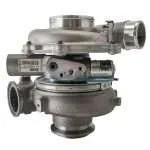
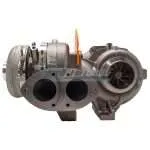
If you wrench on OBS and Super Duty Fords, you already know the 7.3L Powerstroke turbocharger is one of the most reliable factory units ever bolted to a light-duty diesel. But “reliable” doesn’t mean “all the same.” Between 1994 and 2003, Ford ran three distinct Garrett pedestal-mount turbos on the 7.3L: the TP38, the early-1999 E99 GTP38, and the late-1999-and-up GTP38. Bolt the wrong one to the wrong engine and you’ll fight boost lag, EBPV problems, and pedestal oil leaks all day. Here’s how to tell them apart and spec the right unit the first time.
The Three 7.3L Powerstroke Turbos at a Glance
All three share the same basic Garrett architecture: a single, fixed-geometry, oil-cooled center section mounted to a cast pedestal in the engine valley, fed by twin up-pipes. Where they differ is turbine housing sizing (the TP38’s 1.15 A/R against 0.84 on both GTP38s), wastegate setup, and the compressor outlet, pedestal and plenum connections. That’s what changes spool-up, drive pressure, and how the truck behaves towing heavy.
| Spec | TP38 | E99 GTP38 | GTP38 (Late 99-03) |
|---|---|---|---|
| Model Years | 1994.5-1997 (OBS) | Early 1999 | Late 1999-2003 |
| Wastegate | None | Yes (internal) | Yes (internal) |
| Turbine A/R | 1.15 | 0.84 | 0.84 |
| Compressor Inducer | ~60mm | ~60mm | ~60mm |
| Intercooled | No (air-to-air added later) | Yes | Yes |
| EBPV / Exhaust Backpressure | Yes | Yes | Yes |
| Typical Peak Boost (stock) | ~18-20 psi | ~18-22 psi | ~18-24 psi |
TP38: The OBS Workhorse (1994.5-1997)
The TP38 came on the 7.3L Powerstroke in the “Old Body Style” trucks. It’s a non-wastegated, fixed-geometry unit with a larger 1.15 A/R turbine housing. Because there’s no wastegate to dump drive pressure, the TP38 builds boost predictably but doesn’t spool quite as quick down low as the later GTP38. These trucks were not factory intercooled, so EGTs climb faster under load, something to watch if you’re towing or tuned.
The most common TP38 complaints we see at PT Turbo aren’t the turbo itself, they’re the support hardware: worn pedestal o-rings causing oil weeping into the valley, leaking exhaust up-pipes (the dreaded donut gaskets), and a sticking exhaust backpressure valve. When you pull a TP38 for a rebuild or swap, replace every seal in the system. A fresh turbo bolted to crusty up-pipe gaskets is money wasted.
Order the gaskets and seals by the turbo and the truck’s build date: send us both and we will match the installation kit.
E99 GTP38: The Odd One Out (Early 1999)
When the Super Duty arrived for 1999, Ford introduced the GTP38, but early-build 1999 trucks (commonly called “E99”) got a transitional version that catches a lot of techs off guard. The E99 GTP38 is wastegated and has the same 0.84 A/R turbine housing as the later unit, but its compressor outlet is smaller and its pedestal and intake plenum connections differ from later trucks.
Here’s the critical part: you cannot freely interchange an E99 turbo with a late-99 GTP38 without addressing the pedestal and plenum differences. The early trucks use a different pedestal and intake plenums, so a late turbo will not simply bolt in. Always verify your build date off the door sticker before ordering. If you’re not sure which camp your 1999 truck falls into, the team at PT Turbo can cross-reference your VIN and build date, reach out here before you buy.
The E99 and the late-99 unit differ mainly on the compressor and intake side (compressor housing and plenum inlets). Owners sometimes convert to the late-99 setup, but that’s a parts-matching job, not a straight bolt-on.
GTP38: The Wastegated Late Model (Late 1999-2003)
Late-1999 through 2003 trucks got the refined GTP38 with an internal wastegate and the same 0.84 A/R turbine housing as the early-1999 unit. The 1.0 A/R housings sold for these trucks are an upgrade, not the factory part. The wastegate bleeds off excess drive pressure up top, giving a better balance of throttle response and EGT control. This is the most common 7.3L turbo on the road and the one most reman cores are built from.
The wastegate is also the part that fails most on these. The actuator diaphragm cracks, the linkage gums up, or the canister loses its reference signal, and suddenly you’ve got overboost spikes or boost that won’t build. Before condemning the whole turbo, check the wastegate actuator and the line to it. Many “bad turbo” calls on a late GTP38 are actually an actuator problem.
When the center section is genuinely worn, shaft play, oil in the exhaust, or a scored compressor wheel, it’s time for a rebuild or a quality reman. PT Turbo has been rebuilding turbochargers for over 45 years, and our turbocharger rebuild service restores your original core to spec with new bearings, seals, and a balanced CHRA. If you need a unit on the shelf ready to go, browse our remanufactured turbochargers.
Common 7.3L Turbo Failure Symptoms and What They Mean
The 7.3L Powerstroke turbo is tough, but nothing lasts forever behind 200,000-plus miles of towing. Here’s how symptoms typically progress so you can catch a failing unit before it grenades the engine.
| Severity | Symptom | Likely Cause |
|---|---|---|
| Early | Slight oil weep in valley, minor smoke on startup | Pedestal o-rings, worn seals |
| Early | Boost slow to build, lazy throttle | Wastegate actuator (GTP38), EBPV sticking, intake leak |
| Moderate | Whistle or siren noise that changes with RPM | Air leak or early bearing wear |
| Moderate | Blue/gray smoke under load, oil in intake tract | Failed turbo seals, excessive shaft play |
| Severe | Metallic grinding, sudden boost loss, visible wheel damage | Bearing failure, wheel contact |
| Severe | Overboost spikes, codes | Stuck wastegate, failed actuator |
If you’re cross-shopping turbos across the Powerstroke lineup, our deeper dives on the later engines are worth a read, including the 6.0L Powerstroke turbocharger guide, the 8 warning signs of 6.0L turbo failure, and the 6.4L Powerstroke twin turbo guide.
The takeaway with any of these three is that most “turbo” problems on a 7.3L start small and cheap. A weeping pedestal o-ring or a sticky EBPV ignored long enough turns into oil in the intake, then bearing wear, then a scored wheel. Catch the early symptoms and you’re into a seal kit and an afternoon. Let the severe column sneak up on you and you’re pulling the whole unit, or worse, chasing debris through the intake tract.
Match the turbo to your exact build year, verify the pedestal and wastegate setup before you order, and treat the up-pipes and backpressure valve as part of the job every time. Do that and the 7.3L turbo will keep earning its reputation for another couple hundred thousand miles.
Frequently Asked Questions
What’s the difference between the TP38 and GTP38 turbos?
The TP38 is the earlier non-wastegated turbo used on 1994-1997 7.3L Powerstrokes, while the GTP38 of the 1999-2003 trucks added a wastegate for better drivability and emissions.
What is the E99 GTP38 turbo?
The E99 GTP38 is the early-1999 version of the GTP38 turbo, with a smaller compressor outlet and different pedestal and plenum connections than the late-1999 and newer units.
Are 7.3L Powerstroke turbochargers interchangeable?
All three share the Garrett pedestal-mount design, but housing, wastegate and connection differences mean they aren’t always direct swaps without considering performance and fitment changes.
Further reading: Learn more about turbocharger technology.
Need a Turbocharger?
PT Turbo has rebuilt and sold turbochargers since 1978. We stock remanufactured units for Cummins, Duramax, Power Stroke, Detroit Diesel, and more — backed by a 12-month unlimited mileage warranty and same-week shipping from San Bernardino, CA.
📞 (909) 824-1020 · 346 S I St. #3, San Bernardino, CA 92410 · [email protected]