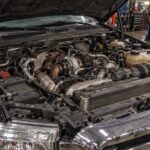
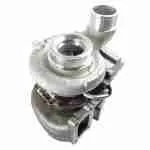
An International ProStar with the MaxxForce 13 carries two turbochargers, not one: a large low-pressure BorgWarner turbo and a small high-pressure BorgWarner turbo working in series. Neither is a variable geometry turbo. Boost is controlled by a wastegate on the high-pressure unit, moved by truck air. When a ProStar loses boost or goes into derate, the cause is more often in the wastegate circuit, the plumbing between the turbos or the EGR system than in the turbos themselves.
This guide explains what is on the truck, how failures show up, what to check first, and the rebuild and replacement options.
What Is on a MaxxForce 13 ProStar
The MaxxForce 13 is a 12.4L inline-six based on the MAN D26. Navistar ran it through EPA 2010 on heavy EGR alone, using emissions credits, and later switched to SCR, so the engine moves a lot of exhaust back through the intake and leans hard on its air system.
- Low-pressure turbo: the large one. It takes in outside air and does most of the work at high load.
- High-pressure turbo: the small one. It responds quickly at low engine speed and carries the wastegate.
- Wastegate control: an air actuator fed with truck air through an air control valve that the engine computer switches.
- Coolers: an interstage cooler between the two compressors and a charge air cooler after the second.
The two turbos are different parts and do not interchange, and the high-pressure part number varies by engine. Read the tag on each turbo before ordering anything. Our MaxxForce 13 turbocharger guide covers the system in more detail.
Common Failure Symptoms
| Stage | Symptom | Likely cause |
|---|---|---|
| Early | Slow response, slight power loss under load | Wastegate not sealing, small charge air leak |
| Moderate | Low boost codes, intermittent derate | Wastegate stuck open, air control valve fault, leak between the stages |
| Serious | Persistent derate, black smoke | Large boost leak, EGR fault, worn turbo |
| Critical | Oil in the charge pipes, whine or grinding, shaft play | Bearing failure, failed seals, wheel contact |
Oil pooling in the charge piping together with noise means a turbo’s bearings are worn and it should come off before a wheel touches its housing and sends debris into the second turbo and the engine.
Check the Wastegate Circuit Before the Turbos
- Air control valve: confirm it switches when commanded and does not pass air when it is off.
- Air line and actuator: check for leaks and confirm the actuator rod moves.
- The gate itself: it should move freely and close fully. A gate stuck open keeps boost low even with two good turbos.
- Charge air system: pressure test the pipes, the interstage cooler and the charge air cooler.
- EGR cooler, EGR valve and DPF: faults here change exhaust pressure and look like turbo trouble.
Only when these pass, and a shaft has play or a wheel shows damage, is the turbo itself the fault.
Rebuild and Replacement Options
| Option | Price at PT Turbo | Best for |
|---|---|---|
| Rebuild of both turbos | $1,350 for both (price list) | Sound housings and wheels with worn bearings and seals |
| Replacement turbo | Quoted by part number | A cracked housing or a wheel that has broken up |
Rebuilding the pair together is usually the sound choice: both turbos have run the same hours on the same oil. Our turbocharger rebuild service inspects the cores and confirms the price before any work starts, VSR balances every rebuild and backs it with a 12-month unlimited-mileage warranty. Turnaround is 3 to 5 business days after inspection. For a replacement unit, contact PT Turbo with the numbers from both turbo tags.
What Improves Reliability
The two-stage system is matched to the engine’s airflow and emissions calibration, so there is little to gain from a larger turbo. What helps is removing the causes of failure:
- EGR system: repair a leaking or plugged EGR cooler and a sticking valve. See EGR cooler failure and turbocharger damage.
- Oil supply: keep to the oil change interval and make sure the feed and drain lines of both turbos are clear.
- Crankcase breather: a plugged breather pushes oil past the turbo seals.
- Coolers and pipes: pressure test them whenever a turbo is off.
Installation Tips
- Prime each turbo with clean oil before the first start, and let the engine idle until oil pressure is steady.
- Use new gaskets and seals. PT Turbo lists MaxxForce 11 and 13 installation kits 172-784-0018 and 172-784-0019.
- Clean the charge pipes and coolers if the old turbo passed oil or metal.
- Confirm the wastegate moves and the air control valve works before the truck goes back on the road.
- Road test under load and confirm boost reaches its target.
Related: our International DT466 turbocharger guide for the medium-duty engines.
Frequently Asked Questions
What turbocharger does the International ProStar MaxxForce 13 use?
Two BorgWarner turbochargers in series: a large low-pressure turbo and a small high-pressure turbo with a wastegate. Neither is a variable geometry turbo.
Why does the MaxxForce 13 turbo system fail so often?
The engine uses heavy EGR, which runs the turbos hot and dirty, and the two-stage layout adds a wastegate circuit, an interstage cooler and extra joints that can leak or stick.
What are the symptoms of a failing MaxxForce 13 turbo?
Low boost, derate messages, loss of power, black or blue smoke, oil in the charge pipes, and a whine or grinding noise. Check the wastegate circuit and for charge air leaks before condemning the turbos.
Should I rebuild or replace MaxxForce 13 turbos?
Rebuild when the housings and wheels are sound; PT Turbo rebuilds the pair together. Replace a turbo whose housing is cracked or whose wheel has broken up.
Further reading: Learn more about Navistar International.
Need a Turbocharger?
PT Turbo has rebuilt and sold turbochargers since 1978. We stock remanufactured units for Cummins, Duramax, Power Stroke, Detroit Diesel, and more — backed by a 12-month unlimited mileage warranty and same-week shipping from San Bernardino, CA.
📞 (909) 824-1020 · 346 S I St. #3, San Bernardino, CA 92410 · [email protected]
More From PT Turbo
 Ford 6.7L Powerstroke Turbocharger: Problems, Symptoms and Replacement Guide
- Mack Anthem Turbocharger Guide: MP8 Applications & Replacement Cost
- Cummins ISB 5.9L Turbocharger Guide: HX35 vs HE351CW for Dodge Ram Applications
- Detroit DD16 Turbocharger Guide: Turbo-Compound System, Failure Symptoms & How It Differs from the Mack MP10