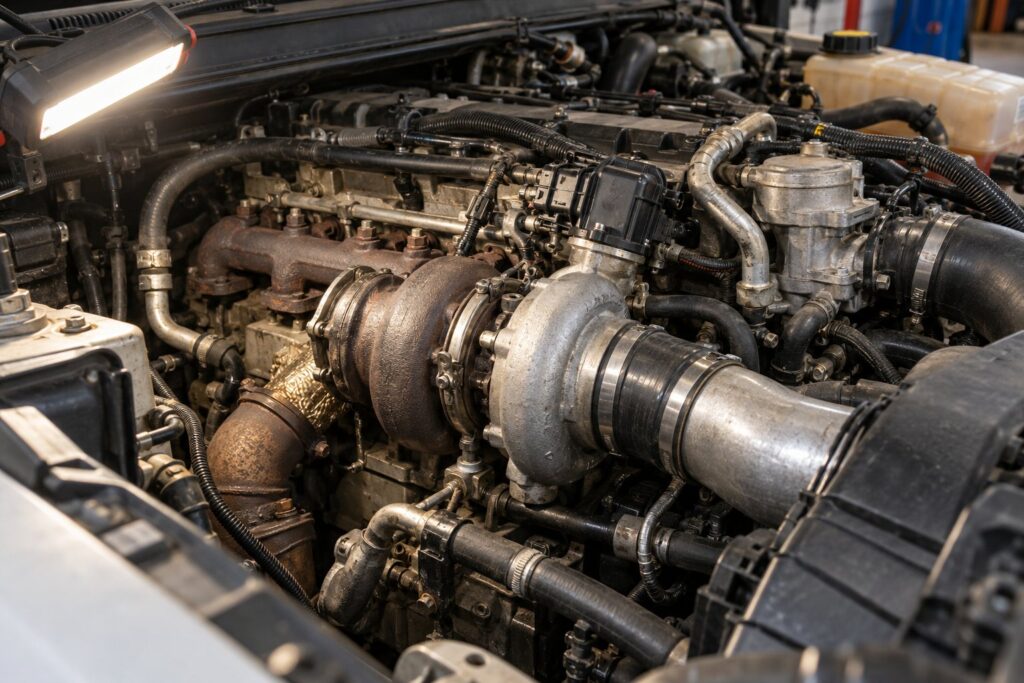
Understanding the relationship between EGR System and Turbocharger Health is one of the most overlooked skills in diesel maintenance, yet it separates mechanics who fix symptoms from those who fix root causes. When an exhaust gas recirculation system goes bad, it rarely fails alone. It takes the turbocharger down with it, often slowly, often expensively, and usually in ways that get misdiagnosed as a simple turbo failure.
At PT Turbo, we have spent more than 45 years rebuilding turbochargers and watching the same failure patterns repeat across every major diesel platform. A huge percentage of the “bad turbos” that land on our bench were killed by soot, heat, and carbon fed directly from a neglected EGR system. This guide breaks down exactly how these two systems interact, what to inspect, and how to stop a cheap EGR problem from becoming a four-figure turbo replacement.
How the EGR System Affects Turbocharger Health
The exhaust gas recirculation system routes a portion of spent exhaust gas back into the intake to lower combustion temperatures and reduce NOx emissions. That recirculated gas is hot, dirty, and loaded with soot. On modern diesels, this exhaust travels the same plumbing that feeds and exits your turbocharger.
When the EGR valve or cooler works correctly, the system stays balanced. When it fails, you get one of two problems: too much recirculated gas or restricted exhaust flow. Both hammer the turbo.
- Carbon loading: Soot-heavy EGR flow coats the compressor and turbine side, building deposits that throw off balance and choke flow.
- Excessive backpressure: A clogged EGR cooler or sticking valve raises exhaust backpressure, overspeeding the turbine and stressing the bearings.
- Heat soak: A failed EGR cooler dumps uncooled exhaust into the system, spiking temperatures past what the turbo’s seals and bearings were designed to handle.
- VGT contamination: On variable geometry turbos, EGR soot packs the vane mechanism solid, which is the number one cause of sticking vanes.
On a variable-geometry turbocharger, this contamination is especially brutal. The moving vanes rely on tight tolerances, and EGR soot turns that precision assembly into a seized chunk of carbon.
Warning Signs of EGR-Related Turbo Failure
Diagnosing an EGR-driven turbo problem means catching it before the turbo grenades. The symptoms overlap heavily with a failing turbo, which is exactly why so many mechanics replace the turbo, skip the EGR, and watch the new unit fail within months.
Here is how the warning signs typically progress by severity.
| Severity | Symptoms | Likely Cause |
|---|---|---|
| Early | Slight power loss, minor smoke, occasional hesitation | Carbon buildup starting on intake and vanes |
| Moderate | Noticeable turbo lag, surging boost, EGR fault codes, higher EGTs | Sticking EGR valve, partial cooler clog, early vane binding |
| Severe | Limp mode, overboost/underboost codes, heavy smoke, whistling or grinding | Stuck VGT vanes, actuator failure, bearing damage |
| Critical | Complete power loss, oil in intake, shaft play, no boost | Turbo bearing or seal failure, often secondary to EGR neglect |
If you are seeing overboost and underboost codes together on the same vehicle, that is a classic signature of a carbon-bound VGT mechanism or a failing actuator fighting against soot resistance.
The Actuator Connection: Where EGR Soot Does Its Damage
The turbo actuator is the component that gets the least attention and takes some of the worst abuse from EGR-related issues. On VGT and wastegate turbos, the actuator controls vane position or boost pressure. When carbon builds up in the mechanism it is commanding, the actuator works harder, overheats, and eventually fails.
A worn or failed pneumatic actuator produces inconsistent boost, delayed response, and the dreaded intermittent limp mode. Before you condemn an entire turbocharger, verify the actuator. We stock a wide range of OEM-grade replacements for the most common platforms.
- For many Garrett applications, the Garrett Pneumatic Actuator 757979-5102 is available from PT Turbo for $240.94. View the Garrett Pneumatic Actuator 757979-5102 here.
- For TD03-equipped engines, the Mitsubishi Turbocharger Pneumatic Actuator TD03 49S3118761 runs $104.33. View the Mitsubishi TD03 actuator here.
- Another common Mitsubishi unit, the Mitsubishi Pneumatic Actuator 4918918935, is one of the most affordable fixes at $83.99. View the Mitsubishi Pneumatic Actuator 4918918935 here.
- For heavier-duty Garrett setups, the Garrett Pneumatic Actuator 445963-0040 is priced at $465.52. View the Garrett Pneumatic Actuator 445963-0040 here.
Replacing a failing actuator for under a few hundred dollars is a smart play before committing to a full turbo swap. If you are unsure which actuator matches your turbo, the team at PT Turbo can cross-reference your part number. Reach out through our contact page.
Protecting EGR System and Turbocharger Health During Service
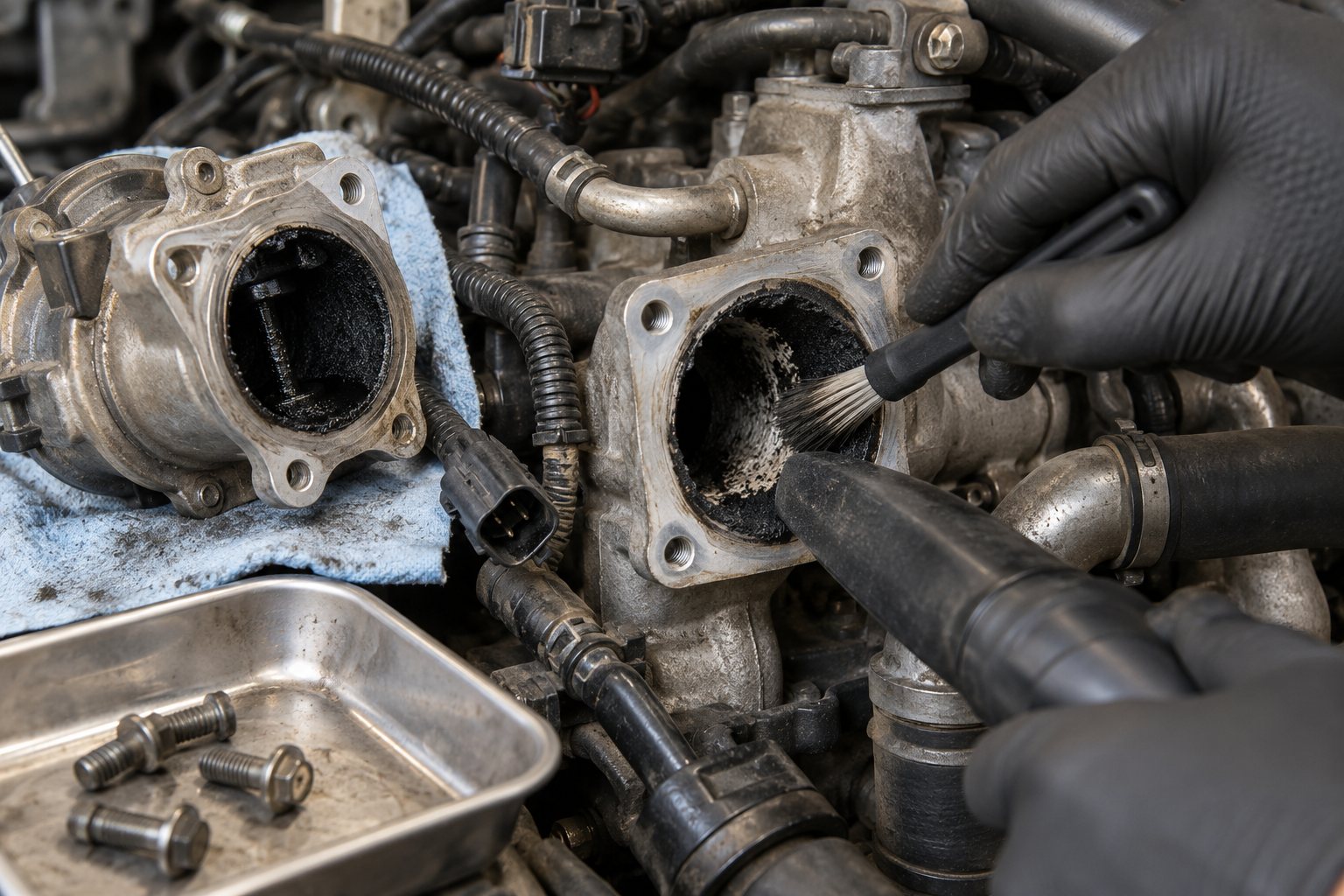
Keeping these systems healthy is mostly about discipline. The EGR and turbo share the same contamination problems, so service them as a pair, not as separate jobs.
Clean the carbon before it becomes a failure
Carbon is the common enemy. Intake soot deposits restrict airflow, foul sensors, and feed the exact buildup that seizes VGT vanes. Routine decarbonizing of the intake tract and EGR passages extends turbo life dramatically. Our full walkthrough on how to clean turbocharger carbon deposits from the intake system covers the process step by step.
Inspect the EGR cooler and valve
Check the EGR cooler for internal coolant leaks and clogging. A failed cooler lets exhaust temperatures climb, and sustained high EGTs are a direct threat to turbo bearing and seal life. Verify the EGR valve moves freely and seats fully. A valve stuck partially open floods the intake with soot continuously.
Flush the oil system after any turbo failure
If a turbo has already failed, contaminated oil will kill its replacement fast. Debris and coked oil circulate through the system and starve the new bearing. Never install a turbo into a dirty oil system. Follow our guide on how to flush the turbo oil system after a turbocharger failure before fitting any new or reman unit.
New vs Remanufactured: Choosing the Right Replacement
When EGR-related damage has gone too far and the turbo needs to be replaced, you have two solid paths. PT Turbo has stocked both new and remanufactured turbochargers for over 45 years, and the right choice depends on your budget, availability, and how long the unit needs to last.
| Factor | New Turbocharger | Remanufactured Turbocharger |
|---|---|---|
| Cost | Highest | Typically 30 to 50 percent less |
| Availability | Varies by platform | Strong for common diesel applications |
| Quality | OEM spec, zero hours | Rebuilt to OEM spec with new wear parts |
| Best for | Latest platforms, long service goals | Cost-conscious fleets and older equipment |
A quality remanufactured turbocharger is rebuilt with new bearings, seals, and balanced rotating assemblies, which makes it a dependable choice for the majority of working trucks. If your existing core is in good shape, our turbocharger rebuild service can restore it to spec for less than the cost of new. Browse everything on our main shop page to compare options.
Whichever route you choose, the installation matters as much as the part. A fresh turbo bolted onto an untreated EGR problem is a warranty claim waiting to happen. Walk through our complete turbocharger installation guide and consider a proper turbocharger installation kit to get every gasket, seal, and oil line right the first time.
Frequently Asked Questions
How does a failing EGR system damage the turbocharger?
A faulty EGR system increases soot and carbon buildup that restricts exhaust flow and clogs the turbo’s variable geometry vanes. Over time this causes sticking, reduced boost, and premature turbocharger failure.
What are the warning signs of EGR and turbocharger problems?
Common symptoms include loss of power, black smoke, poor fuel economy, turbo lag, and check engine codes for boost pressure or EGR flow. Catching these early prevents expensive cascading damage.
Can cleaning the EGR system restore turbocharger performance?
Cleaning or replacing a clogged EGR system can improve exhaust flow and reduce carbon loading on the turbo. However, if the turbo is already damaged, it may need repair or replacement alongside the EGR service.
Cross-Reference & Superseded Part Numbers
The turbochargers covered in this article match or supersede the following OEM and manufacturer part numbers. If you are searching by part number, these are the units stocked by PT Turbo for this application:
742582-0001 • 773326-0001 • 775839-2 • 812080-0001 • 891185-6001 • 893516-6001 • 898198-5001S • 901654-5001W • 914956-0001 • 953223-5001S • CHRA-T3-60-Trim-GAR • GTX2867R+Bolt-on+Turbo • H30-RBL-KIT-201 • PTT-ACS-045 • PTT-ACS-046 • PTT-CWH-004 • PTT-CWH-010 • PTT-CWH-011 • PTT-CWH-012 • PTT-FIE-004 • PTT-FIE-007 • PTT-FLS-023 • PTT-FLS-098 • PTT-FOC-010 • PTT-FOC-051 • PTT-FOC-064 • PTT-FOC-076 • PTT-FOC-096 • PTT-FOC-B12 • PTT-FOC-B17 • PTT-HSG-405 • PTT-HSG-426 • PTT-HSG-429 • PTT-HSG-430 • PTT-HSG-431 • PTT-HSG-432 • PTT-HSG-445 • PTT-HSG-476 • PTT-HSG-591 • PTT-HSG-597 • PTT-HSG-790 • PTT-LTS-001 • PTT-MS3-003 • PTT-MUS-001 • PTT-MUS-002 • PTT-MUS-010 • PTT-RB2-002 • PTT-SR2-002 • PTT-STC-001 • PTT-SUB-100 • PTT-SUB-105 • PTT-TBO-023 • PTT-TBO-034 • PTT-TBO-035 • PTT-TBO-048 • PTT-TBO-066 • PTT-TBO-067 • PTT-TBO-490 • PTT-TBO-591 • PTT-TBO-592 • PTT-TBO-595 • PTT-TBO-612 • PTT-TBO-620 • PTT-TBO-752 • PTT-TBO-753 • PTT-TBO-763 • PTT-TBO-795 • PTT-TBO-817 • PTT-TBO-826 • PTT-TBO-828 • PTT-TBO-840 • PTT-TBO-847 • PTT-TBO-848 • PTT-TBO-890 • PTT-TBO-898 • PTT-TBO-899 • PTT-TBO-911 • PTT-TBO-B35 • PTT-TBO-B92 • PTT-TBO-F83 • PTT-TBO-H94 • PTT-TBO-J24 • PTT-TBO-J46 • PTT-TBO-J55 • PTT-TBO-J57 • PTT-TBO-J58 • PTT-TBO-J59 • PTT-TBO-L13 • PTT-TBO-L30 • PTT-TBO-M19 • PTT-TBO-N23 • PTT-TBO-R94 • PTT-TBO-R97 • PTT-VEVO-008 • PTT-VEVO-158 • PTT-VEVO-189 • PTT-VEVO-200 • PTT-VVW-047 • PTT-VVW-088 • PTT-VVW-171 • PTT-VVW-173 • PTT-VVW-174 • PTT-VVW-195 • PTT-VVW-214 • PTT-WGT-032 • PTT-WGT-103 • PTT-WGT-108 • stock+location+fsi/tsi+option+3
Can’t find your number above? Contact PT Turbo — our team has been matching part numbers since 1978.
Need a Turbocharger?
PT Turbo has rebuilt and sold turbochargers since 1978. We stock remanufactured units for Cummins, Duramax, Power Stroke, Detroit Diesel, and more — backed by a 12-month unlimited mileage warranty and same-week shipping from San Bernardino, CA.
📞 (909) 824-1020 · 346 S I St. #3, San Bernardino, CA 92410 · [email protected]