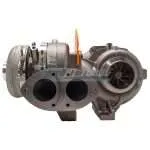
The Caterpillar C15 turbocharger is one of the hardest-working components in over-the-road trucking, and when it starts to fail it takes your boost, your fuel economy, and your uptime down with it. Whether you’re running an ACERT C15, an MBN bridge engine, or a 6NZ pulling 80,000 pounds over the Rockies, knowing how to diagnose and replace your turbo correctly is the difference between a one-day repair and a roadside breakdown. This guide breaks down the most common C15 turbo failures, the right replacement parts, and what the job actually costs.
Understanding the C15 Turbocharger System
The Caterpillar C15 is a 15.2-liter inline-six diesel (the earlier C-15 it grew from is usually given as 14.6 liters) rated anywhere from 435 to 625 horsepower depending on application and tune. The earlier single-turbo C-15 engines (serial prefixes 6NZ and MBN) use a fixed-geometry turbocharger, typically a Garrett GTA4702 or a BorgWarner S410G, depending on the rating. The later C15 ACERT engines went to a series turbo (twin) arrangement with a low-pressure and high-pressure turbo working in sequence to broaden the torque curve and meet emissions targets.
That distinction matters. A 6NZ single turbo and an ACERT twin-turbo setup share the same engine family name but are very different beasts when it comes to diagnosis, parts, and labor. Knowing which one you have before you order anything will save you a costly mistake.
- C-15 6NZ and MBN: Single fixed-geometry turbocharger. Robust, easy to service.
- C15 ACERT (BXS, MXS, NXS, SDP): Series turbocharger system, low-pressure plus high-pressure stages. More complex, more failure points.
Common C15 Turbocharger Failures
After 45+ years rebuilding diesel turbos, we see the same C15 failure patterns over and over. Most aren’t random. They trace back to oil, heat, or wear that could have been caught earlier.
1. Bearing Failure and Shaft Play
The number-one killer. The C15 turbo rides on a floating journal bearing fed by engine oil. Extended drain intervals, coolant contamination, or a clogged oil feed line starve that bearing and let the shaft wallow out. You’ll hear a high-pitched whine that changes with throttle, and a quick check of axial and radial shaft play will confirm it. Radial play is specified in thousandths of an inch, so a little side-to-side movement at the compressor wheel is normal; in-and-out play you can feel, or a wheel that touches its housing, means the turbo is done.
2. Oil Leaks Into the Charge System
Blue smoke on acceleration and oil pooling in the intake piping points to failed turbo seals. On the C15 this is often caused by restricted oil drain back to the pan, which pressurizes the center housing and pushes oil past the seals. Always check the drain line before condemning the turbo.
3. Compressor and Turbine Wheel Damage
Foreign object damage from a failed air filter, a chunk of carbon, or a previously failed turbo shedding debris will nick or shear the blades. Even small leading-edge damage destroys balance and efficiency. Bent or missing blades mean immediate replacement, not a rebuild of that wheel.
4. Wastegate and Actuator Problems
A sticking wastegate or a leaking actuator diaphragm causes overboost or underboost codes. On ACERT series turbos, problems in the high-pressure stage actuator or the interstage plumbing throw the whole boost map off and trigger derates.
5. Carbon Buildup and Coking
Hot shutdowns without a cooldown bake the oil in the center housing into hard carbon. That carbon then accelerates bearing wear on the next cold start. Drivers who shut down hot after a hard pull are the ones who replace turbos most often.
| Symptom | Likely Cause | Severity |
|---|---|---|
| High-pitched whine, changes with RPM | Worn journal bearing / shaft play | High, replace soon |
| Blue smoke, oil in intake piping | Failed seals / restricted oil drain | High |
| Loss of power, low boost, derate | Wastegate / actuator fault | Medium to High |
| Grinding or rattle | Wheel contact / FOD damage | Critical, stop driving |
| Black smoke, sluggish throttle | Boost leak / carbon buildup | Medium |
New vs. Remanufactured C15 Turbochargers
Once you’ve confirmed the turbo is bad, you have three real paths: buy new, buy remanufactured, or rebuild the unit you have. Each makes sense in different situations.
| Option | Typical Cost | Best For |
|---|---|---|
| New OEM Cat turbo | Quoted by part number | Warranty-sensitive fleets, newest ACERT engines |
| Remanufactured turbo | Quoted by part number | Best value for most owner-operators |
| Rebuild your core | From $575 at PT Turbo (price list) | Original housing in good shape, cost control |
For most C15 owners, a quality remanufactured turbocharger is the sweet spot. A properly remanned unit gets new bearings, new seals, a balanced cartridge, and is run on a VSR balancing machine to OEM tolerance, all at roughly half the cost of new. PT Turbo stocks both new and remanufactured C15 units and has been doing it since 1978.
If your housings are clean and your core is rebuildable, our turbocharger rebuild service restores your original unit to spec, often with a faster turnaround and lower cost than buying a replacement outright. Send us the core and we’ll tell you straight whether it’s worth saving.
Installation Kits and Gaskets You’ll Need
Here’s where a lot of turbo jobs go wrong: installing a fresh turbo on old, crushed gaskets and reused hardware. A turbo is only as good as its seal. Reusing a flattened exhaust manifold gasket or a hardened oil feed gasket invites the exact oil leak and boost leak problems you just paid to fix. Always install a complete kit.
PT Turbo carries Ajusa Caterpillar installation kits that include the exhaust gaskets, oil supply and drain gaskets, and seals needed to do the job right. Match the kit to your application:
- Installation kits are listed by turbo part number: send us the number on your turbo and we will match the kit.
If you’re not sure which kit fits your serial prefix, give us the engine number and we’ll match it. You can contact PT Turbo here and we’ll confirm the right parts before you order.
C15 Turbo Replacement: Doing the Job Right
The mechanical job on a single-turbo 6NZ is straightforward for an experienced tech, usually 3 to 5 hours of labor. ACERT twin-turbo setups run longer because of the interstage plumbing and tighter packaging. Follow these fundamentals regardless of configuration:
- Prime the turbo. Before first start, pour clean engine oil into the oil supply port and spin the shaft by hand. Dry starts kill new bearings in seconds.
- Replace the oil feed line. Don’t reuse a 600,000-mile feed line that may be partially coked. A restricted feed line will take out your new turbo just like it did the old one.
- Check the drain back. Verify the oil drain to the pan is clear. Restricted drainage pressurizes the center housing and blows seals.
- Inspect the air filter and intake. Find out why the old turbo failed. If FOD took out the compressor wheel, fix the source before you bolt on a new unit.
- Torque to spec. Use new hardware from your gasket kit and torque the V-band and mounting bolts evenly to avoid leaks and cracked flanges.
- Idle and cooldown. After install, let it idle 3 to 5 minutes to confirm oil pressure and check for leaks before loading it.
If you run other Cat or diesel equipment, our application-specific guides cover related units, including the VW and Audi 1.9 TDI turbocharger guide, the full list of turbo guides, and the Audi 2.0L TDI turbocharger guide. Running a Powerstroke in the fleet too?
The same fundamentals carry across platforms: confirm why the old unit died, prime before start, and never trust an old gasket. A Powerstroke runs a different turbo architecture, but a dry start or a coked oil feed will kill one just as fast as it kills a C15.
Get the diagnosis right, match the part to your serial prefix, and seal it up with fresh gaskets and hardware. Do those three things and a C15 turbo job is a one-day repair that holds for the long haul instead of a comeback that strands you on the shoulder.
Frequently Asked Questions
What are the most common Caterpillar C15 turbocharger failures?
Common C15 turbo failures include worn bearings, oil leaks, cracked housings, and failed wastegate actuators. These often cause boost loss, excessive smoke, and reduced fuel economy.
How much does it cost to replace a Caterpillar C15 turbocharger?
A C15 turbocharger is quoted by part number: the price depends on whether you choose a new or a remanufactured unit, plus labor. ACERT and pre-emissions models may vary in price.
What are the symptoms of a failing C15 turbocharger?
Signs of a failing C15 turbo include loss of boost pressure, black or blue exhaust smoke, whining noises, and poor fuel economy. Catching these early prevents engine damage and costly downtime.
Further reading: Learn more about turbocharger technology.
Need a Turbocharger?
PT Turbo has rebuilt and sold turbochargers since 1978. We stock remanufactured units for Cummins, Duramax, Power Stroke, Detroit Diesel, and more — backed by a 12-month unlimited mileage warranty and same-week shipping from San Bernardino, CA.
📞 (909) 824-1020 · 346 S I St. #3, San Bernardino, CA 92410 · [email protected]
More From PT Turbo
 Ford F-250/F-350 Super Duty Turbocharger Guide: 6.0L, 6.4L & 6.7L Powerstroke Compared
- Peterbilt 389 Turbocharger Guide: Cummins ISX & PACCAR MX-13 Applications
- Cummins ISM Turbocharger Guide: HX55 & HE531V for On-Highway Trucks
- Volvo D13 Turbocharger Guide: Holset HE451VE, Symptoms & Replacement Options