
Ram 1500 EcoDiesel Turbocharger Guide: 3.0L VM Motori Failures & Replacement
This Ram 1500 EcoDiesel Turbocharger Guide breaks down exactly why the 3.0L VM Motori turbo fails, how to spot it early, and what it costs to fix. If you run one of these trucks or you wrench on them, you already know the EcoDiesel is a capable engine with one recurring weak spot: the turbocharger system and its actuator. We have rebuilt diesel turbos at PT Turbo since 1978, and the EcoDiesel comes across our bench often enough that we know its failure patterns cold.
The 3.0L V6 EcoDiesel was designed by VM Motori in Italy and used in the Ram 1500 from 2014 to 2023, along with the Jeep Grand Cherokee. It uses a single variable geometry turbocharger, and understanding how that unit works is the key to diagnosing it correctly.
How the 3.0L EcoDiesel Turbo System Works
The EcoDiesel runs a single water-cooled variable geometry turbocharger (VGT). Instead of a wastegate, movable vanes inside the turbine housing change the effective aspect ratio of the exhaust flow. At low RPM the vanes close to spool the turbo fast and kill lag. At high RPM they open to prevent overboost and reduce backpressure.
On the second-generation (2014-2019) and third-generation (2020-2023) EcoDiesel engines, vane position is controlled by an electronic actuator bolted to the turbo. That actuator is the single most common failure point on the whole system. When it drifts out of calibration or sticks, you get boost problems, limp mode, and a check engine light.
The turbo also relies on the EGR system and the diesel particulate filter downstream. Soot loading and EGR contamination feed directly into how hard the turbo has to work, and both accelerate vane fouling.
Common 3.0L VM Motori Turbocharger Failures
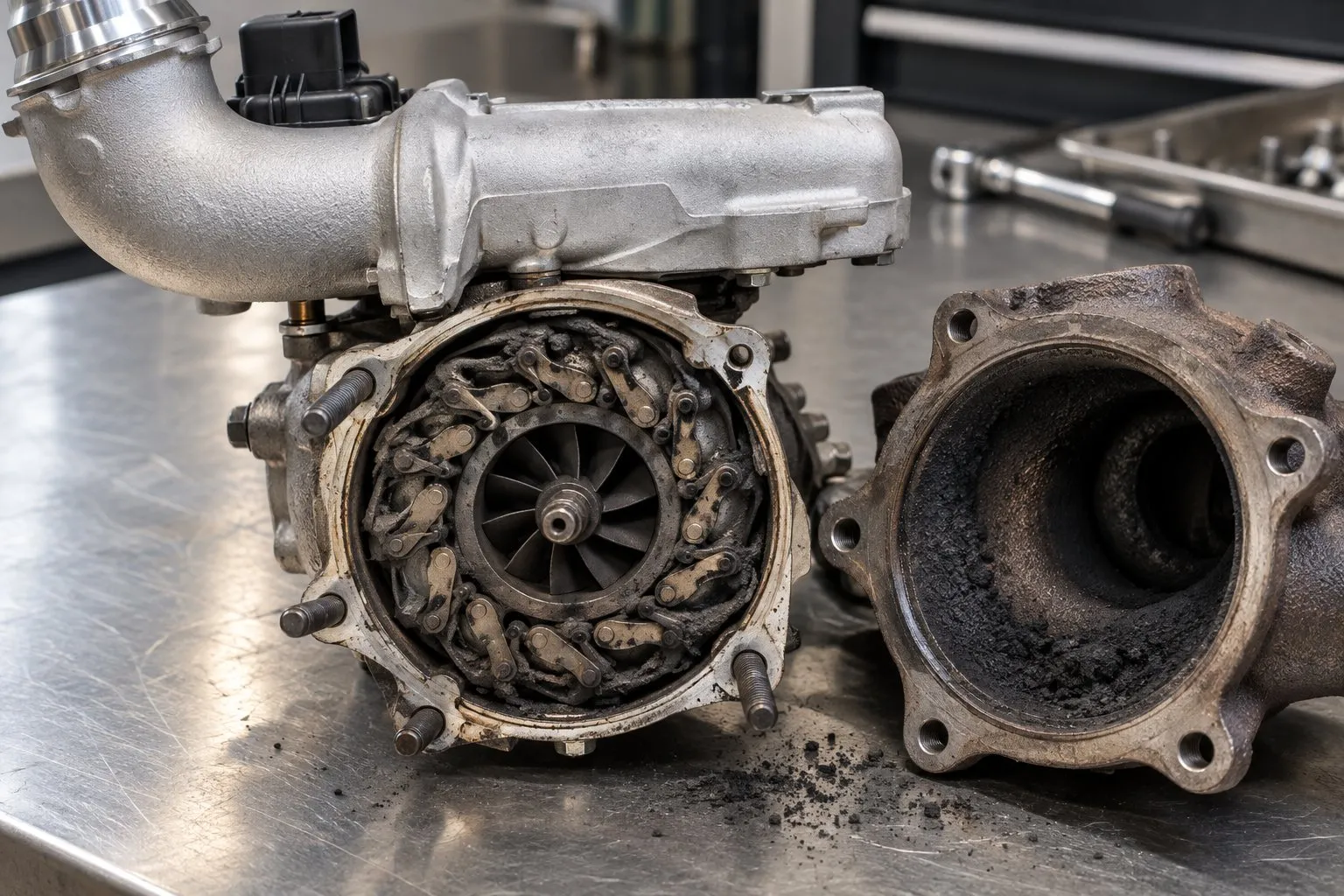
The EcoDiesel turbo rarely fails from a catastrophic bearing or shaft event the way a hard-worked heavy-duty unit does. Instead, it dies from carbon buildup and actuator wear. Here are the failures we see most often on the bench.
1. Sticking VGT Vanes
Soot and oil vapor from the EGR and crankcase ventilation bake onto the vane mechanism. Over time the vanes stick or move slowly, throwing underboost or overboost codes. This is the number one EcoDiesel turbo complaint.
2. Electronic Actuator Failure
The actuator’s motor or electronics fail, or the linkage binds, and vane position no longer matches what the ECU commands. You will often see the truck fall into limp mode under load. In many cases replacing the actuator restores full function without replacing the entire turbo.
3. Oil Feed and Coolant Issues
Clogged oil feed lines starve the center bearing, and coolant crossover leaks cook the seals. Extended oil change intervals with the wrong spec oil are the usual culprit here.
4. Bearing and Shaft Play
Less common, but high-mileage units develop shaft play that leads to compressor wheel rub, oil in the intake, and eventual failure. Blue smoke and a whine that changes pitch are the tells.
Symptoms by Severity
Not every symptom means the turbo is scrap. Use this to triage what you are dealing with before you condemn the unit.
| Severity | Symptom | Likely Cause |
|---|---|---|
| Early | Slight power loss, delayed spool, occasional CEL | Vane fouling beginning, actuator drift |
| Moderate | Boost codes (P0299 underboost, P0234 overboost), intermittent limp mode | Sticking vanes, actuator calibration loss |
| Serious | Persistent limp mode, hard hesitation under load | Failed actuator, badly carboned vanes |
| Critical | Blue smoke, whining, oil in intake, metal in oil | Bearing failure, shaft play, wheel contact |
If you are chasing a P0299 or P0234, start at the actuator and vane mechanism, not the turbine wheel. That approach saves a lot of parts money on this engine.
Ram 1500 EcoDiesel Turbocharger Guide to Actuator Replacement
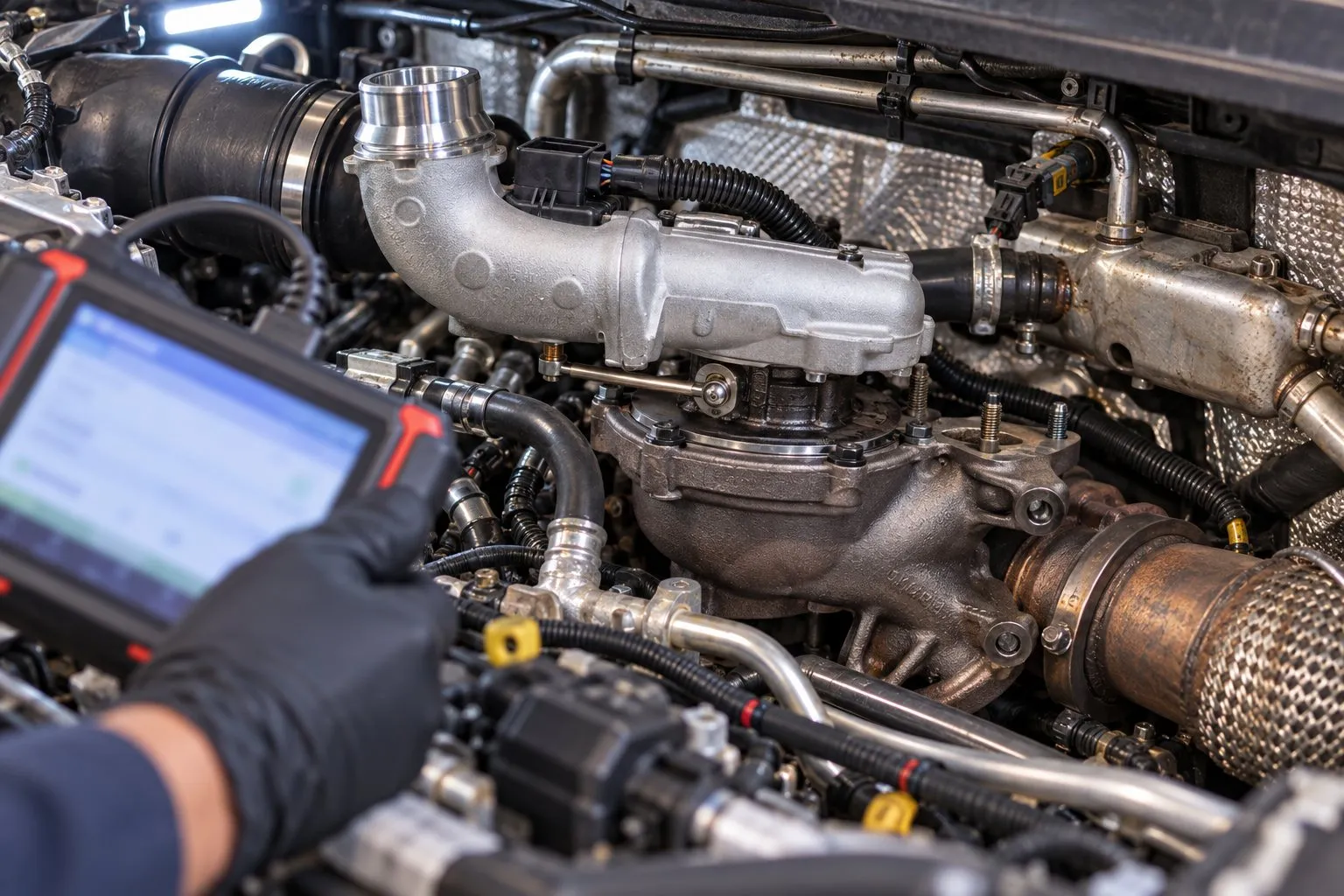
The actuator is behind many EcoDiesel turbo complaints. Match the part number on the turbo’s tag, not just the truck year, since suppliers changed units across production.
Garrett part numbers and cross-references can be checked at garrettmotion.com.
If you are unsure which actuator matches your unit, send us the part number from the turbo’s tag through our contact page and we will verify it before you buy.
One critical note: on the EcoDiesel the actuator must be calibrated to the turbo after installation. A pre-calibrated replacement unit takes most of the risk out of the job, but always confirm vane sweep with a scan tool before you call it done.
Replacement Options: New vs Remanufactured
When the turbo itself is beyond an actuator swap, you have three real paths. A brand-new OEM turbo, a quality remanufactured unit, or a rebuild of your existing core. Here is how they compare on the EcoDiesel.
| Option | Typical Cost | Best For |
|---|---|---|
| New OEM turbo | Quoted by part number | Warranty trucks, no core available |
| Remanufactured turbo | Quoted by part number | Best value with restored specs |
| Rebuild your core | From $575 at PT Turbo (price list) | Cost control, keep your matched unit |
| Actuator only | see actuator prices + labor | Healthy cartridge, actuator fault |
A properly remanufactured turbocharger is built back to OEM tolerances with new bearings, seals, and a balanced rotating assembly. For most owner-operators and fleet trucks, this is the sweet spot between cost and reliability. Browse everything we carry on our main shop page.
If you want to keep your original matched unit, our turbocharger rebuild service restores it with new internals and full balancing. With 45+ years in the turbo business, we stock both new and remanufactured parts, so you are not stuck waiting on a single supply chain.
Preventing EcoDiesel Turbo Failure
Most EcoDiesel turbo problems trace back to maintenance, not design. A few habits keep these turbos alive well past 150,000 miles.
- Use only the correct 5W-30 or 5W-40 full synthetic diesel spec oil and change it on time. Extended intervals cook the bearing.
- Let the engine idle 1 to 3 minutes after towing or hard runs so the center housing cools evenly.
- Keep the EGR and intake clean. Carbon that fouls the vanes starts in the EGR path.
- Address DPF regeneration issues early. A struggling DPF raises backpressure and stresses the turbine.
- Fix small boost codes fast before sticking vanes become a full failure.
The physics here are the same across every diesel VGT. If you want a deeper look at how variable geometry turbos behave in other applications, our Cummins ISB 6.7L turbocharger guide covers VGT operation in detail, and our Ford 6.7L Powerstroke guide walks through similar failure modes on the GT32.
The takeaway on the EcoDiesel is that the turbo is not fragile, it is sensitive to neglect. Stay on top of oil, keep the exhaust side clean, and the VGT will outlast plenty of people’s expectations for this engine. Let it slide and the carbon does the damage for you.
When a code does show up, work the system in order. Confirm actuator function and vane movement before you condemn the cartridge, because on this platform the cheap fix is usually the right one. Jumping straight to a full turbo when all you needed was an actuator is how people spend triple what the repair called for.
Frequently Asked Questions
Why does the 3.0L VM Motori EcoDiesel turbocharger fail?
The most common failure point is the turbo actuator, which can stick or fail due to heat and carbon buildup. This leads to boost issues and limp mode on the Ram 1500 EcoDiesel.
What are the early warning signs of EcoDiesel turbo failure?
Watch for reduced power, whistling or whining noises, black or blue smoke, check engine lights, and the truck entering limp mode. Catching these early can prevent costly damage.
How much does it cost to replace a Ram 1500 EcoDiesel turbocharger?
Costs vary based on whether you replace just the actuator or the entire turbo, plus labor. A professionally rebuilt turbo is often a more affordable option than a new OEM unit.
Need a Turbocharger?
PT Turbo has rebuilt and sold turbochargers since 1978. We stock remanufactured units for Cummins, Duramax, Power Stroke, Detroit Diesel, and more — backed by a 12-month unlimited mileage warranty. Units in stock at our shop in San Bernardino, CA ship the same day when ordered before 2 PM Pacific, Monday through Friday.
📞 (909) 824-1020 · 346 S I St. #3, San Bernardino, CA 92410 · [email protected]