Jeep Grand Cherokee EcoDiesel Turbocharger Guide: 3.0L VM Motori Replacement
This Jeep Grand Cherokee EcoDiesel Turbocharger Guide is written for the mechanics, fleet managers, and owner-operators who need to diagnose, source, and replace the turbo on the 3.0L VM Motori diesel without wasting a shop day on guesswork. The EcoDiesel is a strong engine when it’s healthy, but the turbocharging system has some well-documented weak points that show up between 80,000 and 150,000 miles. Get the diagnosis right and you save a customer thousands. Get it wrong and you’re chasing a “bad turbo” that’s actually a stuck actuator or a clogged DPF.
At PT Turbo we’ve been rebuilding and supplying turbochargers since 1978, that’s 45+ years of hands-on experience with variable-geometry diesel units exactly like the one bolted to this engine. This guide breaks down what fails, how to confirm it, and what parts you actually need.
The 3.0L VM Motori Turbo System: What You’re Working With
The EcoDiesel V6 in the WK2 Grand Cherokee (2014-2019 in North America) uses the VM Motori A630 3.0L engine, the same core power unit found in the Ram 1500 EcoDiesel. If you’ve worked the Ram, most of this will feel familiar. For a deep comparison of failure patterns on the pickup platform, see our companion piece, the Ram 1500 EcoDiesel Turbocharger Guide.
The engine runs a single Garrett variable-geometry turbocharger (VGT) mounted in the valley between the cylinder banks. A variable-geometry turbo uses movable vanes to change the effective aspect ratio of the exhaust housing, giving strong low-end response and controlled top-end boost. On this engine those vanes are moved by an electronic actuator bolted to the turbo, which is a critical detail when ordering parts.
Here are the baseline specs worth keeping in front of you:
| Specification | Detail |
|---|---|
| Engine | 3.0L VM Motori A630 V6 diesel |
| Turbo type | Garrett VGT, single, valley-mounted |
| Actuator type | Electronic |
| Peak boost | Approx. 26-28 psi |
| Factory output | 240 hp / 420 lb-ft |
| Common failure window | 80,000-150,000 miles |
Common Failure Symptoms and What They Actually Mean
The number one mistake we see is a good turbo cartridge getting condemned because of an actuator or vane problem. The compressor and turbine wheels on these units are usually still healthy when the truck comes in limping. The moving parts on the exhaust side are what wear out.
Soot and carbon build up inside the variable vane mechanism. Combine that with the constant heat cycling of a valley-mounted turbo and the vanes start to stick, hesitate, or bind. When that happens, boost control goes out the window and the ECU throws a fault.
Symptom Severity Breakdown
| Severity | Symptom | Likely Cause |
|---|---|---|
| Early | Slight lag, occasional puff of gray smoke | Vanes starting to carbon up |
| Moderate | P0299 underboost, reduced power, hesitation | Sticking vanes or weak actuator |
| Serious | Limp mode, P0234 overboost, whistle or siren noise | Actuator failure or stuck vanes |
| Terminal | Loud metallic grinding, blue smoke, oil in intake | Bearing failure, shaft play, wheel contact |
P0299 (turbo underboost) and P0234 (overboost) are the two codes you’ll live with most on this platform. Before you pull the turbo, always rule out the cheaper failure points. A restricted diesel particulate filter or a leaking EGR circuit can mimic boost complaints exactly.
The Electronic Actuator: The Part That Fails Most
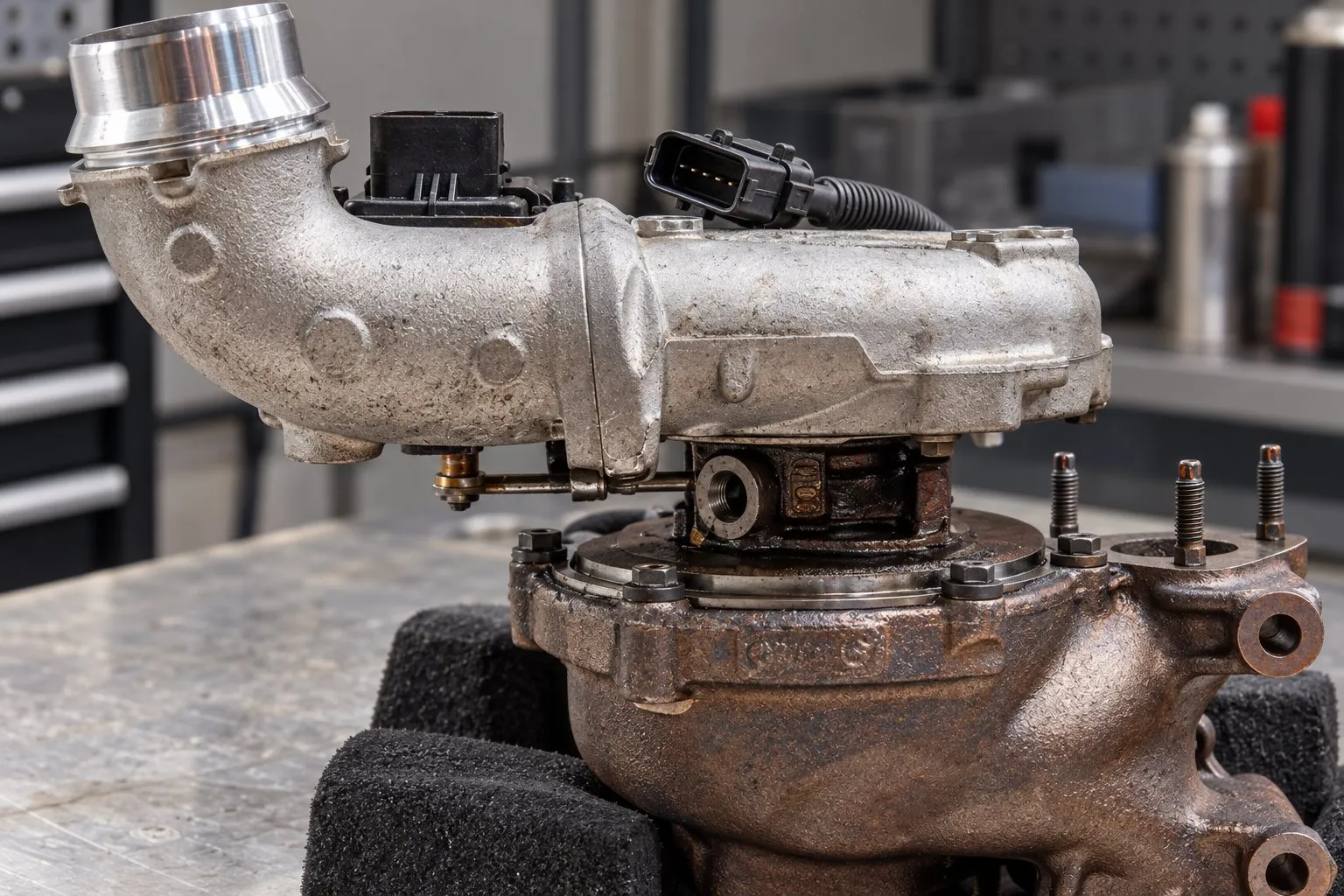
On the EcoDiesel VGT, the electronic actuator is the single most replaced turbo component. Its motor turns the unison ring to open and close the vanes. Over time the motor or electronics fail from heat, or the linkage seizes from carbon. The result is inconsistent boost and repeat P0299/P0234 codes.
The good news: in many cases you can replace the actuator without replacing the whole turbo, which saves the customer serious money. The key is matching the exact actuator to the turbo’s part number. Get the wrong one and the calibration is off, which puts you right back in the shop.
Always confirm the actuator against the part number on your existing turbo’s tag before ordering. If you’re unsure which unit is on your specific build year, send us the part number from the turbo’s tag and we’ll match it. You can reach the team through the PT Turbo contact page.
Jeep Grand Cherokee EcoDiesel Turbocharger Guide: Replacement vs. Rebuild vs. Reman
Once you’ve confirmed the cartridge itself is done, meaning shaft play, wheel damage, or a spun bearing, you have three real paths. Which one makes sense depends on the truck’s mileage, the customer’s budget, and how fast they need it back.
| Option | Typical Cost | Best For | Notes |
|---|---|---|---|
| New OEM turbo | Quoted by part number | Low-mileage, warranty-sensitive vehicles | Highest cost, longest availability wait |
| Remanufactured turbo | Quoted by part number | Most repairs, best value | Built to OEM spec, balanced and tested |
| Actuator only | see actuator prices + labor | Healthy cartridge, failed actuator | Cheapest fix when the core is good |
| Rebuild your core | Varies by core condition | Owner wants their original unit back | Full balance and new internals |
For most EcoDiesel owners, a properly balanced remanufactured turbocharger is the smart middle ground. You get OEM-level performance without the OEM sticker shock, and every reman unit we ship is cleaned, rebuilt with new wear parts, and VSR balance tested before it leaves the building.
If the customer wants their original numbers-matching turbo back on the vehicle, our turbocharger rebuild service restores your core to spec. Either way you’re getting parts touched by people who’ve been doing this since before the EcoDiesel existed.
Replacement Tips From the Bench
The valley-mounted location makes this a labor-intensive job. Budget the time and do it once. A few things that save headaches:
- Replace the oil feed line and check the drain. A restricted return line is a fast way to kill a fresh turbo through coking.
- Change the engine oil and filter at install. Debris from a failed turbo can migrate.
- Inspect the intake and intercooler piping for oil pooling and clean it out. Oil left in the intercooler and charge pipes goes into the engine on the first hard pull.
- Check the actuator connector and wiring. A poor connection causes the same codes people blame on the turbo.
- Prime the new turbo with clean oil before first start and crank it for 10 to 15 seconds while it is kept from starting (the service manual names the fuse or connector) to build oil pressure.
After the first start, let it idle for several minutes and watch for smoke, leaks, and abnormal noise before you load it. Take it through a drive cycle and confirm boost holds clean against your scan tool, no lingering P0299 or P0234. A VGT that was just installed should sweep smoothly through the range with no hesitation.
One last thing worth doing on this platform: force a DPF regen and verify it completes. If the old turbo was underboosting for a while, the filter has likely been loading up, and sending the truck out with a clogged DPF just masks whether your repair actually fixed the breathing problem. Confirm the whole air path is clean before you hand back the keys.
Frequently Asked Questions
What are the common signs of a failing turbocharger on the 3.0L EcoDiesel?
Common symptoms include loss of power, excessive smoke, whining or whistling noises, and increased oil consumption. These often appear between 80,000 and 150,000 miles.
At what mileage do EcoDiesel turbo problems typically occur?
Turbocharger issues on the 3.0L VM Motori engine commonly show up between 80,000 and 150,000 miles due to well-documented weak points in the system.
Can I replace the Jeep Grand Cherokee EcoDiesel turbocharger myself?
Experienced owner-operators and mechanics can replace the turbo with the right tools and guidance, though the job requires care due to tight engine packaging and precise reassembly.
Need a Turbocharger?
PT Turbo has rebuilt and sold turbochargers since 1978. We stock remanufactured units for Cummins, Duramax, Power Stroke, Detroit Diesel, and more — backed by a 12-month unlimited mileage warranty. Units in stock at our shop in San Bernardino, CA ship the same day when ordered before 2 PM Pacific, Monday through Friday.
📞 (909) 824-1020 · 346 S I St. #3, San Bernardino, CA 92410 · [email protected]
More From PT Turbo
 BorgWarner Schwitzer S2A Turbocharger: John Deere & Case Equipment Guide
- What Is a Variable Geometry Turbocharger (VGT) and How Does It Work?
- Garrett GT35 Series Turbocharger: Medium Diesel & Performance Applications
- Garrett GTB1752VK and GTB1752VKL Turbochargers: Chevy Colorado & GMC Canyon 2.8L Duramax Guide