Learning How to Read a VSR Turbocharger Balance Report is one of the most valuable skills a diesel mechanic or shop owner can pick up, because that single sheet of paper tells you whether a rebuilt center housing rotating assembly (CHRA) will run smooth for 300,000 miles or shake itself apart in a week. At PT Turbo, we have been building and balancing turbochargers for over 45 years, and every unit that leaves our bench gets a VSR report. This guide breaks down exactly what those numbers mean, so you can judge the quality of any rebuilt turbo before it goes on an engine.
What a VSR Machine Actually Measures
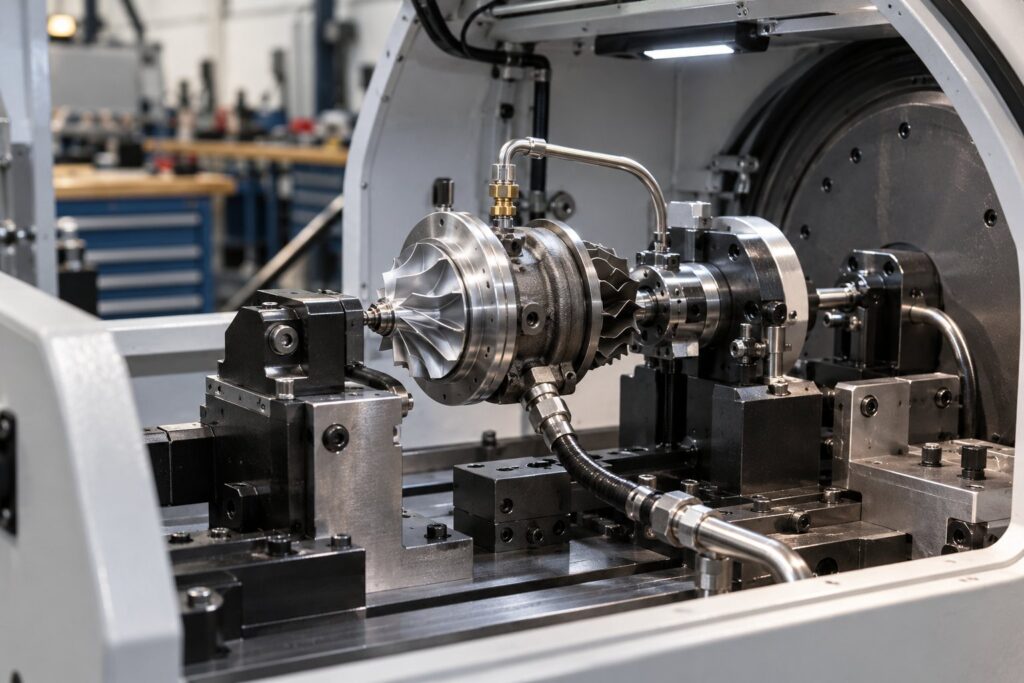
VSR stands for Vibration Sorting Rig. It is a high-speed balancing machine that spins a fully assembled CHRA, the compressor wheel, shaft, turbine wheel, and bearing housing together, under its own oil pressure at or near real operating speeds.
Unlike a simple component balance done on the bare shaft and wheel, a VSR balance accounts for the assembly as a system. Stack-up tolerances, bearing clearances, and wheel runout all show up on the final report. This is why a shaft that balances perfectly on its own can still fail on the VSR once it is assembled.
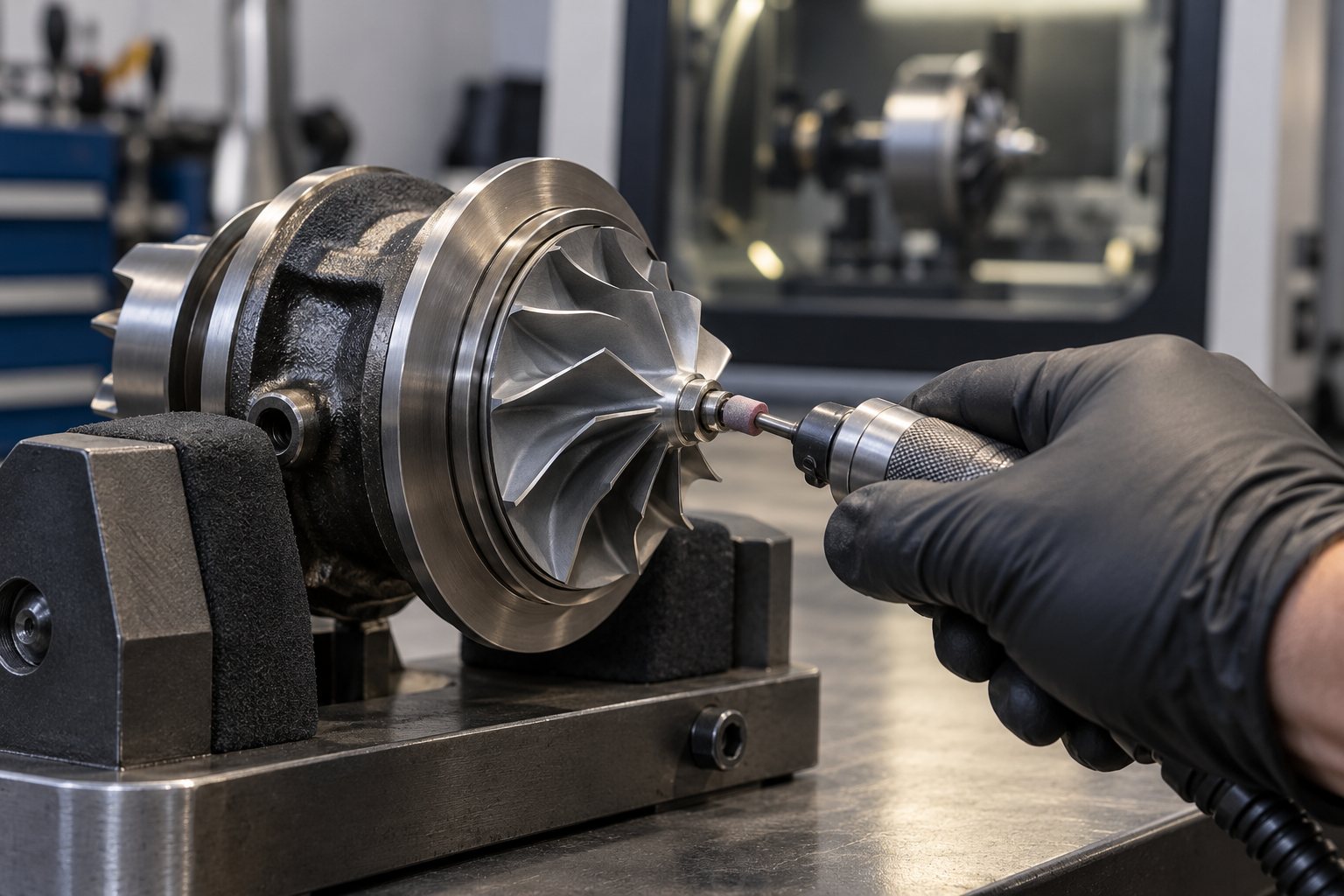
The machine accelerates the core through its full RPM range, often 100,000 to 240,000 RPM depending on the frame size, and records vibration amplitude at each speed band. A technician then makes tiny material removal corrections on the compressor nut or wheel until the residual imbalance drops into spec.
How to Read a VSR Turbocharger Balance Report Line by Line
A good VSR report is a graph plus a data table. Here is what each field is telling you and the values you want to see on a healthy heavy-duty core.
- RPM / Speed bands: The horizontal axis. The report sweeps from idle speed up to max rated speed. Imbalance that spikes only at the top end points to a wheel issue, not a bearing issue.
- Vibration amplitude (mm/s or g): The vertical axis. This is the core number. Lower is better. Most quality shops target residual vibration well under the OEM limit across the whole sweep.
- Residual imbalance (mg or mg-mm): The leftover mass that could not be corrected. This is reported for both the compressor and turbine planes.
- Pass/fail threshold line: The horizontal limit line printed on the graph. The entire trace must stay under it. One brief spike over the line is a reject.
- Phase angle: Shows where the heavy spot sits on the wheel. Technicians use this to know exactly where to remove material.
The single most important thing to confirm: the vibration trace stays below the threshold line through the entire speed sweep, not just at peak RPM. A core that is quiet at 120,000 RPM but spikes at 200,000 RPM will scream and fail in service.
Typical VSR Residual Imbalance Targets by Frame Size
| Turbo Frame Class | Max Test Speed (RPM) | Target Residual Imbalance | Typical Pass Vibration |
|---|---|---|---|
| Small (automotive / light truck) | 200,000 to 240,000 | Under 1.0 mg | Under 2.0 mm/s |
| Medium (medium-duty diesel) | 150,000 to 190,000 | Under 2.0 mg | Under 2.5 mm/s |
| Large (Class 8 / off-highway) | 100,000 to 150,000 | Under 3.0 mg | Under 3.0 mm/s |
These are representative shop targets. Always compare against the OEM-published limit for the specific part number, since Garrett and BorgWarner publish different thresholds by model.
Reading the Vibration Trace: Good, Marginal, and Reject
The shape of the trace tells you as much as the raw numbers. Experienced techs read the curve like an EKG.
- Flat and low: A clean trace that hugs the bottom of the graph across all speeds. This is a properly balanced core. Expect a long service life.
- Gradual rise: A trace that climbs steadily with RPM but stays under the line usually means a healthy assembly with normal bearing load. Acceptable.
- Sharp spike at one speed: A resonance point. If it crosses the threshold, the core is a reject. This often indicates a bent shaft or a wheel with uneven material.
- Erratic / noisy trace: Jagged readings throughout suggest excessive bearing clearance, debris, or a damaged journal. Do not accept this core.
If you see a trace that passes but sits close to the limit line the whole way up, treat it as marginal. Marginal cores are the ones that come back under warranty. A reputable rebuilder rejects these and reworks them.
Why Balance Reports Matter for Actuator and VGT Setup
A perfectly balanced core still needs the right actuator calibration to perform. On wastegated and variable geometry turbos, the actuator controls boost by moving the wastegate flap or the VGT vanes. If the core is balanced but the actuator is weak or mis-set, you get overboost, underboost, or hunting codes.
This matters because many “turbo failures” that come across our bench are actually actuator failures on a good core. Before condemning a CHRA, verify the actuator. For common Garrett applications, the Garrett Pneumatic Actuator 757979-5102 is available from PT Turbo for $240.94. For larger Garrett frames, the heavier-duty Garrett Pneumatic Actuator 445963-0040 runs $465.52.
On the Mitsubishi side, the TD03 platform is extremely common on light and medium diesels. The Mitsubishi TD03 Pneumatic Actuator 49S3118761 is $104.33, and the Mitsubishi Pneumatic Actuator 4918918935 is $83.99. Matching the correct actuator to a freshly balanced core is what makes a rebuild drive like factory.
If you are working with a variable-geometry turbocharger, remember that the vane mechanism adds its own friction and wear variables that a balance report will not capture. Pair your VSR data with a vane sweep test for a complete picture.
New vs Remanufactured: What the Report Should Prove
Both new and quality remanufactured turbos should ship with, or be able to produce, a VSR balance report. The report is your proof that the core was tested, not just cleaned and reassembled.
| Factor | New OEM Turbo | Quality Remanufactured Turbo |
|---|---|---|
| VSR balanced | Yes, at factory | Yes, if from a real rebuilder |
| Typical cost | Highest | 30% to 50% less |
| Lead time | Often backordered | Usually in stock |
| Core charge | None | Refundable on return |
| Balance report provided | Rarely shared | Available on request |
This is where buying from an established shop matters. PT Turbo has been in business since 1978 and stocks both new and remanufactured turbochargers, every one of them VSR balanced. If you need a core rebuilt and balanced, our turbocharger rebuild service returns a full report with the finished unit.
Using Balance Data Alongside Other Diagnostics
A balance report tells you the core is mechanically sound, but it does not tell you if the turbo is the right match for the engine. Combine it with airflow data. If you are sizing a replacement, learn how to read a turbocharger compressor map so the balanced core actually delivers the boost your application needs.
When the part number tag is missing, you cannot look up the correct balance spec. In that case, our guide on matching a replacement using cast numbers walks you through identifying the unit before you test it.
For application-specific failures, the Caterpillar C7 turbocharger guide and the BMW N57 diesel turbo guide both show how balance problems present differently across engine platforms.
If you ever get a report you are not sure how to interpret, send it to us.
The point is that no single document condemns or clears a turbo on its own. A clean VSR trace, a healthy actuator stroke, a vane sweep within range, and a compressor map that fits the engine all have to line up before you bolt the unit on. Treat the balance report as one leg of that diagnostic stool, not the whole chair.
Once you can read the trace, spot a marginal curve, and cross-check it against the OEM limit for that part number, you stop guessing on rebuilds. You know before the turbo ever sees the engine whether it was built right, and that is the difference between a unit that lasts and a comeback.
Frequently Asked Questions
What is a VSR turbocharger balance report?
A VSR (Vibration Sorting Rig) balance report is a document showing the vibration measurements of a spinning CHRA at various speeds. It confirms whether a rebuilt turbocharger is balanced within safe tolerances.
What do the numbers on a VSR balance report mean?
The numbers represent residual vibration or imbalance values, usually in mg or g-force, measured across different RPM ranges. Lower numbers indicate a smoother, better-balanced rotating assembly.
Why is VSR balancing important for a rebuilt turbocharger?
Proper VSR balancing ensures the CHRA won’t vibrate excessively at high speeds, which prevents premature bearing failure and extends turbocharger life. An unbalanced unit can fail within days of installation.
Cross-Reference & Superseded Part Numbers
The turbochargers covered in this article match or supersede the following OEM and manufacturer part numbers. If you are searching by part number, these are the units stocked by PT Turbo for this application:
006393 • 006396 • 706451-5014S • 761208-0080 • 761208-0082 • 761208-0083 • 775839-2 • 800269-10 • 800269-2 • 800269-5 • 800269-6 • 800269-7 • 800269-8 • 804878-1 • 804878-3 • 804878-4 • 804878-5006S • 836026-5006S • 841297-5004S • 841691-5002S • 860779-5010S • 860779-5016S • 879779-5012S • 880546-5002S • 880700-5011S • 880701-5008S • 898198-5001S • 911984-5003S • 953223-5001S • CHRA-GT2560R • CHRA-GT2871R • CHRA-GTX2867R-GEN1 • CHRA-GTX4088R • CHRA-T3/T4E • GTX2867R+Bolt-on+Turbo • PTT-C30-004 • PTT-CHRA97-3 • PTT-CHRA97-4 • PTT-CWH-006 • PTT-CWH-007 • PTT-CWH-008 • PTT-CWH-012 • PTT-FIAT-004 • PTT-FIE-004 • PTT-FIE-008 • PTT-FLS-226 • PTT-FOC-010 • PTT-FOC-030 • PTT-FOC-050 • PTT-FOC-051 • PTT-FOC-052 • PTT-FOC-056 • PTT-FOC-064 • PTT-FTG-006 • PTT-HGC-069 • PTT-HSG-011 • PTT-HSG-012 • PTT-HSG-014 • PTT-HSG-038 • PTT-HSG-042 • PTT-HSG-135 • PTT-HSG-138 • PTT-HSG-145 • PTT-HSG-277 • PTT-HSG-395 • PTT-HSG-398 • PTT-HSG-429 • PTT-HSG-430 • PTT-HSG-436 • PTT-HSG-445 • PTT-HSG-447 • PTT-HSG-448 • PTT-HSG-449 • PTT-HSG-470 • PTT-HSG-473 • PTT-HSG-491 • PTT-HSG-594 • PTT-HSG-597 • PTT-HSG-625 • PTT-HSG-790 • PTT-HSG-792 • PTT-MS3-012 • PTT-MS3-037 • PTT-MUS-001 • PTT-MUS-011 • PTT-S60-002 • PTT-STC-001 • PTT-TBO-001 • PTT-TBO-021 • PTT-TBO-023 • PTT-TBO-025 • PTT-TBO-034 • PTT-TBO-035 • PTT-TBO-038 • PTT-TBO-042 • PTT-TBO-043 • PTT-TBO-044 • PTT-TBO-045 • PTT-TBO-051 • PTT-TBO-053 • PTT-TBO-054 • PTT-TBO-060 • PTT-TBO-066 • PTT-TBO-083 • PTT-TBO-105 • PTT-TBO-106 • PTT-TBO-107 • PTT-TBO-353 • PTT-TBO-406 • PTT-TBO-602 • PTT-TBO-604 • PTT-TBO-607 • PTT-TBO-612 • PTT-TBO-614 • PTT-TBO-617 • PTT-TBO-620 • PTT-TBO-752 • PTT-TBO-753 • PTT-TBO-769 • PTT-TBO-770 • PTT-TBO-817 • PTT-TBO-847 • PTT-TBO-849 • PTT-TBO-889 • PTT-TBO-890 • PTT-TBO-898 • PTT-TBO-902 • PTT-TBO-913 • PTT-TBO-965 • PTT-TBO-967 • PTT-TBO-B21 • PTT-TBO-B22 • PTT-TBO-B34 • PTT-TBO-B38 • PTT-TBO-B40 • PTT-TBO-C41 • PTT-TBO-G21 • PTT-TBO-G24 • PTT-TBO-G26 • PTT-TBO-G2B • PTT-TBO-H34 • PTT-TBO-H36 • PTT-TBO-H63 • PTT-TBO-H64 • PTT-TBO-H75 • PTT-TBO-H76 • PTT-TBO-J15 • PTT-TBO-J22 • PTT-TBO-J24 • PTT-TBO-J25 • PTT-TBO-J26 • PTT-TBO-J27 • PTT-TBO-J28 • PTT-TBO-J30 • PTT-TBO-J49 • PTT-TBO-J55 • PTT-TBO-J58 • PTT-TBO-K91 • PTT-TBO-K98 • PTT-TBO-L12 • PTT-TBO-L16 • PTT-TBO-L17 • PTT-TBO-L30 • PTT-TBO-L89 • PTT-TBO-L97 • PTT-TBO-L99 • PTT-TBO-N21 • PTT-TBO-N23 • PTT-TBO-N24 • PTT-TBO-P68 • PTT-TBO-P69 • PTT-TBO-P71 • PTT-TBO-P72 • PTT-TBO-P95 • PTT-TBO-P97 • PTT-TBO-P99 • PTT-TBO-Q14 • PTT-VEVO-028 • PTT-VSRT-007 • PTT-VVW-004 • PTT-VVW-047 • PTT-VVW-171 • PTT-VVW-174 • PTT-VVW-327 • PTT-WGT-019 • PTT-WGT-098 • TIL-BOV-007 • TIL-WGT-035
Can’t find your number above? Contact PT Turbo — our team has been matching part numbers since 1978.
Need a Turbocharger?
PT Turbo has rebuilt and sold turbochargers since 1978. We stock remanufactured units for Cummins, Duramax, Power Stroke, Detroit Diesel, and more — backed by a 12-month unlimited mileage warranty and same-week shipping from San Bernardino, CA.
📞 (909) 824-1020 · 346 S I St. #3, San Bernardino, CA 92410 · [email protected]