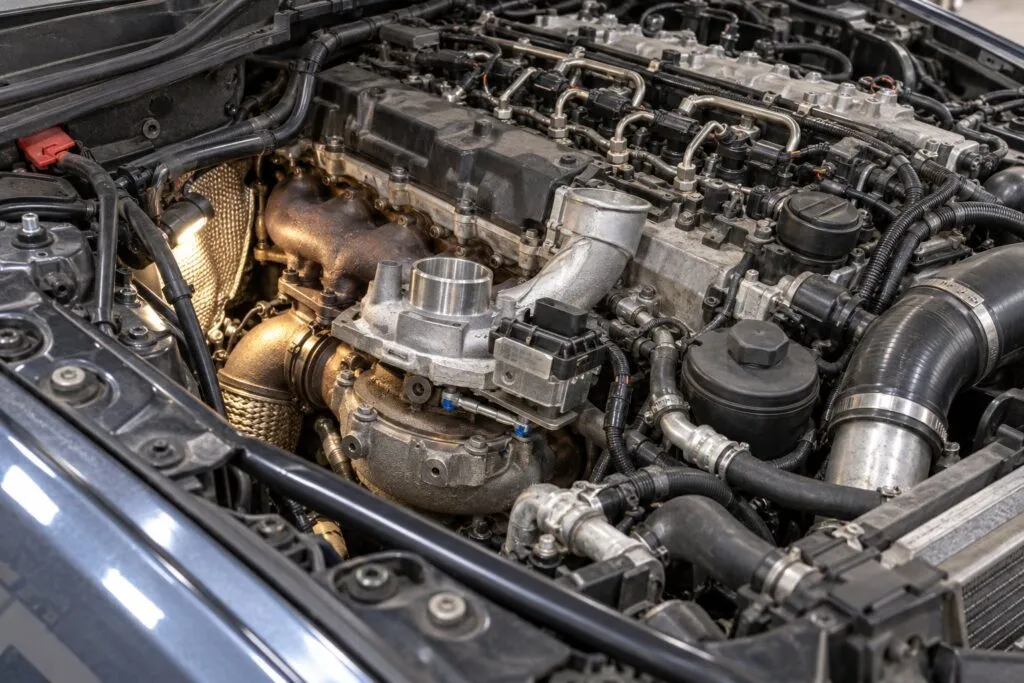
This BMW N57 Turbocharger Guide covers everything a diesel technician, fleet manager, or owner needs to know about the turbocharging system on BMW’s 3.0L inline-six diesel: how it works, why it fails, the exact part numbers you need, and what replacement actually costs. The N57 is one of the most widely deployed diesel engines BMW ever built, powering the 330d, 335d, 530d, 535d, X3, X5, X6, and 740d across model years roughly 2008 through 2019. It earned a reputation for smooth power delivery, but the forced-induction hardware has predictable weak points that show up as the miles climb.
At PT Turbo we have been rebuilding and supplying turbochargers since 1978, more than 45 years in the business, and the N57 comes across our bench often enough that we know exactly where these units let go. Here is the real-world breakdown.
How the N57 Turbocharger System Works
The N57 was offered in three layouts. Single-turbo variants use one variable-geometry turbocharger. The twin-turbo N57D30T (from 2009) stacks a small and a large charger in series, and the tri-turbo N57S (from 2012) adds a second small high-pressure turbo for a broad torque curve.
Every N57 has at least one variable-geometry turbocharger. On the twin- and tri-turbo versions it is the high-pressure stage that is variable; the large low-pressure turbo is fixed geometry. Movable vanes in the turbine housing change the effective aspect ratio of the exhaust flow, giving strong low-end response without choking top-end power. On the single-turbo N57 these vanes are driven by an electric actuator bolted to the turbo, which is a critical detail when you go shopping for parts.
The single-turbo N57 typically runs a Garrett GTB2260VK-class unit. Twin-turbo cars use a two-stage system: a small high-pressure turbo and a large low-pressure turbo in series, with vacuum-operated flaps directing exhaust and intake air between them. When an actuator, a flap or the vanes stick, the whole system falls apart.
Common N57 Turbocharger Failures
The N57 does not usually fail from a spun bearing or shattered wheel the way an abused truck turbo does. It fails from carbon, from actuators, and from the same soot cycle that plagues every modern common-rail diesel. Here are the failure modes we see most.
1. Sticking Variable Vanes
Soot and oil vapor from the exhaust gas recirculation system bake onto the vane mechanism over time. The vanes gum up, stop sweeping freely, and either stick open (no low-end boost, sluggish) or stick closed (overboost spikes, then a limp-mode cut). Short-trip cars that never get the exhaust hot enough to burn off deposits are the worst offenders.
2. Actuator Failure
This is the single most common N57 turbo complaint we field. The electric actuator fails internally or its linkage seizes, and the vanes no longer move to the commanded position. The actuator lives right next to a very hot turbine housing, and heat cycling is what wears it out. The good news is that a failed actuator does not always mean a failed turbo. Replacing the actuator alone is often the correct, and far cheaper, fix.
3. Oil Feed and Seal Issues
A restricted or coked oil feed line starves the center bearing and leads to shaft play, followed by oil pushing past the seals. You will see blue smoke, oil in the intercooler piping, and rising oil consumption. Once shaft play is past the limit, the core needs a rebuild.
4. Wastegate and Boost Control Faults
On twin-turbo N57 engines, the interaction between the two stages is managed by control flaps and actuators. A lazy or leaking actuator on either stage throws boost-deviation codes and puts the car into reduced power.
Symptoms by Severity
| Severity | Symptoms | Likely Cause |
|---|---|---|
| Early | Slight lag, occasional whistle, minor power loss | Vanes starting to carbon up, actuator getting lazy |
| Moderate | Boost deviation codes, intermittent limp mode, hesitation under load | Sticking vanes or failing actuator |
| Severe | Blue/black smoke, oil in charge pipes, whining, hard limp mode | Shaft play, failed seals, seized actuator |
BMW N57 Turbocharger Guide to Part Numbers and Actuators
Getting the right part comes down to matching your exact engine variant and, critically, the actuator. Because so many N57 problems are actuator problems, replacing that component first can save you the cost of a whole charger. The actuator is matched to the turbo, so the numbers on the turbo decide which one fits.
Always confirm the casting numbers on your existing turbo and actuator before ordering. The N57 went through several revisions and BMW superseded part numbers multiple times over the production run. If you are unsure which actuator matches your core, send us photos and your VIN through the PT Turbo contact page and we will match it for you.
Replacement Cost: New vs Remanufactured vs Actuator-Only
The smart move on an N57 is to diagnose before you spend. If the turbine wheel spins freely with no shaft play and the only fault is boost deviation, an actuator swap may fully restore function. If the play is past the limit or the core shows oil leakage, you need a rebuilt or new unit.
| Repair Path | Typical Parts Cost | Best For |
|---|---|---|
| Actuator only | see actuator prices | Healthy core, boost deviation codes, sticking vane fault |
| Remanufactured turbocharger | Quoted by part number | Shaft play, oil leakage, high-mileage cores |
| Brand-new OEM turbocharger | Quoted by part number | Buyers who require new, or discontinued reman cores |
| Rebuild your existing core | Labor plus parts, quoted per unit | Keeping matched OEM hardware, twin-turbo balancing |
Labor to remove and install an N57 turbo runs several hours because the units sit low in a tight engine bay, and twin-turbo cars take longer. Factor shop time on top of parts. A remanufactured turbocharger from PT Turbo is the value sweet spot for most owners, giving new-part performance at a lower price with the vanes cleaned, the actuator calibrated, and the core balanced.
If you want to keep your original matched hardware, our turbocharger rebuild service restores your existing core to spec. This matters on twin-turbo N57 engines where the two stages are calibrated to work together.
How to Diagnose Before You Buy
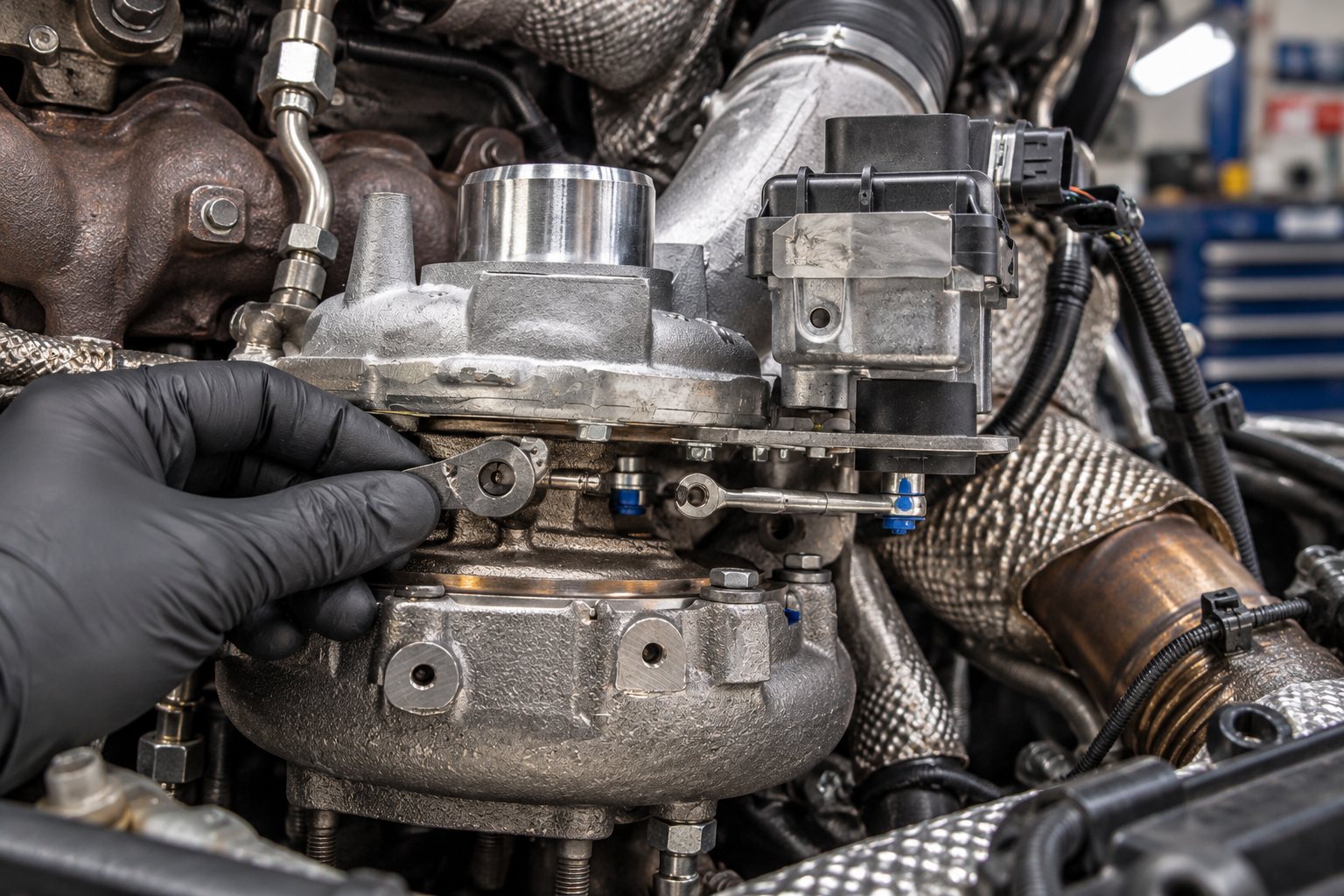
Do not throw a turbo at a boost code. Work through this order first.
- Scan for exact fault codes. Boost deviation (over or under) points to vanes or actuator, not always the whole turbo.
- On twin-turbo cars, check the vacuum lines to the control flaps. On single-turbo cars, check the actuator connector and wiring.
- With the actuator link disconnected, move the vane lever by hand. It should sweep smoothly with no sticking.
- Inspect for shaft play. Radial or axial movement past spec means the core is done.
- Look for oil in the charge pipes and intercooler. A light film is normal on an engine with closed crankcase ventilation; oil pooling there points to a seal failure or a blocked breather.
- Verify the diesel particulate filter is not clogged. A blocked DPF raises backpressure and can imitate turbo faults.
If the vanes stick but the shaft is tight, a clean and a fresh actuator often bring the unit back. If shaft play is past the limit, order a rebuilt or new charger. You can browse the full range on the PT Turbo shop page, and our team can cross-reference the numbers on your turbo.
Working on an older BMW six-cylinder diesel? See our BMW M57 turbocharger guide for the E46, E39 and E53.
Frequently Asked Questions
Why do BMW N57 turbochargers fail?
Common causes include oil starvation, carbon buildup, worn variable geometry vanes, and actuator faults. Poor maintenance and extended oil change intervals accelerate wear.
Which BMW models use the N57 diesel engine?
The N57 3.0L inline-six diesel powers the 330d, 335d, 530d, 535d, X3, X5, and X6, among other BMW models.
How much does an N57 turbocharger replacement cost?
Replacement costs vary by model and whether single or twin turbos are involved, typically ranging from parts alone to significant labor-inclusive totals depending on the configuration.
Need a Turbocharger?
PT Turbo has rebuilt and sold turbochargers since 1978. We stock remanufactured units for Cummins, Duramax, Power Stroke, Detroit Diesel, and more — backed by a 12-month unlimited mileage warranty and same-week shipping from San Bernardino, CA.
📞 (909) 824-1020 · 346 S I St. #3, San Bernardino, CA 92410 · [email protected]