Mitsubishi TF035 Turbocharger: Diesel & Gasoline Applications Guide
The Mitsubishi TF035 Turbocharger is one of the most widely used small-frame Mitsubishi turbos on the planet, and that very popularity is where the confusion starts. The same frame designation covers several wheel combinations, housing sizes, and control setups across different engines, so two units can share a name and still be completely wrong for each other.
At PT Turbo, family-owned and rebuilding turbochargers since 1978, we deal with that confusion every day. This guide walks through what the TF035 is, which engines it lives on, how it fails, and how to make sure the one you order actually bolts on and spools the way it should.
What Is the Mitsubishi TF035 Turbocharger?
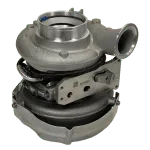
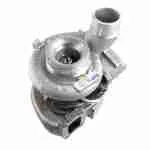
The TF035 is a compact, single-stage turbocharger built on one of Mitsubishi’s smaller frame sizes. It is used mostly on four-cylinder engines, both diesel and gasoline, and in pairs on the six-cylinder BMW S55, where quick spool-up matters more than peak airflow.
Like any journal-bearing turbo, the TF035 rides on an oil film fed from the engine, and its cast iron center housing carries the shaft between the compressor and turbine wheels. On the diesel applications we see most often, the TF035 is a fixed-geometry turbo, meaning it has no sliding nozzle or variable vanes to move. Boost is managed by a wastegate rather than by changing the turbine’s geometry.
That distinction matters because Mitsubishi also fits variable-geometry units to closely related engines, and the two do not interchange. If you want the background on how a variable nozzle differs from a fixed-geometry wastegated turbo, Wikipedia’s variable-geometry turbocharger entry is a solid primer.
Diesel and Gasoline Applications of the Mitsubishi TF035 Turbocharger
On the diesel side, the best-documented home for the TF035 is the Mitsubishi 4M41 3.2L. That engine used a fixed TF035 across a long production run before Mitsubishi moved higher-output versions to a variable-geometry IHI unit.
A smaller variant, the TF035HL2, is listed on the 2.5L Mitsubishi DI-D diesel. The 3.2L turbo is a TF035HL as well, yet the 2.5L TF035HL2 is a variable-geometry version, so even within the TF035 family you cannot assume one turbo swaps for another.
| Engine / Platform | TF035 Variant | Type | Notes |
|---|---|---|---|
| Mitsubishi 4M41 3.2L (1999-2006 Pajero) | TF035 | Fixed geometry | Distributor-pump early, common rail from 2006 |
| Mitsubishi 4M41 3.2L (2005-2011 Triton / L200) | TF035 | Fixed geometry | Go by the tag number, ratings vary |
| Mitsubishi 4M41 3.2L (2008-2011 Pajero Sport) | TF035 | Fixed geometry | Does not interchange with the variable IHI RHV5 |
| Mitsubishi 2.5L DI-D diesel | TF035HL2 | Variable geometry | Variable vanes; does not swap with the fixed 3.2L unit |
On gasoline engines, the TF035 frame has seen service as well, but wheel sizes, housing A/R and wastegate calibration can be very different from the diesel versions. Because a wrong unit is worse than no unit, we will not pin a gasoline fitment to a part number we cannot verify. The right move is always to read the number stamped on the turbo’s data plate and match that, not the frame name alone.
Why the TF035 and the variable-geometry units do not interchange
The 2006-on higher-output 3.2L Mitsubishi moved to a variable-geometry IHI RHV5, which uses movable vanes and a vacuum-operated actuator. The fixed TF035 and that variable unit mount and plumb differently and are not substitutes for one another.
If a listing or a core hands you a turbo with an actuator and vane control where you expected a simple wastegated unit, stop and verify the engine’s original turbo. Matching an electronically controlled variable turbo to a fixed-geometry application, or the reverse, leads to codes, poor driveability, and a comeback.
How the TF035 Fails and What to Check
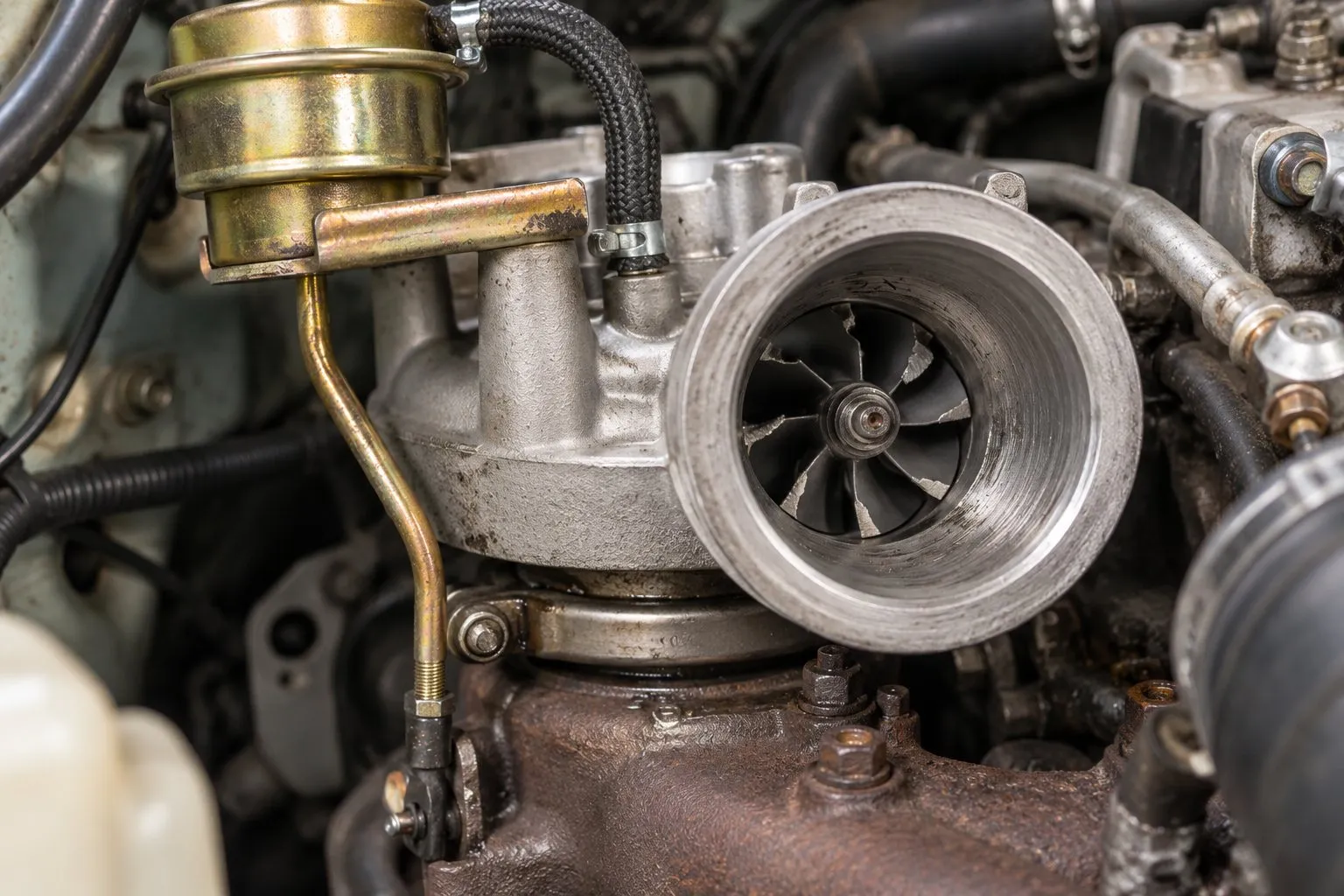
Most turbo failures trace back to the oil supply, not to the turbo itself. The TF035 is no different. Before condemning the cartridge, work through the basics.
- Oil feed and drain: A restricted or coked feed line starves the bearings; a blocked or kinked drain backs oil up and pushes it past the seals at both ends. Replace a feed line that has seen a bearing failure or burnt oil rather than reusing it.
- Air inlet and filter: A restricted inlet pulls oil past the compressor-side seal. Check the filter and ducting before blaming the seal.
- Crankcase ventilation: A light oil film in the charge pipes is normal on an engine with closed crankcase ventilation. Pooled oil is the warning sign, not a trace.
- Shaft play: Some side-to-side rock is normal on a journal-bearing turbo with no oil pressure. Condemn the unit for in-and-out play you can feel or for wheel contact with the housing, never for any movement at all.
- Wastegate: A flapper that does not seat lets exhaust slip past the turbine, giving low boost and slow spool. Low boost shows up as dark or gray smoke from a rich mixture, not white smoke.
One failure path owners overlook: if the compressor wheel has come apart and shed metal, that debris goes downstream into the charge air cooler. Flushing it out reliably is not realistic, so the intercooler should be replaced and the charge piping inspected whenever a compressor wheel grenades. Reinstalling a new turbo onto a cooler full of debris just feeds the next failure.
New, Remanufactured, or Rebuilt?
There are three honest ways to put a healthy TF035 back on the engine, and the right one depends on your core, your timeline, and your budget. PT Turbo stocks both new and remanufactured turbochargers and rebuilds units in-house.
| Option | What you get | Best for |
|---|---|---|
| New turbo | Factory-fresh unit, no core to send | No usable core, or you want the longest service life |
| Remanufactured turbo | Balanced cartridge, new bearings and seals, tested | Fast turnaround with a core exchange |
| In-house rebuild | Your exact unit rebuilt with a kit of bearings, seal rings and thrust parts | Keeping your matched housings and tag number |
A rebuild kit holds bearings, seal rings and thrust parts; the cartridge is balanced on a vibration sorting rig before it ships. For current rebuild pricing by model, see our turbo rebuild price list rather than guessing a figure, since prices are confirmed after inspection and before any work begins. Most rebuilds ship in 3 days or less, and every rebuild and remanufactured turbo carries a 12-month unlimited-mileage warranty.
If you are not sure which variant you have, send us the number off the data plate. Casting numbers on the housings only narrow the search; one casting serves many turbos, so the tag number plus wheel sizes and A/R is what confirms the match.
First Start After Installation
A turbo has no mileage break-in, but it does need a proper first start. Follow the maker’s first-start steps so the bearings see oil before they see load.
- Fill the oil inlet with clean engine oil and turn the compressor wheel by hand.
- Crank the engine while kept from starting, per the service manual, to build oil pressure at the turbo.
- Let it idle a few minutes before putting it under load.
- After a hard pull or towing, give it a few minutes of idle to cool down before shutdown.
No special early oil change, no first-miles boost limit. Clean oil, clean air, and a good drain are what keep a TF035 alive. For the broader picture of how any turbocharger works, Wikipedia’s turbocharger overview is a useful reference.
For readers cross-shopping other small Mitsubishi and IHI frames, the same matching discipline applies across platforms. If your project runs a related Cummins or heavy-duty unit, our Cummins ISB 5.9L turbocharger guide shows how model names and tag numbers sort out on those engines too.
Frequently Asked Questions
Is the Mitsubishi TF035 a variable-geometry turbo?
On the diesel applications we most often see, such as the 4M41 3.2L, the TF035 is a fixed-geometry turbo controlled by a wastegate, while the TF035HL2 on the 2.5L DI-D is a variable-geometry version. Mitsubishi used a separate variable-geometry IHI unit on higher-output later engines, and that variable turbo does not interchange with the fixed TF035. Always verify by the number on the turbo’s tag.
How do I know which TF035 variant I need?
Go by the part number stamped on the data plate, then confirm with the compressor and turbine wheel sizes and the housing A/R. The TF035 name alone covers multiple builds, and a variant like the TF035HL2 on the 2.5L is a variable-geometry turbo, so the frame name is only a starting point. If you are unsure, call PT Turbo at (909) 824-1020 with the tag number.
Do I need to replace the intercooler after a TF035 failure?
If the compressor wheel came apart, yes. Metal shed from a broken wheel lodges in the charge air cooler and cannot be flushed out reliably, so it should be replaced and the charge piping inspected before a new turbo goes on. Skipping that step risks sending debris straight into the engine.
Need a Turbocharger?
PT Turbo has rebuilt and sold turbochargers since 1978. We stock remanufactured units for Cummins, Duramax, Power Stroke, Detroit Diesel, and more — backed by a 12-month unlimited mileage warranty. Units in stock at our shop in San Bernardino, CA ship the same day when ordered before 2 PM Pacific, Monday through Friday.
📞 (909) 824-1020 · 346 S I St. #3, San Bernardino, CA 92410 · [email protected]