Mitsubishi 4M41 3.2L Turbocharger Guide: Pajero, Triton & L200 Replacement
This Mitsubishi 4M41 3.2L Turbocharger Guide covers everything a diesel mechanic, fleet manager, or owner-operator needs to diagnose, service, and replace the turbo on one of the most widely used 4-cylinder diesel engines Mitsubishi ever built. The 4M41 powers the Pajero, Triton (L200), Shogun, and a range of light commercial platforms across three decades of production, which means these turbos are still coming across the bench every day. At PT Turbo, we have been rebuilding and supplying turbochargers since 1978, so we know exactly where these units fail and what it takes to get them right the first time.
Below you will find real specs, the correct part numbers, failure symptoms sorted by severity, and honest guidance on new versus remanufactured options. No fluff, just the information you need to make a decision on the shop floor.
The Mitsubishi 4M41 Engine and Its Turbo Setup
The 4M41 is a 3.2-liter (3,200cc) inline-four direct-injection diesel that first appeared in the Pajero/Montero in 1999 and stayed in production in the Pajero for more than two decades, with the Triton and L200 using it from 2005 to 2011. Bore and stroke are 98.5mm x 105mm, and depending on the market and model year it produced anywhere from roughly 118 kW to 147 kW.
Early 4M41 engines used a fixed-geometry TF035 turbocharger. The 2006-on Pajero moved to a variable-geometry turbo (VGT) to improve low-end torque and reduce turbo lag, while the Triton / L200 and Pajero Sport kept the fixed-geometry unit. Understanding which version you are working on is the first step, because the two are not interchangeable and the actuator hardware is different.
| Spec | Fixed geometry (early Pajero, Triton / L200, Pajero Sport) | Variable geometry (2006-on Pajero) |
|---|---|---|
| Turbo family | TF035 / TD03 class | Variable-geometry (VNT); PT Turbo lists IHI RHV5 cartridges for this engine |
| Boost control | Wastegate / pneumatic actuator | Vane actuator (vacuum/pneumatic) |
| Typical power | ~118-121 kW | ~125-147 kW |
| Fuel system | Electronically controlled distributor pump, later common rail | Common-rail direct injection |
If you want a deeper look at how variable geometry works and why vane sticking is such a common issue on these engines, the variable-geometry turbocharger overview is a solid technical primer worth bookmarking.
Common 4M41 Turbo Failure Symptoms
Turbo trouble on the 4M41 rarely shows up all at once. It builds gradually, and catching it early can be the difference between a straightforward reseal and a scored bore that needs a full replacement. Here is how the symptoms typically progress.
| Severity | Symptom | Likely Cause |
|---|---|---|
| Early | Slight lag, sluggish response off idle | Vanes beginning to stick with soot, actuator wear |
| Early | Occasional overboost or underboost codes | Actuator calibration drift or sticking linkage |
| Moderate | Whistling or siren-like noise under load | Compressor housing leak, worn seals |
| Moderate | Blue/gray smoke, rising oil consumption | Failing shaft seals passing oil |
| Severe | Loud grinding or metal-on-metal noise | Bearing failure, shaft play, wheel contact |
| Severe | Complete loss of boost, limp mode | Seized VNT mechanism or destroyed wheel |
The single most common cause of 4M41 turbo failure is not the bearing, it is the variable-vane mechanism carboning up. Short trips, extended idling, and a clogged EGR system all accelerate soot buildup that jams the vanes. When the vanes stick, the actuator cannot move them, and you get erratic boost and limp mode.
Actuators: The Most Overlooked Repair
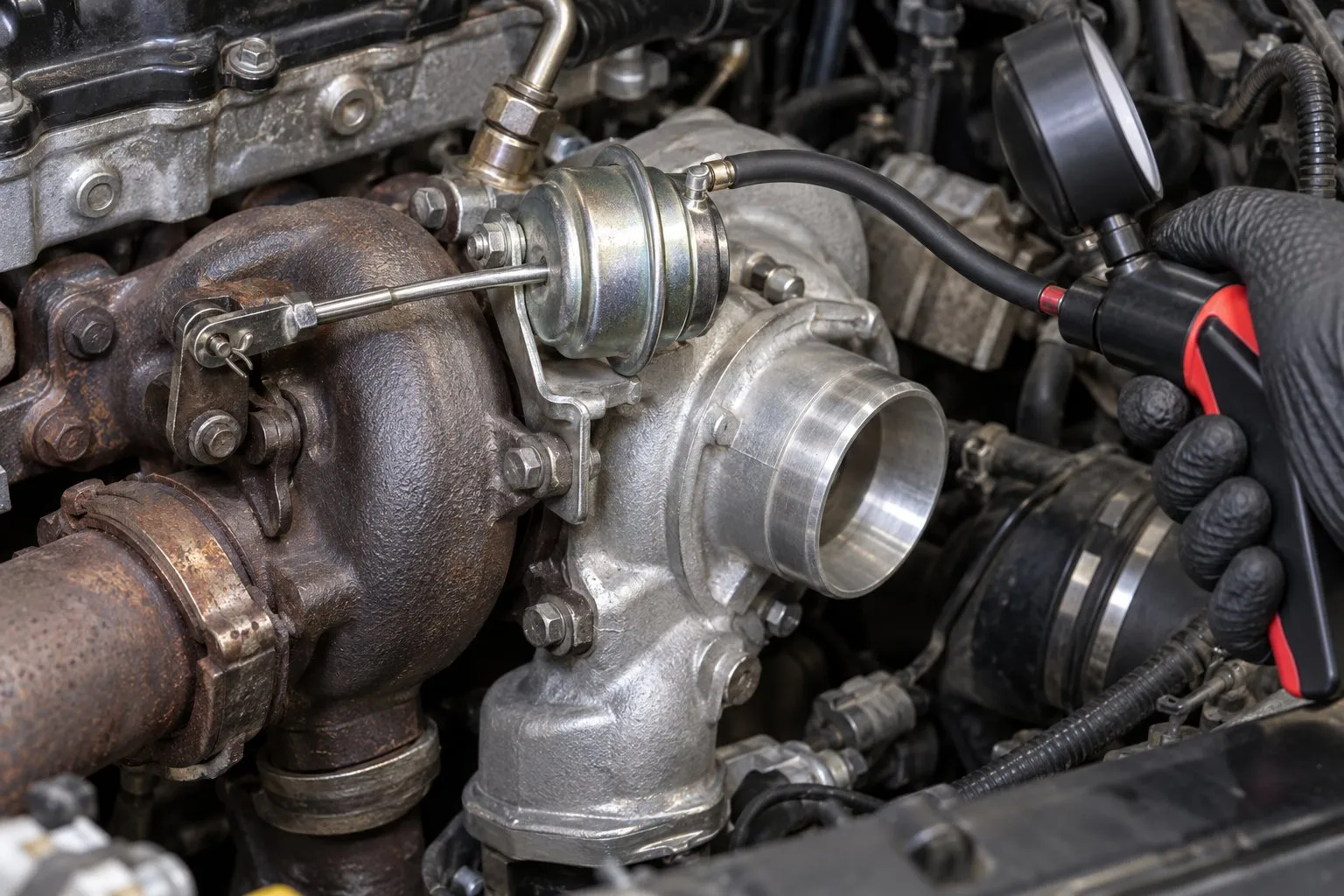
Here is something we tell customers every week: before you condemn the entire turbo, check the actuator. On many 4M41 and related TD03-class units, the core is fine and it is the pneumatic actuator that has failed or drifted out of calibration. Replacing just the actuator can save you hundreds of dollars.
The TD03-family pneumatic actuator is a common service part on these Mitsubishi applications.
Always match the actuator part number and the spring rate to your specific turbo casting, because a mismatched actuator will not hold the correct boost setpoint.
When in doubt about which actuator matches your turbo, contact PT Turbo with your turbo part number and we will confirm the correct fit before you order.
Setting Actuator Preload
A new actuator is only as good as its calibration. When you fit a replacement actuator, set the rod length and preload to the manufacturer spec, then verify with a hand pump or the vehicle’s boost solenoid. Skipping this step is the number one reason a replacement actuator still throws boost codes.
Mitsubishi 4M41 3.2L Turbocharger Guide: New vs Remanufactured Replacement
When the core is genuinely done, you have three real paths: a new OEM-equivalent turbo, a quality remanufactured unit, or a rebuild of your existing core. Each has a place depending on budget, downtime, and how long the truck needs to stay in service.
| Option | Typical Cost | Best For | Notes |
|---|---|---|---|
| New OEM turbo | $$$$ | Late-model, warranty-critical fleets | Highest cost, longest life expectancy |
| Remanufactured turbo | $$ | Most owners and fleets | New wheels, bearings, seals; balanced and tested |
| Rebuild your core | $ | Owners with a good, uncracked housing | Lowest cost if the core is salvageable |
| Actuator only | $ | Boost codes with a healthy core | Fastest, cheapest fix when it applies |
For most 4M41 owners, a properly done remanufactured turbocharger is the sweet spot. A real reman means the unit is stripped to the bare housing, fitted with new CHRA components, VNT mechanism cleaned or replaced, then balanced on a VSR machine and flow-tested before it ships. That is a world apart from a “cleaned and painted” used unit.
If your existing housing is in good shape, our turbocharger rebuild service lets you keep your original casting and get it back to spec for less. With 45+ years in the business, PT Turbo stocks both new and remanufactured Mitsubishi units, so you are not stuck with a single option.
Installation Best Practices for the 4M41
Getting the new or reman turbo to last means doing the install right. The 4M41 is not a forgiving engine when it comes to oil supply and contamination, and most premature failures are install-related, not part-related.
- Prime the oil feed. Before final startup, crank with the feed line open or pre-fill the bearing housing so you never dry-start the new unit.
- Replace the oil feed and drain lines. The feed banjo screen clogs with carbon and starves the bearing. If it is restricted, your new turbo dies the same way the old one did.
- Change the oil and filter. Debris from the failed turbo is now in the sump. Fresh oil and a new filter are non-negotiable.
- Clean or replace the EGR and intercooler piping. Old oil pooled in the intercooler will be carried into the engine and burned, and a large amount can make a diesel run away on its own oil.
- Verify the actuator setpoint. Confirm boost control operation before the vehicle goes back into service.
Take the time to inspect the air filter and the entire intake tract while you are in there. Any dust leak upstream of the compressor will scour the new wheel in short order, and that kind of damage will not be covered by any warranty.
After startup, let the engine idle for a few minutes so oil circulates fully through the bearing housing before you load it up. Watch for leaks at the feed and drain connections, listen for any unusual noise, and confirm boost comes on cleanly without codes. Do these steps every time and a quality turbo on a 4M41 will give you the service life it was built for.
For Mitsubishi Fuso’s Canter light truck, see our Mitsubishi Fuso 4P10 turbocharger guide.
Turbos we list for the TD03
Listings for the turbo models named in this guide that can be ordered online today. Several part numbers can fit one engine by year and rating, so match the number on your turbo’s tag, or call (909) 824-1020 and we will match it for you.
Frequently Asked Questions
What are the signs of a failing turbocharger on the Mitsubishi 4M41 engine?
Common symptoms include loss of power, excessive black or blue exhaust smoke, whining or whistling noises, and increased oil consumption. Boost pressure fluctuations and check-engine warnings can also indicate turbo failure.
Which Mitsubishi vehicles use the 4M41 3.2L diesel engine?
The 4M41 3.2L powers the Mitsubishi Pajero, Triton (L200), and Shogun, along with several light commercial platforms, in production for more than two decades. The fixed-geometry turbo and the variable-geometry turbo of the 2006-on Pajero are different units and do not interchange, so order by the number on the turbo.
How often should the 4M41 turbocharger be inspected or replaced?
Inspect the turbo during regular servicing and monitor for boost or oil issues. Most 4M41 turbochargers last 150,000 to 200,000 km, though poor maintenance or oil supply problems can shorten their lifespan.
Need a Turbocharger?
PT Turbo has rebuilt and sold turbochargers since 1978. We stock remanufactured units for Cummins, Duramax, Power Stroke, Detroit Diesel, and more — backed by a 12-month unlimited mileage warranty. Units in stock at our shop in San Bernardino, CA ship the same day when ordered before 2 PM Pacific, Monday through Friday.
📞 (909) 824-1020 · 346 S I St. #3, San Bernardino, CA 92410 · [email protected]