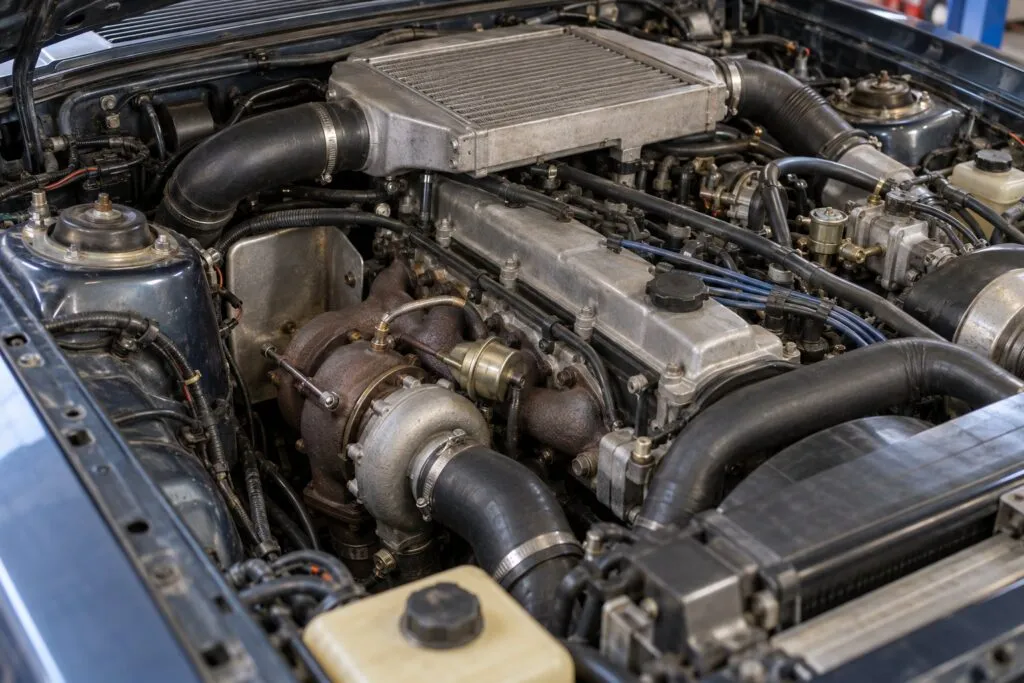
The Garrett T3 Turbocharger is one of the most recognizable turbos ever built, a journeyman design that spent decades bolted to everything from small-displacement diesels to boosted gasoline street cars. If you have turned a wrench since the 1980s, you have seen a T3 come across the bench, and chances are you have rebuilt a few. At PT Turbo we have been working on Garrett units since 1978, so this one is personal.
This guide breaks down the classic T3 design, where it was used, how to tell a tired one from a serviceable core, and the modern Garrett options that have effectively replaced it. We will keep it practical and keep it honest about what fits what.
What the Garrett T3 Turbocharger Actually Is
The T3 is part of Garrett’s “T-series” frame family, sitting between the smaller T2 and the larger T4. It was built around a journal-bearing center housing rotating assembly (CHRA) with a cast compressor wheel and a cast or (in later variants) upgraded inducer design. It was never a high-tech part, and that is exactly why it lasted so long.
The architecture is textbook Garrett: a divided or undivided turbine housing, a wastegated or free-floating exhaust side depending on application, and an oil-cooled journal bearing system. Many T3 units ran oil-only cooling, while heavier-duty and later versions added a water-cooled center section to survive hot shutdowns.
Because the T3 predates widespread variable geometry, you will not find moving vanes inside a true classic T3. Boost control came from an external or integral wastegate. If you want to understand how the industry moved past this fixed-geometry approach, the overview of variable-geometry turbochargers explains why modern diesels went a different direction.
Core Specs at a Glance
Exact dimensions varied widely by application, but the T3 family generally covered the following range. Treat these as representative, not absolute, since Garrett built hundreds of T3 part number variants.
| Characteristic | Classic Garrett T3 |
|---|---|
| Frame family | Garrett T-series (between T2 and T4) |
| Bearing system | Journal bearing, oil-fed (water-cooled on some) |
| Compressor wheel style | Cast aluminum, various trims |
| Common compressor trims | 45, 50, 60 and Super 60 |
| Common turbine A/R | .48, .63, .82 (stage / stepped options) |
| Boost control | Internal or external wastegate, free-floating variants |
| Typical flow capacity | Roughly 250 to 400 crank HP depending on trim |
Where the Garrett T3 Turbocharger Was Used
The T3’s spread is what made it famous. On the diesel side, it appeared on light-duty and small industrial engines, agricultural equipment, and a range of compact European and Asian diesels where its flow range matched displacement well.
On the gasoline side, the T3 became the backbone of factory turbo performance cars in the 1980s and early 1990s. It showed up on turbocharged inline-fours and V6 applications where a compact, journal-bearing unit with good low-end spool was the priority.
Its real legacy, though, is the aftermarket. The T3 became the default building block for the hybrid and “T3/T4” world, where builders mixed a T3 turbine section with a larger T4 compressor to tune spool against top-end flow. For a broader primer on how these matches affect spool and flow, the general turbocharger reference is a solid baseline.
Why It Stayed in Service So Long
- Simplicity. Journal bearings and a wastegate are easy to diagnose and rebuild.
- Parts availability. Decades of production mean cores, seals, and repair kits are still around.
- Flange standardization. The T3 mounting pattern became an industry reference point.
- Trim flexibility. A huge library of wheel and housing combinations let one frame cover many jobs.
Diagnosing a Worn Garrett T3
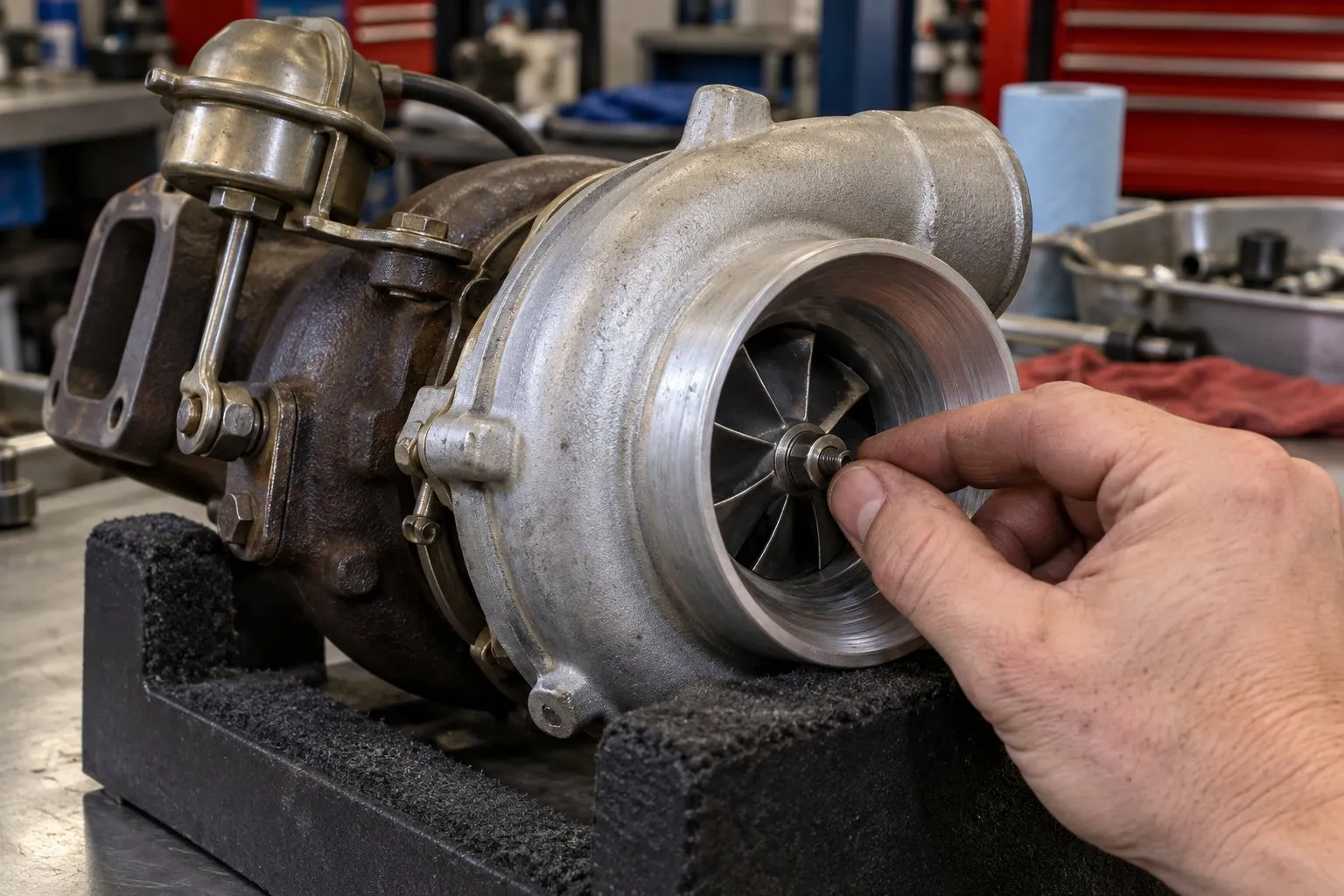
A T3 that is on its way out tells on itself early if you know what to look for. The failure modes are the same classics every journal-bearing turbo shows, and catching them early saves the engine downstream.
| Symptom | Likely Cause | Severity |
|---|---|---|
| Blue smoke on startup or decel | Worn seals, excessive shaft play, oil in exhaust/intake | Moderate to high |
| Whining or siren noise that changes with boost | Bearing wear, shaft imbalance | High |
| Oil at compressor outlet | Seal failure, blocked drain, crankcase pressure | Moderate |
| Low or slow boost | Wastegate stuck open, wheel damage, exhaust leak | Moderate |
| Visible wheel contact / rub marks | Bearing failure, excessive endplay | Critical, stop running it |
Before you condemn any T3, check shaft radial and axial play by hand, inspect both wheels for blade contact, and verify the oil feed is clean. A surprising number of “bad turbos” are really oil-starvation victims from a clogged feed line or a hot-shutdown habit.
Rebuild or Replace?
Here is the good news with a classic journal-bearing design: if the housings and shaft are good and the wheels are undamaged, a T3 is an excellent rebuild candidate. New bearings, thrust components, seals, and a balanced CHRA bring it back to spec at a fraction of new-unit cost.
PT Turbo’s turbocharger rebuild service handles this exact kind of work, and you can check what a given unit runs on our turbo rebuild price list rather than guessing. If your core is damaged beyond saving, our remanufactured turbochargers are a tested, ready-to-run alternative.
Modern Garrett Replacement Options for the T3
Garrett never really stopped serving the T3’s market, it just modernized it. The GT and GTX ball-bearing families now cover the same flow territory with faster spool, better efficiency, and dramatically better durability. If you are upgrading or replacing a T3 rather than restoring an original, these are the units to look at.
For the lower and middle of the old T3’s range, the GT2871R turbochargers and GT3071R turbochargers are the natural step up. They deliver the quick spool a small diesel or boosted four liked about the T3, with modern dual ball-bearing cartridges.
Where a T3 was pushed toward the top of its flow, the GT3076R and GT3582R pick up the slack with room to grow. For builders chasing the most efficient compressor maps available, the GTX3071R and GTX3076R use the forged, fully-machined compressor wheels that outflow anything the classic T3 could do.
| Application Goal | Classic T3 Trim | Modern Garrett Equivalent |
|---|---|---|
| Fast spool, small engine | T3, .48 A/R, 60 trim | GT2871R |
| Balanced street/tow | T3 Super 60 | GT3071R |
| Mid-range power build | T3/T4 hybrid | GT3076R / GTX3071R |
| Top-end flow priority | Large T3 turbine | GT3582R / GTX3076R |
One critical note: ball-bearing GT and GTX units have different oil feed and often different oil-restrictor requirements than an old journal-bearing T3. Do not reuse the original feed setup blindly. Match the feed and drain to the new cartridge’s spec, or you will cook a good turbo.
Picking the Right Replacement
Spool and flow are a tradeoff. A turbine section sized too large on a small engine lags, and a compressor sized too small chokes top end. The T3’s whole appeal was living in a sweet spot, so when you replace it, match the new turbo to the engine’s displacement and your actual power target, not to the biggest compressor you can fit.
If you are not sure which modern frame maps to your old T3 trim, call us. We match old T3 trims to current frames by the numbers on the turbo and can save you from an expensive guess. You can reach us through the PT Turbo contact page or at (909) 824-1020.
A Note on Emissions-Era Diesels
The classic T3 predates modern diesel emissions hardware, so if you are working on a newer EGR and DPF-equipped engine, you are almost certainly not dealing with a true T3. Most of those platforms moved to variable-geometry turbos, their vanes or nozzle moved by an electronic actuator or by engine oil pressure (a few, such as the Detroit DD13, DD15 and DD16, kept fixed geometry), for the precise boost and backpressure control needed to feed the EGR system and manage the diesel particulate filter.
If you landed here looking for a modern diesel truck turbo rather than a classic T3, our platform-specific guides are more useful, including the Ford 6.0L Powerstroke turbocharger guide and the Cummins ISB 5.9L HX35 vs HE351CW guide. For medium-duty work, see our Cummins ISC HX40 guide and the Cummins ISL turbocharger guide.
Whatever you are running, PT Turbo stocks both new and remanufactured units across Garrett, BorgWarner, Holset, and more. You can browse everything we carry in the turbo store, and the Garrett lineup itself is documented at Garrett Motion.
Frequently Asked Questions
Is the Garrett T3 Turbocharger still worth rebuilding?
Yes, if the core is sound. The T3 is a journal-bearing design with widely available internal parts, which makes it one of the more cost-effective turbos to rebuild. As long as the housings and shaft are good and the wheels have no blade damage, a fresh bearing and seal kit plus balancing brings it back to spec. Check current rebuild pricing for your specific unit on our rebuild price list.
What is the difference between a T3 and a T3/T4 hybrid?
A true T3 uses T3-frame turbine and compressor sections. A T3/T4 hybrid mates a T3 turbine housing and center section to a larger T4 compressor cover and wheel. The hybrid keeps much of the T3’s spool character while adding top-end flow, which is why it became a popular performance build in the 1990s and 2000s.
Which modern Garrett turbo replaces a T3?
It depends on your T3’s trim and your power goal. For quick spool on a small engine, the GT2871R is the closest fit (it has a T25 or V-band turbine inlet rather than a T3 flange, so allow for the manifold). For balanced street and tow use, the GT3071R works well, and for higher power the GT3076R, GT3582R, or the GTX versions of those frames outperform anything the classic T3 could do. Just remember that ball-bearing cartridges need the correct oil feed and restrictor, so plan the plumbing accordingly.
Need a Turbocharger?
PT Turbo has rebuilt and sold turbochargers since 1978. We stock remanufactured units for Cummins, Duramax, Power Stroke, Detroit Diesel, and more — backed by a 12-month unlimited mileage warranty and same-week shipping from San Bernardino, CA.
📞 (909) 824-1020 · 346 S I St. #3, San Bernardino, CA 92410 · [email protected]