Perkins 1106 Turbocharger Guide: Agricultural & Construction Equipment Applications
We wrote this Perkins 1106 turbocharger guide for the mechanics, owner-operators and fleet managers who keep six-cylinder Perkins 1106 engines working in farm and construction machines. These engines spend their lives in dust, heat, heavy load and long idle hours, and the turbo takes the brunt of all four.
This guide covers how to identify the right turbo, how these turbos fail in off-highway work, what to check before you condemn one, and how to replace or rebuild it so the next one lasts. PT Turbo is a family-owned shop in San Bernardino, California, and has been rebuilding turbochargers since 1978.
Why the Engine Name Alone Won’t Find Your Turbo
The 1106 is the six-cylinder member of the Perkins 1100 family. It has been built in more than one generation and emission level, and machine makers order it in the ratings that suit their equipment. Each of those choices can change the turbocharger.
Two machines with an 1106 in the engine bay can carry turbos with different compressor wheels, turbine housings, wastegate arrangements and flanges. A turbo that bolts on but has the wrong turbine housing will not deliver the boost the fuel calibration expects. A compressor that is too large for the engine’s airflow can surge. The turbocharger overview on Wikipedia explains how the compressor and turbine work together.
Always work in the same order:
- Read the full engine designation and serial number from the engine label.
- Read the part number off the turbo’s own tag.
Those two numbers decide the replacement, not the machine model. If your fleet also runs Cummins or Caterpillar power, our Cummins QSB turbocharger guide and Caterpillar C9 turbocharger guide cover those engines the same way.
Reading the Turbo Tag Before You Order
Where the tag sits depends on the turbo maker:
- BorgWarner and Holset: on the compressor housing.
- Garrett: the position varies by plant and region, so look over every housing.
After years on a machine the plate is often under a crust of oil and dirt. Clean it with degreaser and a soft brush, never a wire wheel, and photograph it before the job starts.
Off-highway engines from many makers use Garrett, BorgWarner or Holset turbochargers, and each maker formats its numbers differently.
| Turbo maker | Part number format | Also on the plate |
|---|---|---|
| Garrett | Six digits (starting with 4, 7 or 8), a dash, four digits, then S or W. The first digit after the dash: 0 = original equipment, 5 = new aftermarket, 9 = remanufactured. W = gasket kit included. | Original equipment plates also show the engine or vehicle maker’s number. |
| BorgWarner | Six digits (older S-series) or eleven digits. Older KKK-era numbers are written in 4-3-4 digit groups. | BorgWarner number, serial number and, on factory-fitted turbos, the engine maker’s part number. |
| Holset | Seven-digit assembly number plus a letter suffix. | The engine maker’s (customer) number, in a separate field. |
Garrett explains its part numbering on garrettmotion.com. Whatever the maker, do not order by the casting numbers on the housings. One casting serves many turbos, so a casting number can narrow a search, but only the tag number confirms a match.
If the plate is missing or unreadable, call (909) 824-1020 or reach us through the contact page before you order. Have the engine designation, the serial number and clear photos of the turbo and its flanges ready.
How 1106 Turbos Fail in Farm and Construction Work
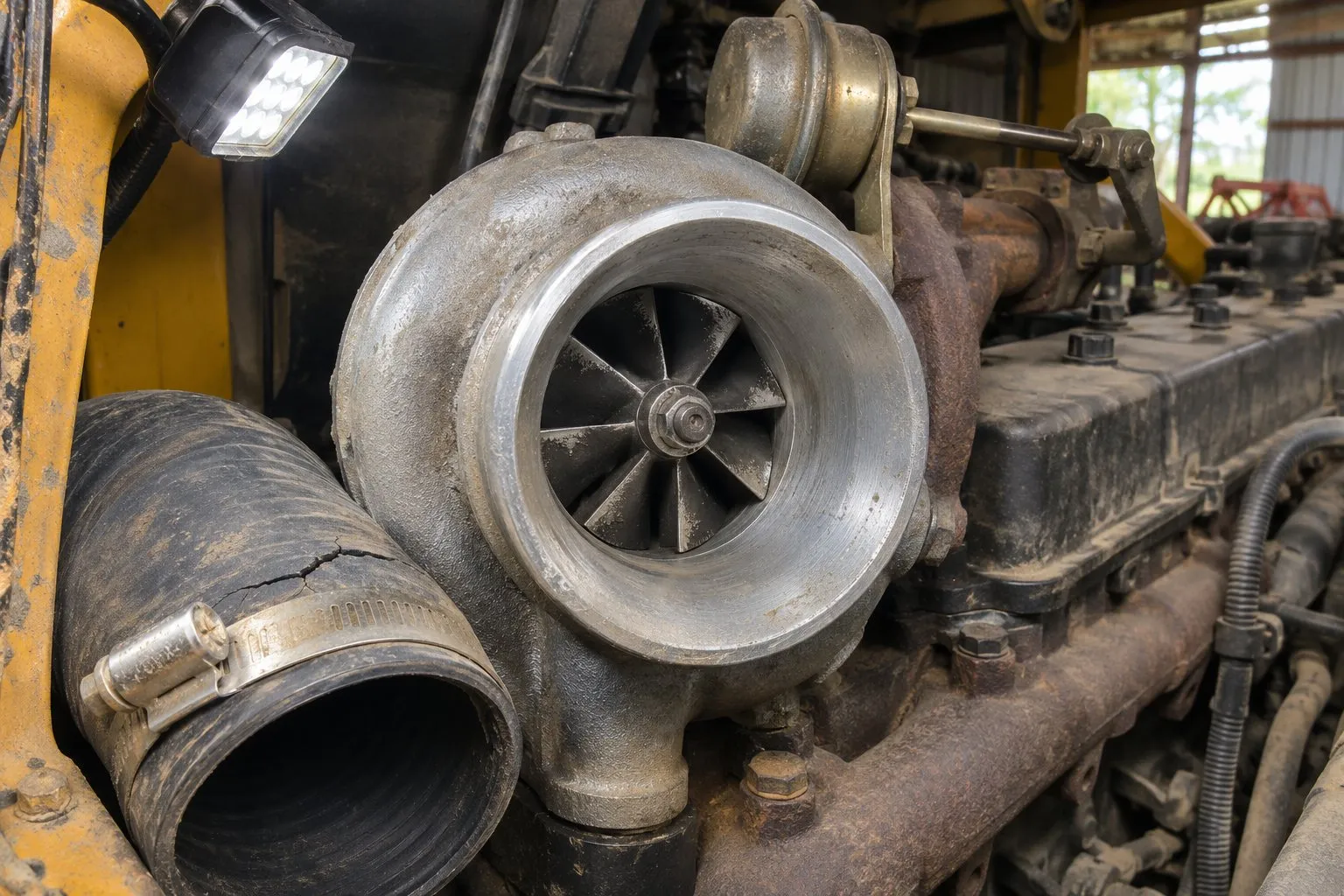
Garrett names oil starvation, oil contamination and foreign objects as the three main causes of turbo failure. It attributes more than 90 percent of failures to oil starvation or contamination. Machine work feeds all three causes and adds a dust load that highway engines rarely face.
Dust and Intake Leaks
Fine dust pits the compressor inlet blades at their leading edges, and larger debris bends or chips them. The pipe between the air filter and the compressor is under suction. A cracked hose, a loose clamp or a torn filter seal there does not leak boost. It pulls unfiltered air straight into the turbo.
Replace the filter element when the restriction indicator calls for it, and check its sealing face every time. Inspect every joint from the filter housing to the compressor inlet. Do not run a choked filter to the limit either, because a restricted inlet can pull oil past the compressor-end seal.
Oil Supply and Contamination
Common causes of oil starvation:
- Hard acceleration from a cold start, before oil reaches the turbo.
- Blocked or leaking oil pipes.
- A turbo fitted without priming.
Contamination wears the bearings. Carbon is the most common contaminant, along with engine wear debris, dirt let in during servicing and oil run past its life.
Change oil and filters on the engine maker’s schedule. Where the manual gives a severe-service schedule, use it for machines that idle a lot or work in dust. Turbo journal bearings are bronze, so rising copper in an oil report can point to bearing wear. Compare the result with your own baseline and the lab’s limits.
Heat, Idling and Shutdown
Shutting down right after a heavy pull leaves oil sitting in a hot center housing, where it cokes. That carbon scores the bearings and sticks the seal rings. Idle the engine before shutdown for the time given in the Perkins operation and maintenance manual.
Long idling causes a different problem. At idle there is little exhaust pressure holding oil in at the turbine-end seal. After long idle periods, oil can show at the turbine end and in the exhaust. It usually clears once the engine works under load.
Drains, Crankcase Pressure and Leaks
Oil leaves the turbo by gravity. The drain port should sit within about 15 to 20 degrees of straight down, and the line must run downhill and enter the sump above the oil level. A kinked or restricted drain backs oil up in the center housing and pushes it out at both ends. High crankcase pressure from ring and cylinder wear does the same. There is no universal crankcase pressure figure, so test it the way your engine’s service manual describes.
Leaks on either side of the turbo cause different problems:
- Charge air cooler or boot leak: the turbo has to spin faster to reach target boost, which can overspeed it.
- Exhaust leak before the turbine: low boost, slow spool and higher exhaust temperature.
- Fouled cooler (common on farm machines): a core packed with chaff or dust on the outside cools the charge air less, so check the outside as well.
Symptoms, Checks and Shaft Play
If the engine has electronic controls, read faults through the machine’s display or the engine maker’s service tool. Off-highway engines generally do not report the generic OBD-II codes used on road vehicles. Read the code, then work through the checks below before you blame the turbo.
| Symptom | Usual source | Check first |
|---|---|---|
| Black or dark gray smoke, low power | Low boost, too little air | Air filter restriction, charge-air leaks, exhaust leaks before the turbine, then the turbo |
| Blue-gray smoke, pooled oil in the charge pipes | Oil past the compressor seal, or crankcase oil | Breather, air filter, oil level, drain, crankcase pressure, then the seals. A light oil film is normal crankcase vapor. |
| Whistle or siren under load | Leaks or wheel damage | Charge-air and exhaust joints, wheel rubbing, bent blades, foreign objects |
| Oil at the exhaust after long idle | Low-load idling | Whether it clears under load, then the drain routing |
| Oil on the outside of the center housing | Gasket or line leak | Feed and drain gaskets and fittings, not the seals |
| White smoke | Coolant, or unburned fuel on a cold engine | Cooling and fuel systems. This is not a turbo symptom. |
For a hands-on check, remove the inlet pipe with the engine off and cool. Some side-to-side rock at the wheel is normal on a journal bearing turbo with no oil pressure, so that alone is no reason to condemn it.
Condemn the turbo for any of these:
- In-and-out play you can feel.
- A wheel that touches its housing when you rock it.
- Play beyond the maker’s limit. Axial play on a journal bearing turbo is typically 0.001 to 0.004 in.
Replacing or Rebuilding an 1106 Turbo
Find the cause before the new turbo goes on. A turbo that failed from dust, starvation or a blocked drain will kill its replacement the same way.
| Option | Best fit | What to know |
|---|---|---|
| New turbo | The housings are cracked or badly damaged, or you want a unit on hand before the old one comes off | Search our store by the number on the tag. Current pricing is on the product page, or call (909) 824-1020. |
| Remanufactured turbo | You want a tested unit and can return a core | Availability depends on core supply, so check the remanufactured turbochargers by tag number. The core goes back within 30 days. |
| Rebuild of your turbo | The housings are sound and you want your own unit back | Balanced and inspected in-house. The price is confirmed after inspection, and most rebuilds ship in 3 days or less. |
Our in-house turbo rebuild service is backed by more than 45 years in business. Every turbo we rebuild in-house is balanced on a VSR (Vibration Sorting Rig) and gets a final quality inspection. That includes a leak test, a visual inspection and, where the turbo has one, an actuator or wastegate function check.
The rebuild price is confirmed after inspection and before any work starts. Our turbo rebuild price list shows current prices by turbo. The warranty is 12 months with unlimited mileage.
Core return terms: return shipping is paid by the customer, and if you need more than 30 days, call ahead. Fleets running several 1106 machines can call about priority or rush turnaround and about having us keep their common cores on hand.
Fitting the Turbo So It Lasts
- After a bearing failure or coked oil, fit a new oil feed line rather than flushing and reusing the old one.
- Confirm the drain is clear and runs downhill. Use new gaskets and no sealant on the oil inlet or drain.
- If the old compressor wheel shed metal, replace the charge air cooler and clean or replace the charge piping. Metal in the fins cannot be flushed out reliably.
- Fit a new air filter element and check every intake joint.
- Fill the oil inlet with clean engine oil and turn the wheel by hand.
- Crank for 10 to 15 seconds while the engine is kept from starting by the engine maker’s procedure.
- Start the engine and idle 3 to 4 minutes, checking for oil, exhaust and air leaks, as Garrett’s installation guide advises.
A turbo has no break-in: no mileage schedule, no early oil change and no boost limit for the first hours.
Frequently Asked Questions
Do all Perkins 1106 engines use the same turbocharger?
No. Engine generation, emission level, rating and the machine maker’s specification can all change the turbo, so the engine name alone is not enough. Match the part number on the turbo’s tag, and keep the engine designation and serial number at hand when you order.
Is it worth rebuilding a Perkins 1106 turbo instead of buying new?
Often, when the housings are sound. A rebuild replaces the bearings, seal rings and thrust parts, and any turbine wheel with blade damage is replaced, never rebalanced and reused. The price is confirmed after inspection, before work starts, and most rebuilds ship in 3 days or less.
Why does my 1106 drip oil from the exhaust after long idling?
At idle there is little exhaust pressure holding oil in at the turbine-end seal, so oil can show at the turbine end after long idle periods. It usually clears under load. If it persists after normal work, check the drain routing and crankcase pressure before blaming the turbo seals.
Need a Turbocharger?
PT Turbo has rebuilt and sold turbochargers since 1978. We stock remanufactured units for Cummins, Duramax, Power Stroke, Detroit Diesel, and more — backed by a 12-month unlimited mileage warranty. Units in stock at our shop in San Bernardino, CA ship the same day when ordered before 2 PM Pacific, Monday through Friday.
📞 (909) 824-1020 · 346 S I St. #3, San Bernardino, CA 92410 · info@ptturbo.com
More From PT Turbo
 Holset HX40 Turbocharger: Specs, Cummins ISC Applications & Replacement
- BorgWarner AirWerks Turbocharger Guide: Performance Diesel Application Reference
- Holset HX35 Turbocharger: Dodge Ram 5.9L Cummins Application & Fitment Guide
- UD/Nissan FE6 Turbocharger Guide: Medium Duty Truck Applications & Replacement