This UD/Nissan FE6 Turbocharger Guide covers everything diesel mechanics, fleet managers, and owner-operators need to know about the turbocharger systems on the FE6 inline-six diesel, from application data and failure diagnosis to real replacement and rebuild options. The FE6 has powered UD (Nissan Diesel) medium-duty trucks for decades, and while these engines are famously durable, the turbo is one component that eventually wears out. Getting the right replacement, and knowing whether to rebuild or replace, saves both downtime and money.
At PT Turbo, we have been rebuilding and supplying turbochargers since 1978. Over 45 years in the business means we have seen just about every FE6 turbo failure mode there is, and we stock both new and remanufactured units to get your truck back on the road fast.
The FE6 Engine and Its Turbocharger System
The Nissan Diesel FE6 is a 6.9-liter inline-six naturally aspirated or turbocharged diesel, depending on the variant. The turbocharged and intercooled versions, commonly badged FE6T and FE6TA, were used across the UD medium-duty lineup including the 1800, 2000, 2300, 2600, and 3300 series trucks.
These trucks found homes in delivery fleets, tow operations, landscaping, and municipal service. Power output on turbocharged FE6 variants ranged from roughly 160 to 230 PS (about 158 to 227 hp) across the FE6 family, with torque in the 400 to 480 lb-ft range depending on model year and injection setup.
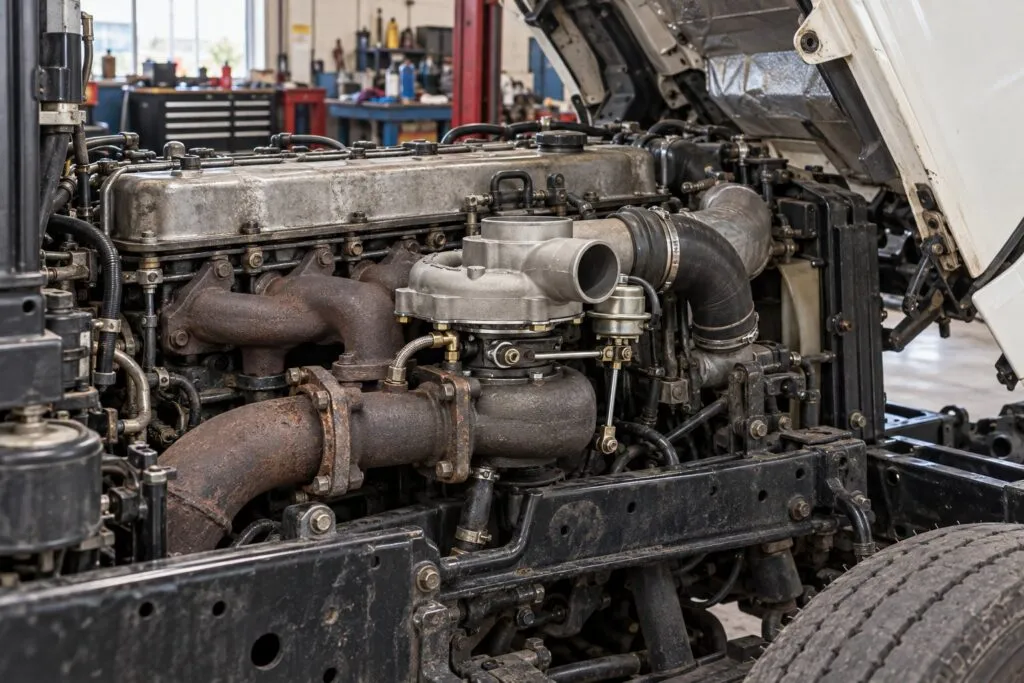
FE6 engines run a single turbocharger: parts listings show an IHI RHC62E on the FE6T (Nissan number 14201-Z5613) and a Garrett GT3576DL on the FE6TA and FE6TC (14201-Z5905). Go by the number on your own turbo. The turbocharger compresses intake air to force more of it into the cylinders, and on the FE6 that boost is regulated by a pneumatic wastegate actuator that opens under manifold pressure to bleed off excess exhaust gas.
Typical FE6 Turbocharger Specs
| Parameter | Typical FE6T Value |
|---|---|
| Turbo type | Single, wastegated |
| Common turbos | IHI RHC62E (FE6T), Garrett GT3576DL (FE6TA, FE6TC) |
| Boost pressure | Approx. 12 to 18 psi |
| Wastegate control | Pneumatic actuator (boost referenced) |
| Oil feed | Pressure fed from engine oil gallery |
| Bearing system | Journal bearing, oil cooled |
Common FE6 Turbocharger Failure Symptoms
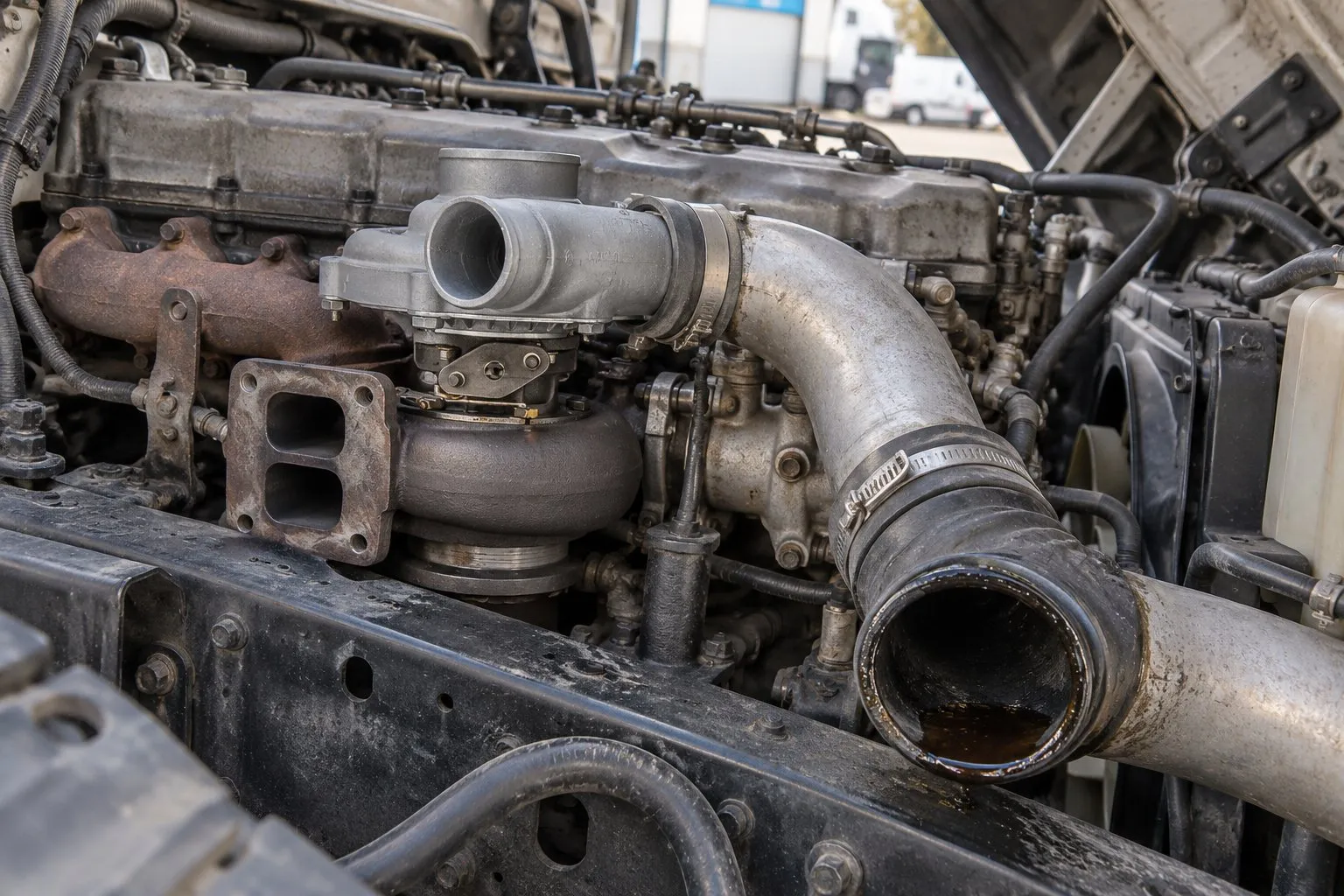
A failing turbo rarely quits all at once. It gives you warning signs, and reading them early prevents a small repair from turning into a catastrophic one that sends debris downstream into the intercooler and intake.
The most common failure driver on high-mileage FE6 units is bearing wear from oil contamination or extended service intervals. When the journal bearings wear, the shaft develops play, the seals leak, and boost falls off.
Symptoms by Severity
| Severity | Symptom | Likely Cause |
|---|---|---|
| Early | Slight power loss, longer to build boost | Actuator drift, minor shaft wear |
| Early | Faint whistle or siren noise | Compressor seal or housing leak |
| Moderate | Blue smoke on acceleration | Oil past worn seals |
| Moderate | Black smoke, sluggish throttle | Underboost from stuck wastegate |
| Severe | Grinding or metallic rattle | Bearing failure, shaft contact |
| Severe | Oil in intercooler or intake piping | Complete seal failure |
If you find oil pooling in the charge piping or intercooler, do not simply bolt on a new turbo. Clean the entire intake tract first, because leftover oil will smoke and can cause a runaway condition on a fresh unit.
The Wastegate Actuator: The Most Overlooked FE6 Turbo Part
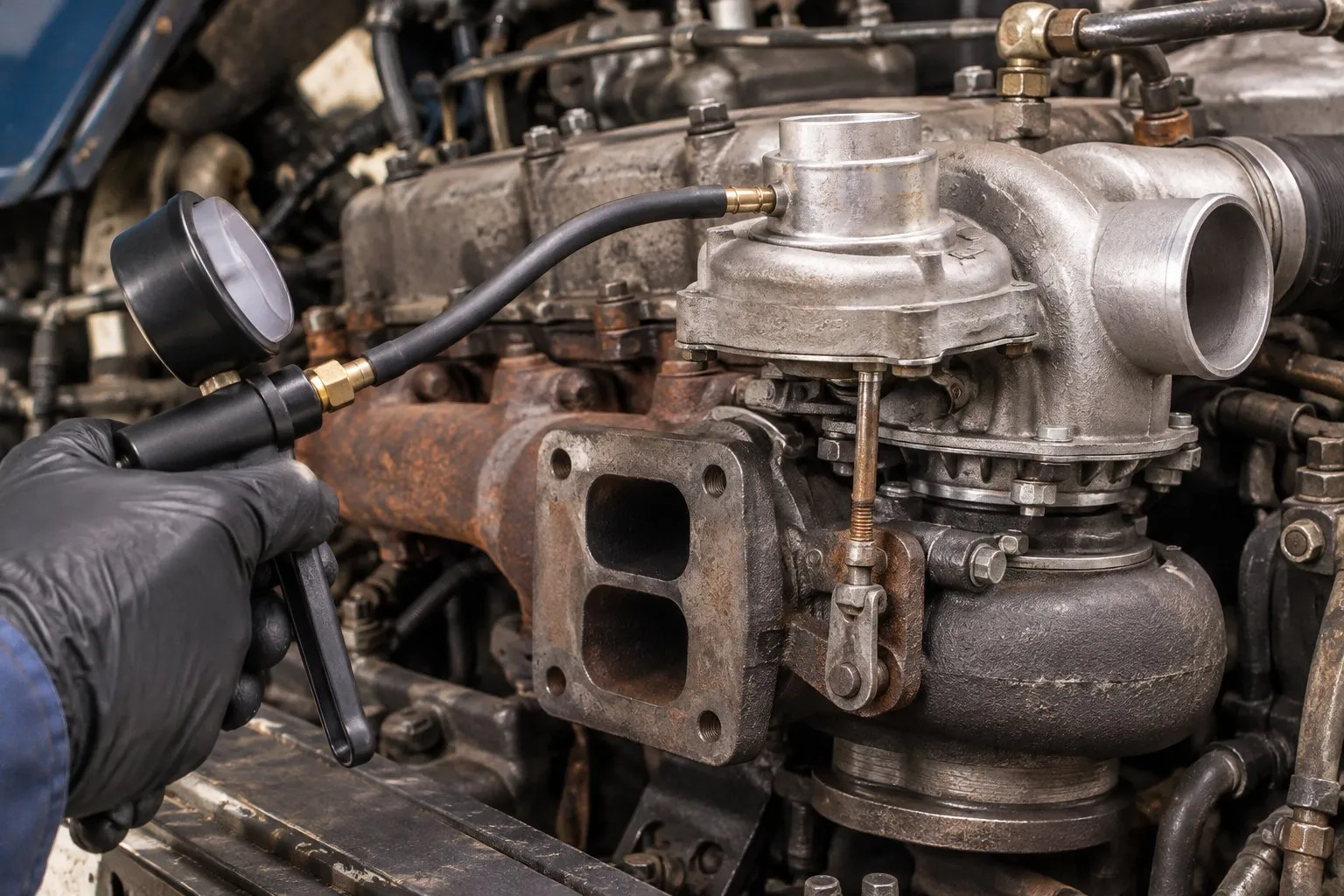
On many FE6 turbos, the turbo itself is fine but the pneumatic wastegate actuator has failed. A leaking diaphragm or a corroded, seized rod is one of the most common causes of both underboost and overboost complaints, and it is a fraction of the cost of a full turbo.
A stuck-closed wastegate causes overboost and can crack ring lands. A wastegate stuck open bleeds boost early, giving you the classic “no power up a grade” complaint; a leaking actuator does the opposite and lets boost run high. Testing the actuator with a hand pump is a five-minute job that saves an unnecessary turbo swap.
Always confirm the actuator’s boost crack pressure and rod length against your original before ordering. If you are unsure which actuator matches your specific FE6 build, contact PT Turbo with your turbo part number and we will match it.
UD/Nissan FE6 Turbocharger Guide to Replacement Options
When the core is worn, you have three real paths: a new OEM turbo, a quality remanufactured unit, or rebuilding your existing core. Each makes sense in different situations, and the right call depends on downtime tolerance, budget, and core condition.
New OEM turbos deliver the longest warranty but carry the highest cost and, for older FE6 platforms, can involve long lead times as supply thins out. Remanufactured turbos offer the best balance for most fleet and owner-operator work.
New vs Remanufactured vs Rebuild
| Option | Relative Cost | Turnaround | Best For |
|---|---|---|---|
| New OEM | Highest | Varies, can be long | Warranty-critical fleet units |
| Remanufactured | Moderate | Fast, in stock | Most FE6 replacements |
| Rebuild your core | Lowest | Depends on core | Rare or hard-to-source frames |
Our remanufactured turbochargers are built to OEM tolerances with new bearings, seals, and balanced rotating assemblies, then flow tested before they ship. For fleets running multiple FE6 trucks, standardizing on reman units keeps per-unit cost down without sacrificing reliability.
If you have a sound core, our turbocharger rebuild service restores it to spec with a full balance and inspection. This is often the most economical route when a specific FE6 turbo frame is hard to source new.
Installation and Longevity Tips
A turbo failure is often a symptom, not a root cause. Before you install a replacement, find out why the original died, or you will be doing this job again in short order.
- Prime the oil feed. Before starting, crank with the fuel shut off, or pre-fill the oil inlet so the bearings are not running dry on first fire.
- Replace the oil feed line. Coked or restricted feed lines are the number one killer of FE6 turbo bearings. Never reuse a suspect line.
- Change oil and filter. Fresh oil protects the new unit and clears any debris the old turbo shed.
- Inspect the air filter and intake. A collapsed or dirty filter starves the compressor and pulls dust past worn seals.
- Check the drain. A restricted oil return causes pressurized oil to blow past seals, which mimics a bad turbo on a brand new part.
- Let it idle after start. Give the truck a few minutes at idle before loading it so oil circulates fully.
For crews maintaining mixed fleets, our other medium-duty guides are worth a read, including the Cummins ISC HX40 guide and the Cummins ISL turbocharger guide.
Do all of this once and a quality FE6 turbo will outlast the next set of brake jobs. Skip the root-cause check and even the best reman unit will fail on the same contaminated oil or restricted drain that took out the original. The part is only as good as the system feeding it.
Match the frame and actuator to your exact build, address the feed and drain, and standardize across your trucks where you can. That combination keeps an FE6 making boost for the long haul and keeps your downtime predictable.
For Isuzu FTR and FVR trucks, see our Isuzu 6HK1 turbocharger guide.
Frequently Asked Questions
What trucks use the UD/Nissan FE6 diesel engine?
The FE6 inline-six diesel has powered UD (Nissan Diesel) medium-duty trucks for decades. It’s commonly found in delivery, vocational, and fleet applications valued for durability.
What are the common signs of a failing FE6 turbocharger?
Typical symptoms include loss of power, excessive exhaust smoke, whining noises, and oil leaks around the turbo. Catching these early helps prevent costly engine damage.
Should I replace or rebuild the FE6 turbocharger?
Rebuilding can be cost-effective if the core is in good condition, while replacement offers reliability and a fresh warranty. The best choice depends on damage extent and budget.
Need a Turbocharger?
PT Turbo has rebuilt and sold turbochargers since 1978. We stock remanufactured units for Cummins, Duramax, Power Stroke, Detroit Diesel, and more — backed by a 12-month unlimited mileage warranty and same-week shipping from San Bernardino, CA.
📞 (909) 824-1020 · 346 S I St. #3, San Bernardino, CA 92410 · [email protected]