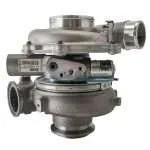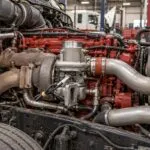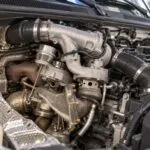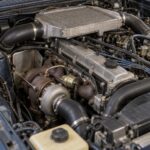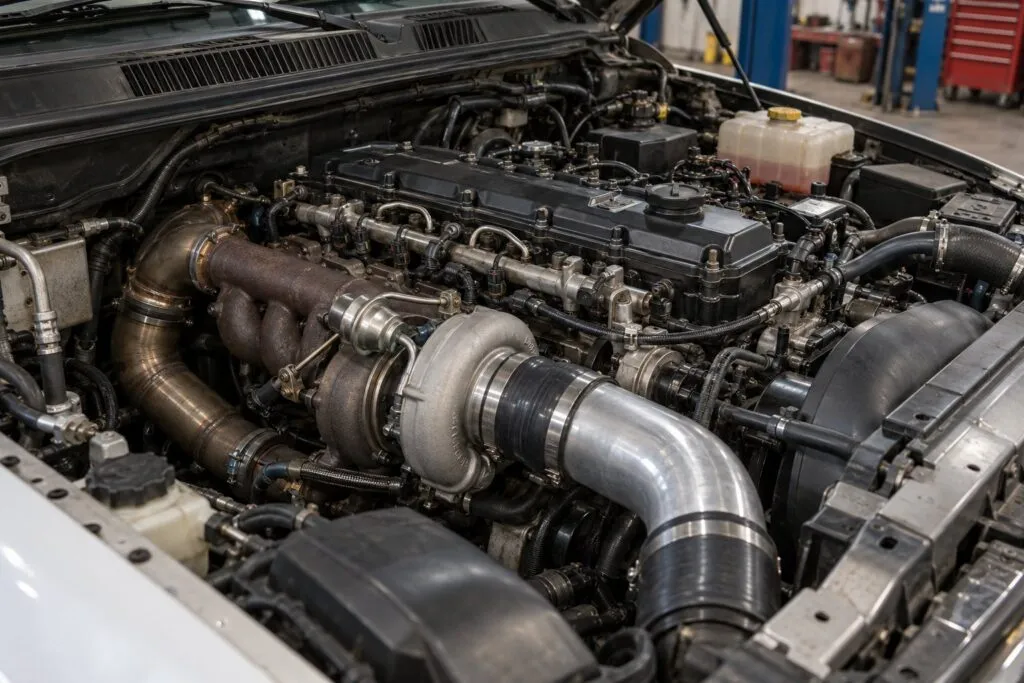
The BorgWarner EFR Series Turbocharger represents one of the most significant leaps in aftermarket forced induction technology, bringing motorsport-grade materials and dual ceramic ball bearing cartridges to diesel builders who demand fast spool and reliable boost under heavy load. EFR stands for Engineered For Racing, but over the past decade these units have earned a serious following in performance diesel circles where transient response and durability matter more than headline numbers alone.
At PT Turbo we have spent 45+ years working with turbochargers of every make and configuration, and the EFR platform continues to show up in dyno-proven diesel builds for good reason. This guide breaks down the lineup, the applications, and what you actually need to know before bolting one to a compression-ignition engine.
What Makes the BorgWarner EFR Series Turbocharger Different
The EFR family was designed from a clean sheet rather than adapted from an existing OE casting. The turbine wheels are Gamma-Ti titanium aluminide, which is roughly half the density of Inconel and dramatically reduces rotating inertia.
Less inertia means the turbine responds faster to throttle and load changes. For a diesel that spends its life in the mid-range under towing or pulling loads, that translates to quicker recovery between shifts and less lag off idle.
Every EFR uses a dual ceramic ball bearing cartridge instead of a traditional journal bearing. Ball bearings tolerate thrust loads better, need less oil flow, and spool measurably sooner. BorgWarner also integrates the wastegate actuator and, on many units, an internal boost control solenoid provision, cleaning up the plumbing on a performance build.
You can read BorgWarner’s own technical overview at borgwarner.com. For broader background on how these systems work, the turbocharger fundamentals reference is a solid primer for anyone training new techs.
EFR Frame Sizes and Diesel Application Ranges
The EFR lineup is organized by turbine wheel frame and compressor wheel diameter. Choosing the right frame is about matching airflow to your engine displacement and target power, not just buying the biggest housing available.
Here is a practical breakdown of where each common EFR frame lands for diesel use:
| EFR Model | Turbine Wheel | Approx. Airflow (lb/min) | Typical Diesel Use |
|---|---|---|---|
| EFR 6758 | 58 mm | up to about 53 | 2.0L to 3.0L, quick-spool street/tow |
| EFR 7163 | 63 mm | up to about 60 | 3.0L to 4.5L, sled pull single |
| EFR 7670 | 70 mm | up to about 64 | 5.9L / 6.7L Cummins, moderate build |
| EFR 8374 | 74 mm | up to about 79 | 6.7L Cummins/Power Stroke, high output |
| EFR 9180 | 80 mm | up to about 95 | Large diesel, compound low-side |
For a 5.9L or 6.7L Cummins builder looking at a single-turbo swap, the 7670 and 8374 frames are the sweet spot. If you are still deciding between a stock-frame upgrade and a full EFR conversion, our Cummins ISB 5.9L turbocharger guide comparing the HX35 and HE351CW covers the OE side of that decision in detail.
Actuators and Boost Control on EFR Diesel Builds
Most EFR turbine housings ship with an internal wastegate and a factory pneumatic actuator (some of the larger twin-scroll housings are for an external wastegate), but diesel builders frequently upgrade or replace actuators to dial in boost precisely. The actuator is the component that opens the wastegate flap against spring pressure once target boost is reached, and it wears out or drifts over time.
Matching actuator spring pressure to your build is critical. Too soft and you cannot hold boost under load; too stiff and you overshoot and risk overspeeding the compressor.
PT Turbo stocks a full range of replacement pneumatic actuators that cross over to many turbo platforms, including EFR-adjacent and OE diesel units.
Not sure which actuator spring rate matches your target boost? Our team has crossed thousands of these. Reach out through our contact page with your turbo model and boost goal and we will spec it correctly.
Oil, Coolant, and Installation Requirements
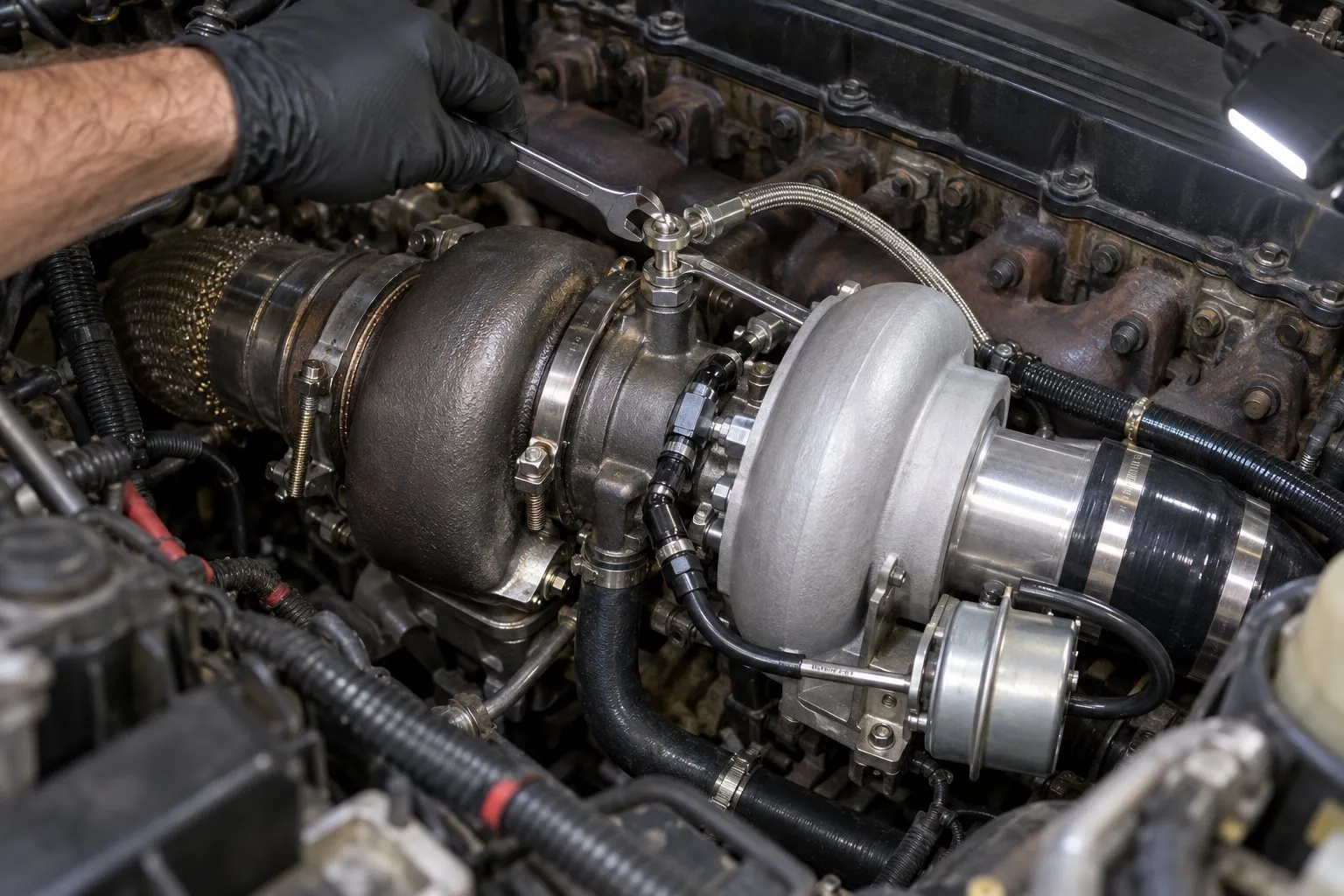
The ceramic ball bearing cartridge in a BorgWarner EFR Series Turbocharger is far more forgiving on oil supply than a journal-bearing unit, but that does not mean you can ignore plumbing. The EFR cartridge has its oil restrictor built in, so a normal installation adds no external restrictor; what it needs is clean oil at normal engine pressure and a free drain.
Over-oiling is the number one cause of premature EFR seal failure. Too much pressure past the ball bearings pushes oil toward the compressor and turbine seals, and you end up chasing a smoking exhaust that is not a ring problem at all.
Key installation points for diesel EFR fitment:
- Do not add an external oil restrictor: the bearing housing has its own, and BorgWarner calls for 15 to 60 psi of oil pressure at the turbo when warm
- Ensure a smooth, downhill drain back to the pan above the oil level with no kinks
- Plumb the coolant lines (every EFR bearing housing is water-cooled) to prevent heat soak after shutdown
- Verify wastegate actuator preload before first start
- Prime the bearing cartridge with clean oil before cranking
On EGR-equipped emissions diesels, remember that intake and exhaust flow characteristics change with the recirculation loop active. If your build retains factory emissions hardware, review how exhaust gas recirculation interacts with your boost targets before finalizing wheel sizing.
EFR Versus OE and Remanufactured Alternatives
An EFR is a premium purchase, and it is not the right answer for every diesel. If you are keeping a work truck near stock and just need reliable boost, a quality remanufactured OE-style turbo delivers better value.
Here is how the options compare for a typical medium-duty diesel owner:
| Option | Relative Cost | Spool | Best For |
|---|---|---|---|
| New EFR unit | Highest | Fastest | Performance and competition builds |
| New OE turbo | High | Good | Warranty-sensitive fleet trucks |
| Remanufactured OE turbo | Moderate | Good | Cost-conscious stock rebuilds |
| Rebuild your existing core | Lowest | Same as original | Keeping an OE unit alive |
PT Turbo stocks both new and remanufactured units, and every reman we sell is built to strict tolerances. Browse our remanufactured turbocharger inventory if a cost-effective OE replacement fits your project better than an EFR conversion.
If you already have a good core, our turbocharger rebuild service restores it to spec with balanced rotating assemblies and new seals, often for less than half the cost of new. You can also shop all turbos to compare part numbers directly.
Where the EFR Fits in the BorgWarner Diesel Family
BorgWarner produces both OE variable-geometry diesel turbos and the performance EFR line, and the two serve different masters.
The variable-geometry units are built to satisfy emissions targets and deliver broad drivability across the rev range on a stock vehicle, with movable vanes managing exhaust flow for low-end response and top-end breathing. That makes them the right tool when you are keeping a truck emissions-compliant and need factory manners.
The EFR line throws the VGT complexity out and leans on wheel materials, bearing design, and precise frame selection to make power. There are no moving vanes to carbon up, which is one less failure point on a hard-working diesel, but you give up the automatic range-management a VGT provides and have to size the frame correctly for your application.
For a builder chasing repeatable performance and fast recovery under load, the EFR earns its place. For a fleet truck that has to pass inspection and never see a dyno, the OE variable-geometry turbo remains the smarter choice.
Frequently Asked Questions
What does EFR stand for in BorgWarner turbochargers?
EFR stands for Engineered For Racing, reflecting the motorsport-grade materials and technology built into the series. These features have made EFR turbos popular in high-performance diesel applications.
Are BorgWarner EFR turbochargers good for diesel applications?
Yes, EFR turbos are well-suited for diesel builds thanks to their dual ceramic ball bearing cartridges, fast spool, and ability to maintain reliable boost under heavy load. They are favored by diesel builders demanding both performance and durability.
What makes the EFR Series different from other aftermarket turbochargers?
The EFR Series uses motorsport-grade materials and dual ceramic ball bearing cartridges for quicker spool and improved reliability. This combination delivers responsive boost and consistent performance under demanding conditions.
Need a Turbocharger?
PT Turbo has rebuilt and sold turbochargers since 1978. We stock remanufactured units for Cummins, Duramax, Power Stroke, Detroit Diesel, and more — backed by a 12-month unlimited mileage warranty and same-week shipping from San Bernardino, CA.
📞 (909) 824-1020 · 346 S I St. #3, San Bernardino, CA 92410 · [email protected]
More From PT Turbo
 Garrett GT3788VA Turbocharger: Duramax LBZ & LMM Application & Replacement Guide
- Holset HE451VE Turbocharger: Cummins ISX15 Application Guide
- Mercedes OM651 Turbocharger Guide: Sprinter 2.1L CDI Failure Symptoms & Replacement
- Garrett T3 Turbocharger: Classic Design, Applications & Modern Replacement Options