Holset HX60 Turbocharger: Cummins QSX & Heavy Industrial Applications
The Holset HX60 Turbocharger is a large-frame, fixed-geometry Holset unit built for heavy-duty Cummins power, and it sits near the top of the HX family in both airflow capacity and physical size. If you run a Cummins QSX in a mining truck, a wheel loader, a drill rig, a genset or a marine application, the Holset HX60 turbochargers family is one of the names you will meet when a turbo comes due. This guide covers what the HX60 is, where it belongs, how it works, and how it fails, from the bench perspective of a shop that has been rebuilding turbochargers since 1978.
Holset has been part of Cummins since 1973, and the brand became Cummins Turbo Technologies in 2006. That relationship is why so many Cummins engines across the on-highway and off-highway ranges carry HX-series hardware from the factory. The HX60 and its wastegated version, the HX60W, belong to the big end of that lineup.
What the Holset HX60 Turbocharger Is
The HX60 is a single, fixed-geometry turbocharger. In Holset naming, the number is the frame size, so the HX60 is a larger frame than an HX55, which in turn is larger than an HX50 or HX40. A “W” suffix, as on the HX60W, means the turbo carries a wastegate; the letter stands for wastegated, not water-cooled.
Because it is fixed-geometry, the HX60 has no variable nozzle, no unison ring, no sliding nozzle and no electronic VGT actuator to calibrate. That is the opposite of the Holset VE and VG models (the HE551VE, HE400VG and similar) you find on later emissions-era engines. If you want to understand how those differ, the general principle is covered well in the variable-geometry turbocharger overview, and the HX60 is firmly on the conventional, fixed-nozzle side of that line.
Every HX60 is identified by the Holset assembly number stamped on the data plate on the compressor housing. Casting numbers on the housings are not part numbers; one casting serves many builds. Always match the number on the tag to your engine, because wheel trims and housing A/R can differ between what look like identical turbos.
Cummins QSX and Heavy Industrial Applications
The HX55W and HX60W were the fixed-geometry, wastegated turbos fitted to the pre-EGR Cummins ISX, the 15-liter engine built through 2002 before cooled EGR and variable-geometry turbos took over (the 2003-2007 CM870 ISX used an HE551V whose actuator is air-operated; electronic actuators came with the CM871). The QSX is the off-highway and industrial member of that same engine family, which is why a large fixed-geometry Holset like the HX60 shows up across the heavy equipment world: mining and construction trucks, loaders, dozers, cranes, drilling and pumping packages, gensets and marine.
The exact turbo for any given rating is decided by the engine’s CPL and the application, not by the engine name alone. A QSX in a genset and a QSX in a haul truck can wear different turbos. Do not order by “QSX15” or by a casting number; order by the Holset assembly number on your turbo’s data plate. If you are not sure what you have, PT Turbo can identify it from the tag; call (909) 824-1020 or use the contact page.
Owners who also run a Ram pickup should note the HX60 has nothing in common with the 5.9L and 6.7L truck turbos. Those are covered in our 5.9L Cummins turbocharger guide and 6.7L Cummins turbocharger guide. The HX60 is a bigger, heavier, industrial-duty unit.
How the HX60 Works, and How It Differs From a VGT
On a fixed-geometry turbo, exhaust energy spins the turbine, the shaft drives the compressor, and the compressor packs more air into the intake. There is no way to change the effective nozzle area on the fly, so on the HX60W boost control is handled by the wastegate (a plain HX60 has none and relies on its housing size and the engine fueling instead): once boost pressure on the wastegate actuator is high enough, the wastegate opens and bleeds exhaust around the turbine to cap boost. The basic cycle is explained in the turbocharger reference.
That is the key practical difference from the later variable-geometry Holsets. A VGT trims airflow continuously and needs its nozzle and actuator in good order; a fixed-geometry HX60 only has to spin freely and seal, and on a W model a wastegate that opens at the right pressure. Fewer moving parts to fail, and no actuator calibration after service.
The HX60 rides on plain journal bearings fed by engine oil. Some side-to-side shaft play is normal on a journal-bearing turbo when it is sitting on the bench with no oil pressure. What you condemn a turbo for is in-and-out (axial) play you can feel, a wheel that contacts its housing when you rock it, or play beyond the maker’s limit, not for any movement at all.
Common HX60 Failure Modes
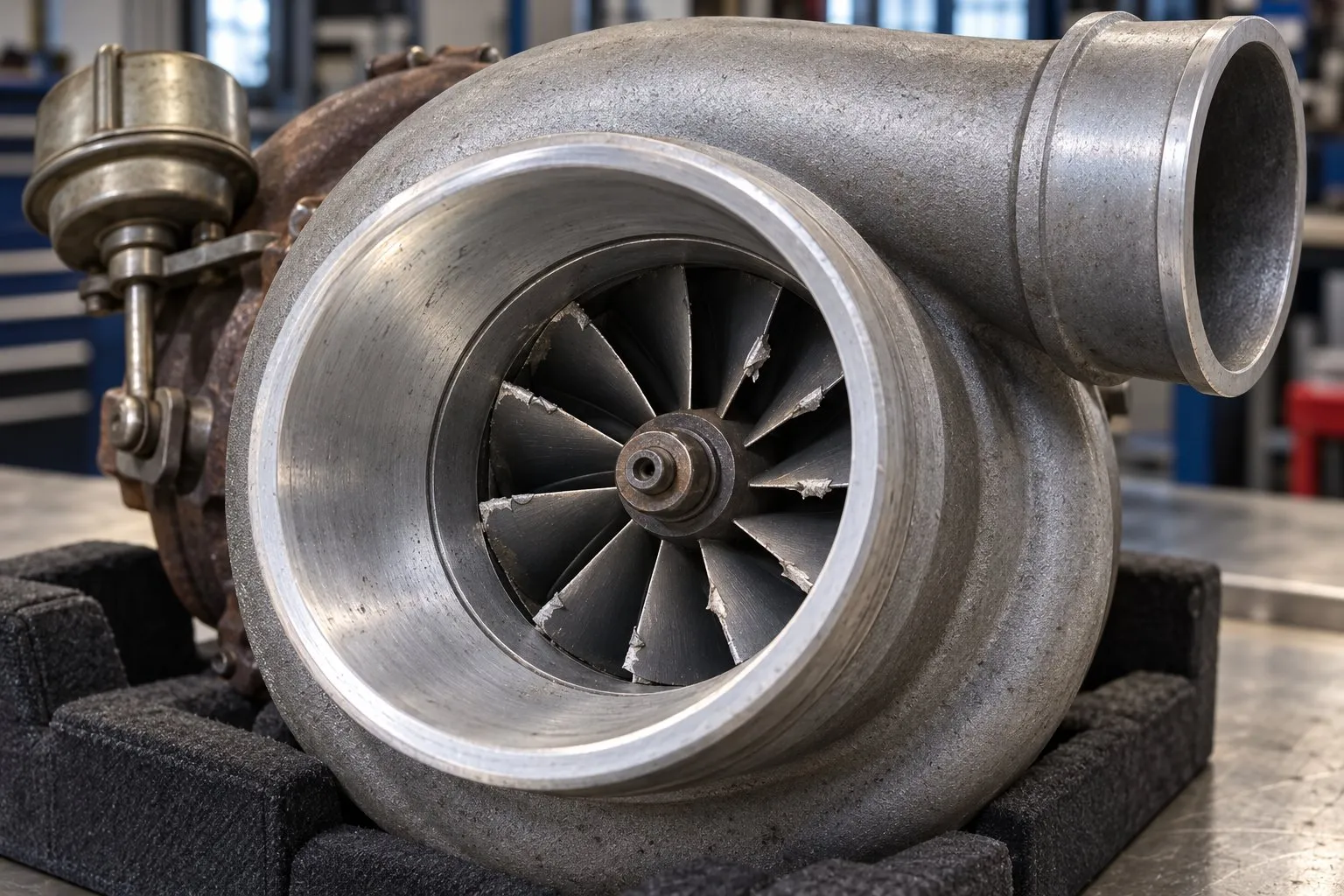
Most turbocharger failures trace back to the oil supply, not to a defect in the turbo. Delayed oil at startup, a restricted feed line, coked oil in a hot-shutdown engine, or contamination from a worn engine will wipe the bearings fast. After any bearing failure, replace the oil feed line rather than reuse it, because debris and varnish hide inside it.
The other big killers are foreign-object damage and wastegate trouble. Debris that comes in through the intake hits the compressor wheel; debris or a broken upstream part hits the turbine on its inlet leading edges. A wheel with blade damage gets replaced, never filed down and reused. Here is how the common complaints usually break down:
| Symptom | Likely cause | What to check first |
|---|---|---|
| Low boost, slow spool, high exhaust temperature | Wastegate not seating, or an exhaust leak in the up-pipes or manifold before the turbine | Wastegate flapper and linkage, manifold and up-pipe joints |
| Overboost | Wastegate held shut (seized linkage or failed actuator diaphragm on a boost-opened gate) | Wastegate movement and actuator signal |
| Blue-gray smoke, oil in charge piping | Compressor-side seal, but often crankcase pressure or a restricted drain instead | Breather, oil level, oil drain, air filter before blaming the seal |
| Oil at the turbine end, clears under load | Extended idling, or a restricted oil drain backing oil up past the seal | Drain routing (must run downhill into the pan above oil level) |
| Grinding, shaft noise, side play you can feel in and out | Bearing wear from oil starvation or contamination | Axial play, wheel-to-housing contact, oil feed condition |
| Metal in the compressor or turbine | Foreign-object damage | Intake tract integrity, upstream exhaust hardware, charge air cooler |
Two mechanical points save a lot of wasted parts. First, some oil film in the charge pipes is normal on any engine with closed crankcase ventilation, so check the breather, filter, oil level and drain before condemning a turbo for “burning oil.” Second, if a compressor wheel has shed metal, the charge air cooler must be replaced, not just flushed; the debris cannot be reliably cleaned out of the fins and will be carried into the engine.
On mechanical and off-highway QSX packages, do not expect generic OBD-II trouble codes. Heavy engines report through SPN and FMI numbers and the engine maker’s own fault codes, and a fixed-geometry HX60 is diagnosed on boost pressure, drive pressure, exhaust temperature and physical inspection, not on a scan tool reading P0299.
Rebuild or Replace Your Holset HX60 Turbocharger
A fixed-geometry HX60 is a strong candidate for rebuild. A proper rebuild kit holds new bearings, seal rings and thrust parts, and the cartridge is rebalanced on a vibration sorting rig after assembly. There is no electronic actuator to source and no nozzle pack to match, which keeps a quality rebuild practical.
PT Turbo is a family-owned turbocharger specialist in San Bernardino, California, in business since 1978, with more than 45 years of turbo work behind it. The shop stocks both new and remanufactured turbochargers and remanufactures units in-house, so an HX60 can be handled either as an exchange unit or as a rebuild of your own core.
For cost, we point you to the live catalog rather than a number that goes stale. Rebuild pricing is shown on our turbo rebuild price list and confirmed after inspection before any work starts; see the turbocharger rebuild service page for how it works. Most rebuilds ship in 3 days or less, remanufactured units carry a 30-day core return, and the work is backed by a 12-month, unlimited-mileage warranty. Fleet customers can arrange priority turnaround and core stocking by phone.
When you reinstall, follow the engine maker’s first-start steps: fill the oil inlet with clean engine oil, turn the wheel by hand, then crank or idle a few minutes before load. Use no sealant on the oil inlet or drain gaskets, and make sure the drain runs downhill into the pan above the oil level.
Frequently Asked Questions
Is the Holset HX60 a variable-geometry turbo?
No. The HX60 is a fixed-geometry turbocharger, and the W models carry a wastegate for boost control. It has no variable nozzle, no sliding ring and no electronic actuator to calibrate, which sets it apart from the later Holset VE and VG units used on emissions-era Cummins engines.
How do I confirm the right HX60 for my Cummins QSX?
Go by the Holset assembly number on the data plate on the compressor housing, not by the engine name or a casting number. QSX and ISX ratings can wear different turbos depending on the CPL and the application, so matching the tag is the only reliable way. Send the number to PT Turbo at (909) 824-1020 and the shop will confirm the correct unit.
Should I rebuild my HX60 or buy a replacement?
Both are good options for a fixed-geometry turbo like this, and the right call depends on the condition of your core and your downtime. If the housings and wheels are sound, a rebuild restores the cartridge; if you need a unit on the shelf, a new or remanufactured exchange turbo gets you running sooner. Current pricing for each is on the product page and the rebuild price list, or call the shop to talk it through.
Shopping by part number?
Every part number we stock for the Holset HX60 is on one page, with live prices and stock: Holset HX60 turbos and parts.
Need a Turbocharger?
PT Turbo has rebuilt and sold turbochargers since 1978. We stock remanufactured units for Cummins, Duramax, Power Stroke, Detroit Diesel, and more — backed by a 12-month unlimited mileage warranty. Units in stock at our shop in San Bernardino, CA ship the same day when ordered before 2 PM Pacific, Monday through Friday.
📞 (909) 824-1020 · 346 S I St. #3, San Bernardino, CA 92410 · [email protected]