Holset H1C Turbocharger: Classic 5.9L Cummins Specs & Replacement Guide
The Holset H1C Turbocharger is the turbo that launched the Dodge Ram Cummins era, bolted to the 5.9L 6BT 12-valve in 1989 and carried through the 1993 model year before the next-generation chargers took over. If you own an early first-generation Ram, keep an old 6BT running in a work truck, or maintain industrial 5.9L equipment, this is the fixed-geometry Holset you are most likely looking at. Here is what it is, how it works, how it fails, and what your real options are when it is tired.
PT Turbo has been rebuilding Holset chargers since 1978, more than 45 years, and we stock both new and remanufactured units for the classic Cummins platform. Below is the straight technical picture, no guesswork.
What the Holset H1C Turbocharger Is
The H1C is a fixed-geometry, journal-bearing turbocharger with no wastegate and no variable nozzle. There are no vanes, no unison ring, no actuator and nothing electronic to calibrate. Exhaust spins the turbine, the shaft drives the compressor, and boost rises with engine load. That simplicity is exactly why these turbos are still turning on trucks decades later.
Holset was founded in 1952 in Huddersfield, England, and Cummins bought the company in 1973 (it has traded as Cummins Turbo Technologies since 2006). The H1C sits in the H1 family alongside the H1D and H1E, and it was the factory charger on the 1989-1993 Dodge Ram 5.9L Cummins. Because the same frame served several applications with different compressor, turbine and housing combinations, the number on the compressor-housing data plate is the only thing that identifies your exact unit. Match that plate, not the engine name. On the Dodge Ram the plate usually reads 3526740H on 1989 and 1990 trucks, and 3531038H or 3531810H on 1991 to 1993 trucks; the wastegated 1994 and 1995 trucks take an HX35W 3539912H.
For a plain-English refresher on how any turbocharger works, Wikipedia keeps a solid overview of turbocharger operation.
H1C Specs and Where It Fits
The H1C is the earliest of the 5.9L Cummins Dodge chargers. On the 1994 trucks, sources differ between a wastegated WH1C and the HX35W that defined the later 12-valve years, so a 1994 truck can turn up with either. From the 1995 trucks on, the 5.9L moved to the HX35W family. If you want the full breakdown of the chargers that followed, our 5.9L Cummins turbocharger guide covering the HX35, HY35 and HE351CW walks through each one.
Because this is a pre-1996 mechanical engine, there are no generic OBD-II trouble codes to read. You diagnose the H1C the old way: boost gauge, exhaust color, shaft play, and your eyes and hands. Do not expect a scan tool to tell you anything about this turbo.
| Feature | Holset H1C | Later HX35W |
|---|---|---|
| Geometry | Fixed | Fixed |
| Wastegate | None | Yes (the “W”) |
| Bearing type | Journal | Journal |
| Actuator | None | Wastegate actuator only |
| Factory engine | 1989-1993 5.9L 12-valve | 1995-2002 5.9L 12-valve / early 24-valve |
| Diagnostics | Mechanical, no fault codes | Mechanical, no fault codes |
Use the engine maker’s figures for your specific build when you check target boost, since the exact rating varies by application and the plate number on the housing is the authority. Do not chase a number you read online for a different truck.
How the H1C Fails

A fixed-geometry turbo has very little to go wrong on the control side, so when an H1C acts up it almost always traces back to one of a few things: the oil supply, the seals, a damaged wheel, or worn bearings. Most turbo failures across every make start at the oil supply, and the H1C is no exception.
- Oil starvation or coked oil: A kinked or restricted feed line, a missed oil change interval, or long periods without a cooldown idle will cook the bearings. After any bearing failure, replace the oil feed line rather than reusing it, because debris and varnish hide inside it.
- Blocked oil drain: The drain is a gravity return that must run downhill and enter the pan above the oil level. A restricted or crushed drain backs oil up and pushes it past both seals, so you see oil at the compressor and the turbine end.
- Seal leaks: Oil in the charge pipes gets past the compressor-side seal; oil in the exhaust gets past the turbine-side seal. Before you blame either seal, check the crankcase breather, air filter, oil level and drain, because some oil film in the charge pipes is normal on any engine with closed crankcase ventilation.
- Wheel damage: Debris through the compressor or turbine chips the leading edges. A wheel with blade damage is replaced, never rebalanced and reused.
- Worn bearings: Some side-to-side shaft play is normal on a journal-bearing turbo. Condemn the unit for in-and-out play you can feel, for the wheel touching its housing when you rock it, or for play beyond Holset’s limit, not for any movement at all.
Reading the Symptoms on an H1C Turbocharger
Low boost with black or gray smoke means too little air for the fuel, which on a fixed-geometry turbo points to a leak in the intake tract, a tired compressor, or exhaust escaping before the turbine through the manifold or up-pipe. Blue-gray smoke points to oil past a seal. A loud, rising whine, in-and-out shaft play you can feel, or a wheel that touches its housing tells you the bearings are done (some side-to-side play is normal on a journal-bearing turbo with no oil pressure). White smoke on this engine is unburned fuel or coolant, not a turbo fault.
Rebuild or Replace the H1C
You have three real paths with a classic Holset: rebuild the core you have, buy a remanufactured turbocharger, or fit a new unit. The right call depends on the condition of your housings and wheels and how fast you need the truck back.
| Option | Best when | What you get |
|---|---|---|
| Rebuild your core | Housings and wheels are clean and undamaged | New bearings, seal rings and thrust parts; balanced cartridge; your original housings reused |
| Remanufactured unit | You want a ready-to-bolt-on turbo and can send a core | Inspected and rebuilt to spec with a core return window |
| New unit | Your core is damaged beyond reuse | All-new turbo, no core needed |
A proper rebuild replaces the bearings, seal rings and thrust components, and the cartridge is balanced on a vibration sorting rig before it ships. There is no such thing as a “balance kit,” and a wheel with blade damage gets replaced, not rebalanced. Our turbocharger rebuild service handles the H1C in-house, and most rebuilds ship in 3 days or less, with the price confirmed after inspection and before any work starts.
For current numbers, our turbo rebuild price list shows real rebuild pricing by model, and new or remanufactured unit pricing is on the H1C model page where every part we stock for this turbo is listed. If you would rather talk it through with the number on your data plate in hand, call the shop at (909) 824-1020.
Installation and First-Start Notes
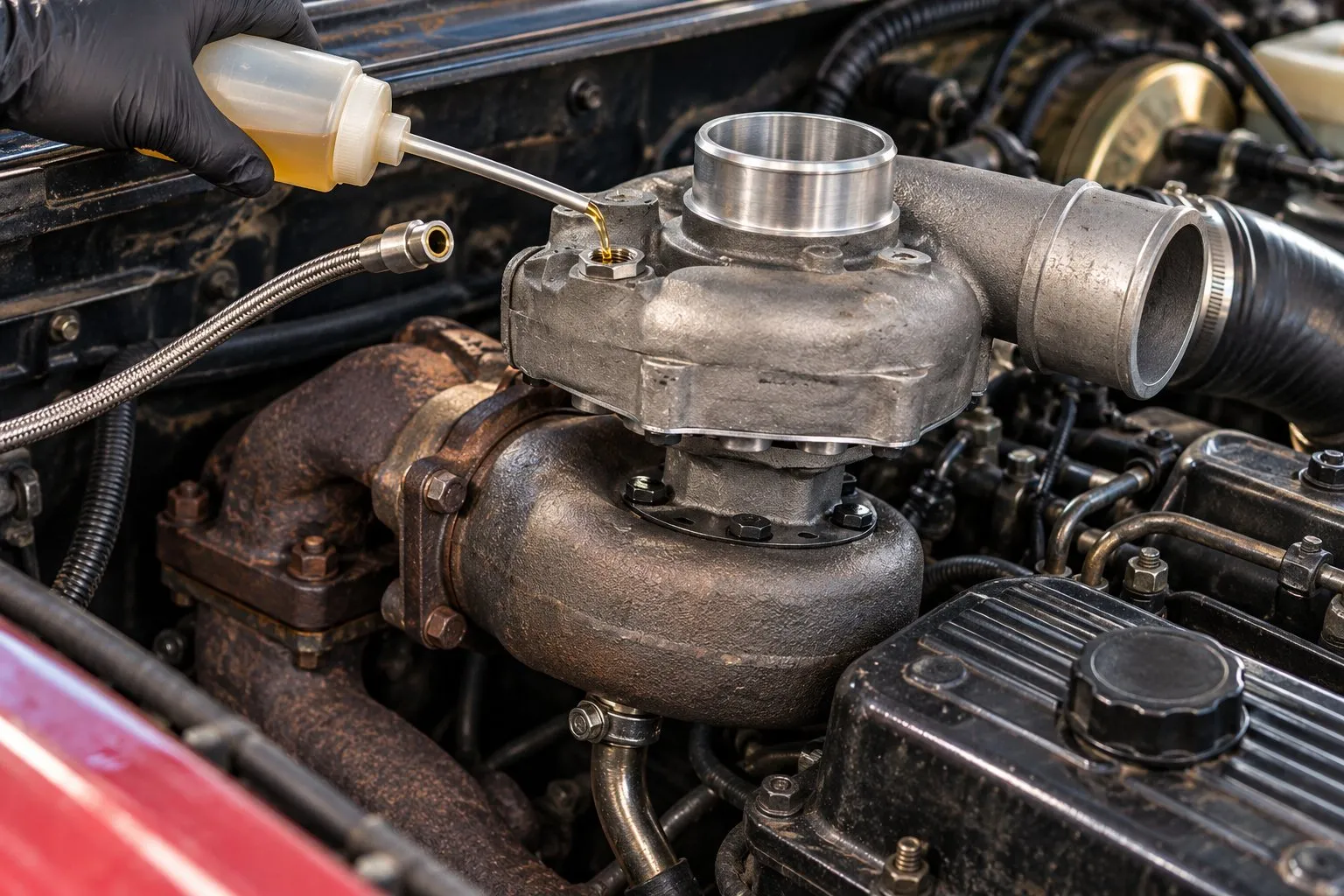
The H1C is a gasket-and-clamp install with an oil feed and a gravity drain, no electronics to plug in. A few things make or break the job:
- Keep the oil drain within about 15 to 20 degrees of straight down so oil returns freely.
- Use no sealant on the oil inlet or drain gaskets.
- If the old turbo spun a bearing, fit a new oil feed line rather than reusing a line full of debris.
- Before first start, fill the oil inlet with clean engine oil, turn the compressor wheel by hand, then crank without starting and let it idle a few minutes before load.
- If the old turbo shed metal, clean the charge piping and replace the intercooler: intercooler makers advise replacing it after a compressor-wheel failure, because metal trapped in the fins cannot be flushed out reliably and debris left there goes straight into the engine.
Follow the engine maker’s priming and start-up procedure only. There is no break-in mileage schedule, no first-miles boost limit and no special early oil change needed beyond that. A 30 to 60 second cooldown idle after normal driving, and up to a few minutes after hard work, is the single best habit for making the next H1C last.
Turbos we list for the HX35W and WH1C
Listings for the turbo models named in this guide that can be ordered online today. Several part numbers can fit one engine by year and rating, so match the number on your turbo’s tag, or call (909) 824-1020 and we will match it for you.
Frequently Asked Questions
Does the Holset H1C have a wastegate?
No. The H1C is a fixed-geometry turbo with no wastegate and no variable nozzle. The wastegated version of the H1 frame carries a W in the name, such as the WH1C that appears on some 1994 trucks. Go by the plate on the compressor housing to confirm which one you have.
Can I upgrade my 1989-1993 Ram from the H1C to a later turbo?
Many owners move to an HX35W-style charger for more airflow, but the swap involves different housings, oil and exhaust connections and fitment details, so it is not a simple bolt-for-bolt change. Bring your application and goals to the shop before you buy, and the team can tell you what actually fits your truck. Call (909) 824-1020 with your data plate number.
How do I know if my H1C needs rebuilding or replacing?
Check shaft play, wheel condition and for oil at either end. Some side-to-side play is normal, but in-and-out play you can feel, a wheel that contacts its housing, or chipped wheel blades means the turbo needs work. If the housings and wheels are clean, a rebuild restores it; if the core is damaged, a new or remanufactured unit is the move.
Shopping by part number?
Every part number we stock for the Holset H1C is on one page, with live prices and stock: Holset H1C turbos and parts.
Need a Turbocharger?
PT Turbo has rebuilt and sold turbochargers since 1978. We stock remanufactured units for Cummins, Duramax, Power Stroke, Detroit Diesel, and more — backed by a 12-month unlimited mileage warranty. Units in stock at our shop in San Bernardino, CA ship the same day when ordered before 2 PM Pacific, Monday through Friday.
📞 (909) 824-1020 · 346 S I St. #3, San Bernardino, CA 92410 · [email protected]