Kubota RTV & SVL Turbocharger Guide: Diesel Utility & Compact Track Loader
We wrote this Kubota RTV & SVL turbocharger guide for the mechanics, rental fleets and owner-operators who keep Kubota diesel utility vehicles and compact track loaders working. Both machines live in dust, heat and stop-start duty, which is hard on a small turbo’s bearings and seals. The sections below cover how to confirm which turbo you have, how this work wears it out, what the symptoms point to, and how to replace or rebuild it so the next one lasts.
PT Turbo is a family-owned shop in San Bernardino, California, and has been rebuilding turbochargers since 1978. After more than 45 years, the rules are the same for a compact equipment turbo as for a heavy-truck unit: identify the exact turbo, find what killed the old one, and give the new one clean oil and clean air from the first start.
Confirm the Engine and the Turbo Before You Order
Start with the machine, not the catalog. Kubota builds both naturally aspirated and turbocharged versions of its compact diesels, so a diesel badge does not guarantee a turbo. This is especially true on a utility vehicle. Open the engine bay and look: a turbocharged engine has a snail-shaped housing bolted to the exhaust manifold, with a pipe running from the air cleaner to its compressor side.
Next, read the Kubota engine plate. Kubota model codes for turbocharged engines carry a T in the suffix, and the engine model and serial pin down the exact build. Then find the tag or data plate on the turbo itself. That number is the one you order by.
Sellers consistently list an IHI RHF3 for the turbocharged Kubota V2403 and a TD03L4 from the Mitsubishi TD03 family for the V3307. Use those listings as a starting point, not as a part number, because turbo numbers change with rating, emissions level and machine. If your SVL’s engine plate reads V3800, our Kubota V3800 turbocharger guide covers that engine in detail.
| What to read | Where you find it | What it tells you |
|---|---|---|
| Engine model and serial | Kubota engine plate | Engine version, whether it is turbocharged, and the build the turbo was matched to |
| Turbo part number | Tag or data plate on the turbo | The exact unit to order or rebuild. Search by this number. |
| Machine model and serial | Machine serial plate | Helps confirm changes made during production |
| Housing casting numbers | Cast into the housings | Narrows the search only, because one casting serves many turbos |
Search our turbocharger store by the number on the tag, or send that number through our contact page and we will match it. If the tag is missing or unreadable, have the engine model and serial ready and call (909) 824-1020. Our agricultural equipment turbocharger buying guide covers Kubota alongside John Deere and Case equipment.
How Track Loader and Utility Work Wears a Turbo
Dust on the Intake Side
A compact track loader breathes dirty air all day. The pipe between the air cleaner and the turbo is under suction, so a cracked hose, a split boot or a loose clamp there pulls unfiltered dirt straight into the compressor. Dust erosion shows as pitting on the inlet edges of the compressor blades. Bent or chipped blades mean something solid went through.
Replace the air filter when the restriction indicator calls for it. Each time the filter comes out, check every hose and clamp between the air cleaner and the turbo. A restricted filter also raises suction at the compressor inlet and can pull oil past the compressor-end seal.
Oil Supply and Oil Quality
According to Garrett, more than 90 percent of turbo failures come from oil starvation or oil contamination. These are the main causes of each:
- Starvation: hard throttle on a cold engine, blocked or leaking oil lines, or a turbo that was never primed when it was fitted.
- Contamination: carbon, engine wear debris, dirt let in during service, a bypassing oil filter, and oil run past its life.
Change oil and filters on Kubota’s schedule. If the machine works in dust, runs long hours or idles a lot, use Kubota’s severe-service schedule instead. Run the oil grade the operator’s manual names.
Idling, Hot Shutdowns and Heat
Utility vehicles and loaders idle for long stretches, then often get shut down right after a hard push up a grade or into a pile. A hot shutdown leaves oil in the turbo’s center housing to bake into carbon, which later scores bearings and sticks seal rings. After hard work, idle for the time Kubota’s operator’s manual gives before you shut down.
Keep the engine compartment and the radiator and cooler screens clear of chaff and debris. Debris packed around the exhaust manifold and turbo traps heat and is a fire risk.
If your machine has a diesel particulate filter, it sits after the turbo. Let an active regeneration finish as Kubota advises, because a loaded filter raises exhaust backpressure on the turbine side.
Symptoms and What to Check First
Many turbo complaints start somewhere else. Work through the simple checks before you pull the turbo.
| Symptom | What it usually points to | Check first |
|---|---|---|
| Black or dark gray smoke under load, low power | Too little air (low boost) | Air filter restriction, intake leaks, boost leaks, exhaust leaks before the turbine, then the turbo |
| Blue-gray smoke | Oil burning | Crankcase breather, air filter, oil level and turbo oil drain before the turbo seals |
| Pooled oil in the pipe after the compressor | Oil past the compressor-end seal | Air filter restriction and breather. A light oil film is normal crankcase vapor. |
| Oil drips from the exhaust after long idle | Oil at the turbine end at low exhaust flow | Usually clears under load. If it does not, check the drain. |
| Whine or siren that changes with load | Exhaust or boost leak, or a wheel touching | Exhaust joints before the turbine and pressure-side joints first, then the wheels |
| Oil on the outside of the center section | Gasket or line leak | Oil feed and drain gaskets and fittings, not the internal seals |
| White smoke | Coolant, or unburned fuel on a cold engine | Not a turbo symptom. Check the cooling and fuel systems. |
Kubota’s electronically controlled engines report faults on the machine display or through the dealer service tool. Look the code up in Kubota’s service manual for that engine rather than in a road-vehicle code list.
When the Turbo Itself Has Failed
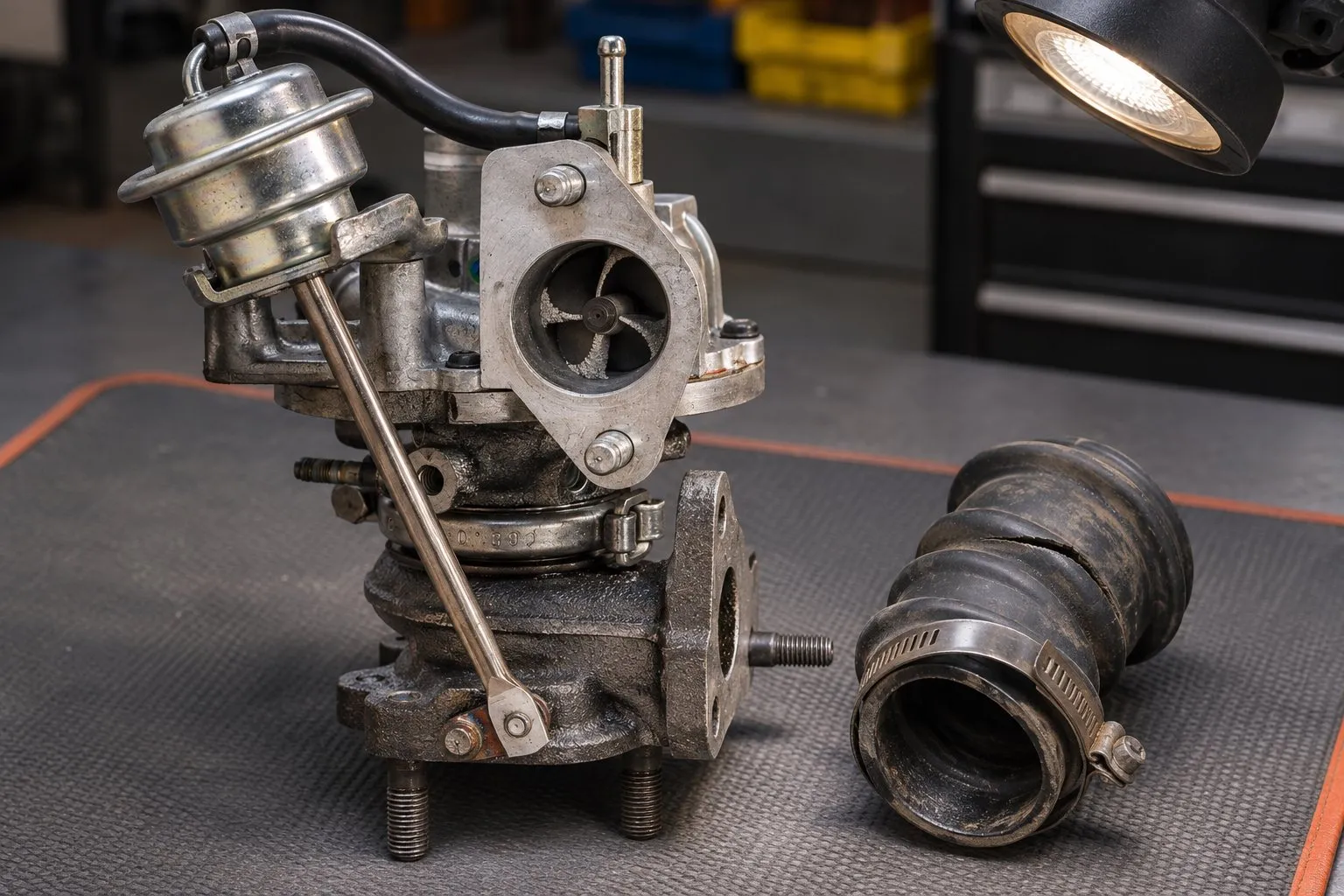
With the intake pipe off, check the shaft. On a journal-bearing turbo with no oil pressure, some side-to-side rock at the wheel is normal. Any of the following condemns the turbo:
- In-and-out play you can feel.
- A wheel that touches its housing when rocked.
- Play beyond the maker’s limit. Measured axial play on a journal-bearing turbo is typically 0.001 to 0.004 in, but go by the figure for your unit.
Then look at the wheels, the center housing and your oil reports:
- Compressor blades bent, chipped or eroded: find where the debris or dust got in before anything new goes on.
- Turbine blades nicked on the inlet edges: something came from the engine side. A wheel with blade damage is replaced, never rebalanced and reused.
- Hard carbon or burnt oil in the center housing: look at shutdown habits, oil change intervals and the oil feed line.
- Copper climbing in oil analysis: turbo journal bearings are bronze. Compare against your own baseline and the lab’s limits.
Fix the cause before the replacement goes on. A new turbo fitted to the same leaking intake pipe or tired oil will fail the same way.
Rebuild, Remanufactured or New
For compact equipment turbos, the choice usually comes down to two things: the condition of your housings and how hard the part number is to find.
| Option | What you get | When it fits |
|---|---|---|
| Rebuild of your turbo | Your housings reused, with new bearings, seal rings and thrust parts, damaged wheels replaced, VSR balancing and a final inspection | Housings are sound, the number is hard to source, or you want your exact unit back |
| Remanufactured exchange | A tested unit from the rebuilt pool, shipped against your core | A unit exists for your number (depends on core supply) |
| New | A new unit built to your part number | The core is beyond rebuilding or the number is current and available |
Our in-house rebuild service handles small equipment turbos the same way as truck units. Every turbo we rebuild is balanced on a VSR (Vibration Sorting Rig) and passes a final quality inspection: leak test, visual inspection, and an actuator or wastegate function check where the turbo has one. Most rebuilds ship in 3 days or less. The price is confirmed after inspection, before work starts; see our turbo rebuild price list for reference.
Rebuilt units ship with inspection notes and carry a 12-month warranty with unlimited mileage. Whether a remanufactured exchange turbo exists for your number depends on core supply. Cores come back within 30 days, and if you need longer, call ahead and we can usually work with you.
Installing the Replacement and First Start
- Oil feed line: fit a new one after a bearing failure or coked oil. Reusing the old line can send the same carbon into the new bearings.
- Oil drain: it returns oil by gravity and must run downhill, within about 15 to 20 degrees of straight down, with no kinks. It should return oil above the oil level. A restricted drain backs oil up past the seals at both ends.
- Gaskets: use new ones, with no sealant on the oil inlet or drain gaskets.
- Intake path: clean everything from the air cleaner to the turbo. If the old compressor wheel shed metal and the engine has a charge air cooler, replace the cooler, because metal in the fins cannot be reliably flushed out.
- Priming: fill the oil inlet with clean engine oil and turn the wheel by hand. Then crank 10 to 15 seconds without starting, keeping the engine from firing by the procedure in Kubota’s service manual.
- First start: Garrett’s installation guidance calls for idling 3 to 4 minutes while checking for oil, exhaust and air leaks before the machine goes to work.
That is the whole first-start routine. A turbo has no break-in period: no reduced-load hours and no early oil change. Clean oil, clean air and a sound installation give it the best chance of a long service life.
Frequently Asked Questions
Do Kubota RTV utility vehicles have turbochargers?
Not every Kubota diesel is turbocharged, so check the machine before ordering anything. A turbocharged engine has the turbo bolted to the exhaust manifold with the air cleaner piped to it, and Kubota model codes for turbocharged engines carry a T in the suffix. If your RTV has a turbo, order the replacement by the number on its tag.
How do I find the right replacement turbo for my Kubota SVL?
Read the number on the turbo’s tag or data plate and order by that number. The engine model and serial confirm the engine version, while housing casting numbers only narrow the search. If the tag is gone, call (909) 824-1020 with the engine model and serial.
Why does my loader drip oil from the exhaust after long idling?
At long idle, with little exhaust flow, oil tends to show at the turbine end first, and it usually clears once the machine works under load. If it persists, check the turbo oil drain for kinks or restriction and check the crankcase breather before blaming the seals. Blue-gray smoke under load is the sign to dig further.
Need a Turbocharger?
PT Turbo has rebuilt and sold turbochargers since 1978. We stock remanufactured units for Cummins, Duramax, Power Stroke, Detroit Diesel, and more — backed by a 12-month unlimited mileage warranty. Units in stock at our shop in San Bernardino, CA ship the same day when ordered before 2 PM Pacific, Monday through Friday.
📞 (909) 824-1020 · 346 S I St. #3, San Bernardino, CA 92410 · info@ptturbo.com