Kubota V3800 Turbocharger Guide: M-Series Tractor & SVL Skid Steer Applications
This Kubota V3800 turbocharger guide is for the mechanics and owners who keep M-Series tractors and SVL compact track loaders working. Its first rule is simple: you identify the turbo by the number on its tag, not by the engine name. Kubota has built the V3800 in more than one version, and the turbo can change with the version and the machine. Below we cover how to find the right unit, how these turbos fail in field work, what the symptoms point to, and how to install a replacement.
PT Turbo is a family-owned shop in San Bernardino, California, and has been rebuilding turbochargers since 1978. In more than 45 years we have built our in-house rebuild service around one idea: send us your turbo and we rebuild that exact unit. That is often the fastest way to get an off-highway machine back to work.
The V3800 in M-Series Tractors and SVL Track Loaders
Kubota fits the V3800 four-cylinder diesel to some M-Series tractors and to SVL compact track loaders, which many operators call tracked skid steers. Which models carry it depends on the generation and the rating. Read the engine plate instead of going by the machine badge. The plate gives the full engine model with its suffix and the engine serial number, and the suffix marks the version.
The engine family may be the same in both machines, but the work is not. That difference decides how the turbo wears.
| Machine | Typical duty | What it does to the turbo | What to watch |
|---|---|---|---|
| M-Series tractor | Long hours at steady load on the PTO or drawbar, plus loader and chore work | Sustained heat in the turbine housing and center section; heat soak if shut down hot | Oil change schedule (severe service for heavy work), cool-down before shutdown, manifold and flange leaks |
| SVL track loader | Short hard bursts, frequent idling, constant direction changes | Repeated heat cycles, oil coking after hot shutdowns, heavy dust at the air intake | Air filter restriction indicator, intake piping and clamps, debris packed around the engine |
| Both | Dust, chaff and mud around the machine | Dirt that gets past the filter wears the compressor wheel | Every joint between the air filter and the turbo inlet |
Track loaders mount the engine at the rear in a tight compartment, where chaff and dirt pack in around the exhaust and the turbo. Blow that material out regularly. A turbo buried in packed debris is hard to inspect, and oil or exhaust leaks stay hidden under it.
Identifying the Right Turbo Before You Order
Before you call or order, write down three things:
- The machine model and serial number
- The engine model, with its full suffix and serial number, from the engine plate
- The part number on the turbo’s tag (data plate)
The tag number decides the part. Two machines that both say V3800 can need different turbos. A unit that bolts up but has the wrong wheels or housings will not perform like the correct one.
Do not order by a casting number on a housing. One casting serves many turbos, so it only narrows the search, and the tag number confirms the match. If the tag is burned off or painted over, contact PT Turbo with the engine serial number and photos of both ends. You can also send the turbo in for a rebuild, which keeps the same unit on your engine.
Do not assume which maker built yours. Kubota uses turbos from more than one supplier across its engine line. The smaller V2403 is listed with an IHI RHF3 and the V3307 with a Mitsubishi TD03L4. Only the tag tells you the maker and model on your V3800. These are some common tag formats:
- IHI: in names such as RHF3 or RHF5, the letter after RH is the series (RHB older, RHF newer) and the number is the frame size, so an RHF5 is larger than an RHF4.
- Mitsubishi: the frame name (TD03, TD04 and its L and H versions) is set by the turbine side. Codes such as 13T or 16G name only the compressor wheel.
- Garrett: six digits, a dash and four digits. The first digit after the dash shows the channel: 0 original equipment, 5 new aftermarket, 9 remanufactured.
- BorgWarner: six or eleven digits. Factory-fitted units also carry the engine maker’s part number.
Many factory tags show the engine maker’s number next to the turbo maker’s number. Give us both if both are there. The same tag-first approach applies to the Cummins-powered machines many of the same fleets run, which our Cummins QSB turbocharger guide covers.
Turbos we list for the RHF3 and RHF5
Listings for the turbo models named in this guide that can be ordered online today. Several part numbers can fit one engine by year and rating, so match the number on your turbo’s tag, or call (909) 824-1020 and we will match it for you.
How V3800 Turbos Fail in Tractor and Loader Work
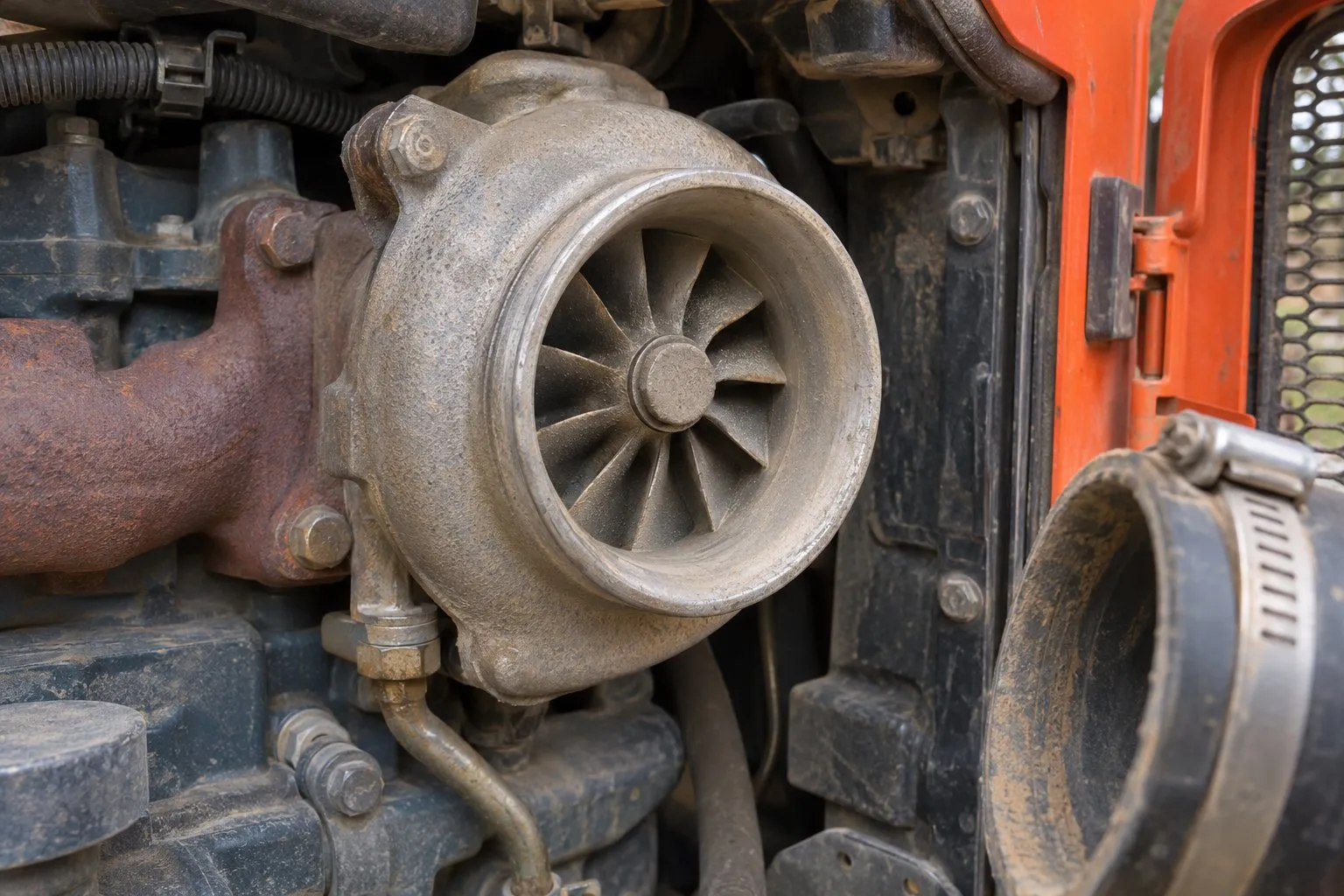
A turbocharger shaft spins at very high speed in bearings fed by engine oil, with the compressor wheel at one end and the turbine wheel at the other. Garrett states that more than 90 percent of turbo failures come from oil starvation or oil contamination. On farm and construction equipment, the ways that happens are predictable.
Oil starvation and contamination
Starvation comes from:
- Hard throttle on a cold engine
- A blocked or leaking oil feed line
- Low oil level
- A new turbo started without priming
Contamination comes from carbon, engine wear debris, dirt let in during servicing, and oil run past its change. Follow Kubota’s schedule, or its severe-service schedule for dusty work, heavy idling and long hours at load.
Hot shutdown and coking
Shutting the engine off right after a hard pass leaves the center section heat-soaked with no oil flowing through it. The oil left in the bearing housing cokes, and that carbon then wears the bearings. Before turning the key off, idle for the cool-down time Kubota gives in the operator’s manual, especially after heavy PTO or loader work.
Dust and foreign objects
Fine dust that gets past the filter leaves pitting on the compressor inlet blades. Bent or chipped blades mean impact damage from something solid, such as a loose clamp or debris left in the intake. The pipe between the air filter and the turbo is under suction. A crack or loose clamp there does not leak boost; it pulls unfiltered dirt into the wheel. Replace the filter when the restriction indicator calls for it.
Drain and exhaust problems
Oil leaves the turbo by gravity. A kinked, crushed or carbon-choked drain backs oil up in the bearing housing and pushes it past the seals at both ends. An exhaust leak at the manifold or turbo flange lets gas escape before the turbine, which gives low boost, slow response and higher exhaust temperature.
Symptoms and What They Point To
| Symptom | What it usually points to | Check first |
|---|---|---|
| Black or dark gray smoke, low power under load | Too little air | Air filter restriction, charge-air clamps and pipes, exhaust leaks before the turbine, turbo wheels, DPF status if fitted |
| Slow response, weak pull | Exhaust or boost leak, sticking wastegate or vanes if the turbo has them | Manifold and flange joints, actuator movement, intake piping |
| Blue-gray smoke, oil pooled in the intake | Oil being burned. A light oil film from crankcase vapor is normal; pooled oil is not | Breather, oil level, drain line, air filter and engine wear, before the turbo seals |
| Whine or siren noise | Exhaust leak before the turbine, boost leak, or a wheel rubbing | Every joint first, then wheel contact |
| White smoke | Coolant, or unburned fuel on a cold engine; not a turbo symptom | Coolant level, cold-start condition |
| Oil on the outside of the center housing | Gasket or line leak, not the seals | Feed and drain fittings and gaskets |
| Wheel touching the housing, in-and-out play | Bearing failure | Stop running it, find the oil cause, rebuild or replace |
If your machine has a diesel particulate filter, it sits after the turbo. A loaded filter raises exhaust backpressure and cuts power. Check its status and let regeneration finish as the maker advises before you blame the turbo.
Fault codes on these machines come from Kubota’s own system and show on the machine’s display or a dealer tool. Look them up in Kubota’s service information instead of reading them as generic road-vehicle codes.
To check the shaft, take the intake and exhaust connections off and move the shaft by hand. Some side-to-side rock is normal on a journal-bearing turbo with no oil pressure. The turbo is condemned by in-and-out play you can feel, a wheel that touches its housing when rocked, or damaged blades.
Replacement Options and Installation
When the turbo is done, you have three ways forward, and the tag number drives all of them.
- Rebuild your own turbo. Our turbo rebuild service rebuilds the unit you send, so fitment is never in question. Every turbo we rebuild is VSR balanced and gets a final quality inspection: a leak test, a visual inspection and an actuator or wastegate function check. We confirm the price after inspection and before work starts; our turbo rebuild price list shows current figures. Most rebuilds ship in 3 days or less.
- New replacement. Search the PT Turbo store by the number on your turbo’s tag, or call (909) 824-1020 with that number. Current pricing is on the product page.
- Remanufactured exchange. Whether remanufactured turbochargers are available for a given number depends on core supply. Cores come back within 30 days; if you need longer, call ahead and we can usually work with you.
Our rebuilds carry a 12-month warranty with unlimited mileage. Fleets and dealers running several machines can arrange priority turnaround or core stocking by phone. If you need an installation kit, send us the turbo number, because we only match kits whose listing names that turbo.
Before the turbo goes on
- Find and fix what killed the old one: oil level and condition, feed line, drain, air filter and intake piping.
- Fit a new oil feed line after a bearing failure or coked oil. Do not flush and reuse the old one.
- Route the drain downhill, within about 15 to 20 degrees of straight down, entering the pan above the oil level.
- Use new gaskets on the oil inlet, drain and exhaust flanges, with no sealant on the oil gaskets.
- If the old compressor wheel shed metal and the engine has a charge air cooler, replace the cooler, because metal in the fins cannot be flushed out reliably. Clean or replace the charge piping too.
- Clean the intake path from the filter to the turbo and fit a new air filter.
First start
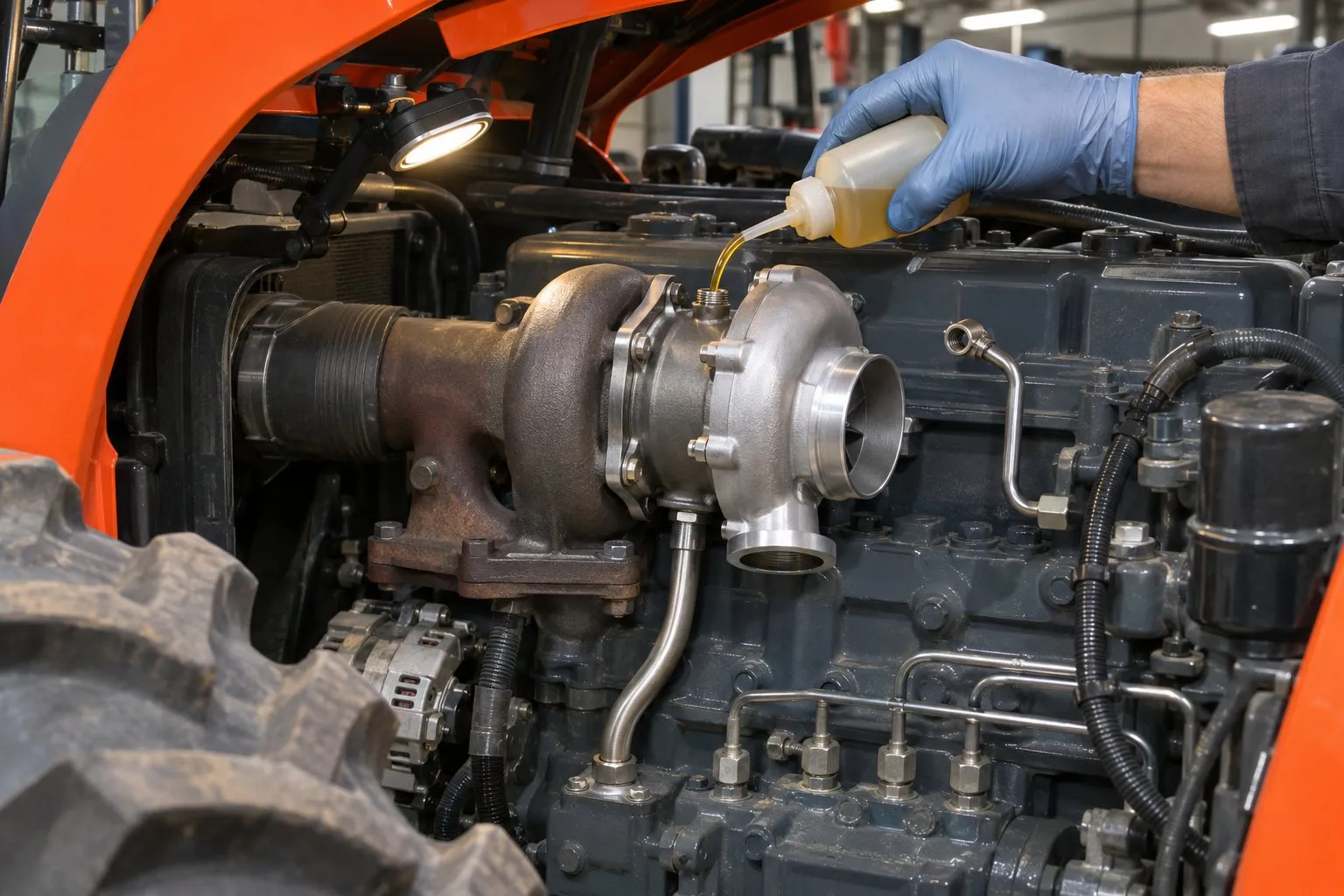
Fill the oil inlet with clean engine oil and turn the wheel by hand. Crank for 10 to 15 seconds without letting the engine start, using the no-start procedure in Kubota’s service manual. Then start the engine and idle 3 to 4 minutes while checking for oil, exhaust and air leaks, as Garrett’s installation steps describe.
A turbo has no break-in period. Once everything is leak-free, the machine goes back to work. Good oil, clean air and a correct installation give it the best chance of a long service life.
Frequently Asked Questions
What turbocharger does the Kubota V3800 use?
It depends on the engine version and the machine, so the number on the turbo’s tag is the only reliable answer. Kubota uses turbos from more than one maker across its engines, so do not assume the maker from the engine name. If the tag is unreadable, send the turbo in for a rebuild or call (909) 824-1020 with the engine serial number.
Is it worth rebuilding a V3800 turbo instead of buying new?
Often, yes, if the housings are sound. A rebuild keeps the same unit on your engine and replaces the bearings, seal rings and thrust parts, along with any wheel that has blade damage. PT Turbo confirms the rebuild price after inspection and before any work starts, so a cracked housing or damaged shaft shows up before you are committed.
Why does my SVL track loader keep failing turbos?
A repeat failure usually has a cause outside the turbo. The usual ones are a reused oil feed line, a restricted drain, dust getting in through a cracked pipe or loose clamp after the air filter, or hot shutdowns after hard work. Fit a new feed line, check the drain route and the intake path, and idle for the cool-down time Kubota gives before shutting down.
Need a Turbocharger?
PT Turbo has rebuilt and sold turbochargers since 1978. We stock remanufactured units for Cummins, Duramax, Power Stroke, Detroit Diesel, and more — backed by a 12-month unlimited mileage warranty. Units in stock at our shop in San Bernardino, CA ship the same day when ordered before 2 PM Pacific, Monday through Friday.
📞 (909) 824-1020 · 346 S I St. #3, San Bernardino, CA 92410 · info@ptturbo.com