Turbocharger Boost Pressure: What Numbers Are Normal for Your Diesel
If you have a boost gauge installed in your diesel truck or you are reading live data on a scan tool, you have probably wondered what the numbers should look like. Boost pressure varies significantly by platform, and what is normal for a 5.9L Cummins is very different from what is normal for a 6.7L Powerstroke. Here is a reference guide.
Normal Boost Pressure Ranges by Platform
These are approximate peak boost values under wide-open-throttle load conditions:
- Cummins 6BT 5.9L (12-valve, 1994–1998): 15–23 PSI stock, depending on rating (the 215 hp trucks run the most). Simple fixed geometry turbo with wastegate.
- Cummins ISB 5.9L (24-valve, 1998.5–2007): 20–28 PSI stock, depending on year and rating. HE351CW wastegated turbo on 2004.5–2007 trucks.
- Cummins ISB 6.7L (2007.5–present, RAM): 25–35 PSI stock. Holset HE351VE to 2012, HE300VG from 2013.
- GM Duramax LBZ/LMM (2006–2010): 20–28 PSI stock. Garrett GT3788VA VGT.
- GM Duramax LML/L5P (2011–present): 25–32 PSI stock.
- Ford 6.7L Powerstroke (2011–present): 25–35 PSI stock.
- Cummins ISX/ISX15 (Class 8): 30–45 PSI depending on rating and VGT mapping.
Note that stock boost pressure varies based on engine calibration, ambient temperature, altitude, and load. These are guidance ranges—use your own vehicle’s factory service documentation for precise specifications.
What Low Boost (P0299) Indicates
Boost pressure consistently below the normal range triggers a P0299 underboost code. Common causes in order of frequency:
- Boost leak in the charge piping
- VGT actuator failure or sticking vanes
- Stuck-open EGR valve
- Worn turbo bearings or damaged compressor wheel
Do not assume the turbo is at fault until you have ruled out a boost leak. See our guide to finding boost leaks before replacing anything.
What High Boost (P0234) Indicates
Boost pressure consistently above the expected range triggers P0234. On VGT trucks this is almost always a stuck-closed actuator or stuck VGT vanes—the vanes cannot open to release pressure at high RPM. On fixed-geometry trucks with a wastegate, a stuck-closed wastegate is the typical cause.
Boost Pressure at Altitude
At higher elevations, atmospheric pressure is lower, which means the turbocharger is working against a different baseline. A diesel truck that makes 28 PSI at sea level may only produce 24 PSI at 5,000 feet elevation under the same load conditions. This is normal physics, not a turbo problem.
If your boost readings are consistently outside the expected range for your platform, PT Turbo can help diagnose the cause. Call (909) 824-1020 or contact us here.
Shop PT Turbo: Browse our turbocharger catalog — OEM-spec replacements with a 12-month, unlimited-mile warranty. Most orders ship within 1–2 business days.
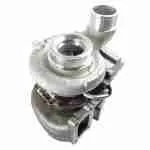
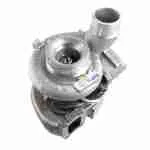
Turbos we list for the HE300VG
Listings for the turbo models named in this guide that can be ordered online today. Several part numbers can fit one engine by year and rating, so match the number on your turbo’s tag, or call (909) 824-1020 and we will match it for you.
Frequently Asked Questions
How much boost should a stock 6.7 Cummins make?
About 25 to 35 PSI at peak under wide-open-throttle load on a stock Ram 6.7L. The figure varies with engine calibration, ambient temperature, altitude and load, so the factory service documentation for the vehicle is the precise reference.
Does altitude lower turbo boost pressure?
Yes. Atmospheric pressure is lower at elevation, so a diesel that makes 28 PSI at sea level may only produce 24 PSI at 5,000 feet under the same load. This is normal physics, not a turbo problem.
What causes overboost on a diesel turbo?
A variable geometry mechanism stuck closed is the usual cause on VGT trucks, because the vanes cannot open to release pressure at high RPM. On fixed geometry trucks a wastegate stuck closed is the typical cause. Either condition sets code P0234.
Further Reading
- How to Find Boost Leaks in Diesel Trucks: Full Guide
- P0299 Underboost Code: Step-by-Step Diagnosis & Fix
- Diesel Turbo Lag: Causes, Diagnosis & Fixes
- 7 Warning Signs Your Turbocharger Is Failing
- Variable Geometry Turbocharger (VGT) Explained
Further reading: Learn more about turbocharger technology.
When your boost numbers fall short because the turbo is worn, PT Turbo’s turbo rebuild service can bring it back to spec.
Need a Turbocharger?
PT Turbo has rebuilt and sold turbochargers since 1978. We stock remanufactured units for Cummins, Duramax, Power Stroke, Detroit Diesel, and more — backed by a 12-month unlimited mileage warranty. Units in stock at our shop in San Bernardino, CA ship the same day when ordered before 2 PM Pacific, Monday through Friday.
📞 (909) 824-1020 · 346 S I St. #3, San Bernardino, CA 92410 · [email protected]
More From PT Turbo
 HE351VE vs HE300VG: Complete Comparison for Ram 2500 & 3500 Cummins Owners
- Land Rover TDV6 3.0L Turbocharger Guide: Discovery, Range Rover & Sport Applications
- Holset H1C Turbocharger: Classic 5.9L Cummins Specs & Replacement Guide
- Holset HX40 Turbocharger: Specs, Cummins ISC Applications & Replacement