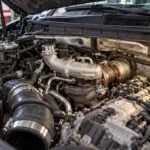
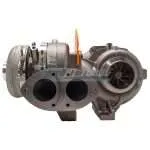
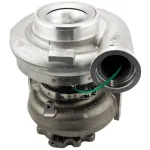
The Cummins QSB is one of the most versatile diesel platforms ever built, and the turbocharger bolted to it is doing serious work whether that block is sitting in a sportfishing boat, a wheel loader, or a 60-foot scissor lift. If you run QSB-powered equipment, understanding which Holset turbo is on your engine, how it behaves, and what fails first will save you downtime and money. At PT Turbo we have been rebuilding and supplying Cummins and Holset turbochargers for over 45 years, and the QSB family lands on our bench in every configuration imaginable. Here is the practical guide.
QSB Engine Family and Turbocharger Basics
The QSB designation covers the QSB3.3, QSB4.5, QSB5.9, and QSB6.7 displacements. “QS” stands for Quantum System, meaning these are electronically controlled, common-rail versions of the older mechanical B-series. The same blocks that power Ram pickups in 5.9L and 6.7L form get rebadged as QSB for marine, industrial, and construction duty with different ratings, cooling packages, and aftertreatment. The QSB3.3 is the exception: it comes from a different, smaller engine family and is listed with a Mitsubishi turbo.
Almost every QSB wears a Holset turbocharger. Depending on displacement, rating, and emissions tier, you will find one of these turbo types:
- Wastegated fixed-geometry (HX35W, HX40W): Common on Tier 2 and Tier 3 industrial and marine ratings. Simple, durable, easy to service.
- Variable Geometry Turbo (HE300VG, HE341VE): Found on higher-tier QSB6.7 ratings that need precise boost control across a wide load range. If you want a deep dive on the VG actuator and how it sticks, our Cummins ISB 6.7L VGT guide covers the same hardware in detail.
- HE300WG: a wastegated Holset listed for some later QSB6.7 ratings.
Because the QSB shares so much DNA with the truck-spec 5.9L and 6.7L engines, parts knowledge crosses over. If you also wrench on pickups, our 5.9L Cummins turbo guide and 6.7L Cummins turbo guide are worth bookmarking.
Marine QSB Turbochargers: The Salt Water Reality
Marine QSB engines, especially the QSB5.9 and QSB6.7 used by Cummins MerCruiser Diesel (CMD) in recreational and light commercial vessels, run hard and live in a brutal environment. These ratings run from roughly 230 to 480 horsepower on the QSB5.9 and up to 550 on the QSB6.7. The turbo itself is typically a wastegated Holset of the HX35 or HX40 class (the top ratings are listed with a larger HX55), but the failure modes differ from land-based engines.
Salt air and seawater-cooled exhaust systems mean corrosion is the number one enemy. The turbine housing, exhaust elbow flange, and any water-jacketed components corrode from the outside in. We routinely see marine QSB turbos with perfect rotating assemblies but housings eaten away at the gasket faces. That is exactly where quality installation gaskets matter, because a corroded flange combined with a cheap gasket will weep exhaust and water.
Marine operators also tend to run sustained high load, which stresses the center bearing housing through heat soak after shutdown. Always idle a marine QSB down before killing it. Hot shutdown coking is the fastest way to glaze a bearing on these engines.
Industrial and Construction QSB Turbochargers
On the industrial side, the QSB shows up in generators, irrigation pumps, compressors, and countless OEM machines. Construction is where it really earns its keep: excavators, wheel loaders, skid steers, telehandlers, and aerial lifts from CASE, JCB, Hyundai, Doosan, and others all spec QSB power.
These applications cycle constantly between idle and full load, which is hard on a turbo in a different way than steady marine running. Key concerns for industrial and construction QSB turbos:
- Soot and EGR loading: Tier 4 ratings with EGR and DPF run higher exhaust backpressure. Carbon builds in the VG mechanism and sticks the vanes. Sluggish boost response and derate codes follow.
- Vibration and dust: Construction air filtration takes a beating. A leaking air cleaner sends abrasive dust straight into the compressor wheel. Check your filtration before you ever blame the turbo.
- Oil quality: Extended drain intervals on machines that skip maintenance starve the turbo of clean oil. A rotating assembly that turns at well over 100,000 RPM does not forgive dirty oil.
Common QSB Turbo Failures and How to Diagnose Them
Across all three application types, the failures cluster into a few categories. Use this table to triage before you pull the unit.
| Symptom | Likely Cause | Severity |
|---|---|---|
| Low power, slow to build boost, derate codes | Stuck VG vanes / sticking actuator (carbon) | Moderate |
| Blue smoke, oil in intake piping | Failed center seals, plugged drain | High |
| Whine or grinding at spool-up | Worn bearings, shaft play, wheel contact | Critical |
| Oil leak at turbine flange | Corroded housing or failed gasket (common on marine) | Moderate |
| Overboost / fault codes, no smoke | Wastegate or actuator calibration | Low to Moderate |
Two checks catch most problems. First, with the engine off and cool, pull the intake hose and wobble the compressor wheel. Axial and radial play should be barely perceptible, and the wheel must never touch the housing. Second, inspect for oil in the cold-side piping. A film is normal, but pooled oil means seals are gone. Before condemning a VG turbo, verify it is not simply a sticking actuator or carbon-bound vanes, because a cleaning and calibration is far cheaper than a unit.
New vs Remanufactured QSB Turbochargers
When a QSB turbo is genuinely done, you have three paths: a new OEM Holset unit, a quality remanufactured turbo, or rebuilding your existing core. Here is how they compare in real terms.
| Option | Typical Cost | Best For |
|---|---|---|
| New OEM Holset | $710 to $6,289 (71 listings) at PT Turbo | Warranty-sensitive fleets, latest VG ratings |
| Remanufactured | 40 to 60% of new | Most operators wanting OEM performance at lower cost |
| Rebuild your core | From $575 at PT Turbo (price list) | Keeping a numbers-matching unit, hard-to-source castings |
Price ranges in this article are general estimates to help with budgeting, not PT Turbo quotes. Our current prices are on each product listing, and our rebuild prices are on the turbo rebuild price list.
For the vast majority of QSB owners, a properly remanufactured turbocharger is the smart buy. A real reman, not a cheap rebuild, gets new bearings, seals, a balanced cartridge, and is flow-tested. If your casting is sound but the rotating group is worn, our turbocharger rebuild service restores the unit to spec and keeps your original housings, which matters when an OEM part number is backordered for weeks. We stock both new and remanufactured QSB turbos, and if you are not sure which unit your engine carries, contact PT Turbo with your engine serial or CPL and we will pin it down.
Installation Kits and Gaskets You Need
Never reinstall a QSB turbo with old gaskets and used hardware. Reused fasteners stretch, and corroded flanges on marine units demand fresh sealing surfaces. The right installation kit prevents exhaust leaks, oil weeps, and comebacks. Match the kit to the turbo, not to the engine name:
- Installation kits are listed by turbo model. Send us the number on your turbo and we will match the gasket and hardware kit for it.
On marine and construction units especially, inspect the oil feed and drain lines while the turbo is off. A partially blocked drain causes the same oil-seal symptoms as a failed turbo and will kill your new unit fast. Replace any line that looks coked or kinked, and confirm the oil supply is clean before the engine fires.
Pre-Installation and Break-In Checklist
- Prime the new turbo with clean engine oil through the supply port and spin the wheel by hand.
- Crank the engine with the fuel shut off or in a no-start mode until oil pressure registers, so the bearing sees oil before it ever spins under load.
- Confirm the drain line is clear and routed downhill with no kinks, then verify the feed line flows clean oil.
- Start the engine and let it idle for three to five minutes. Do not rev it or load it while the bearing and seals settle.
- Watch for leaks at the turbine and compressor flanges, oil connections, and intake joints while it idles.
- On VG units, cycle the actuator and clear any stored codes before putting the machine back to work.
The first few minutes decide how long the turbo lasts. Skipping the oil prime or loading a dry bearing is the most common way a good reman gets killed on day one. Take the extra ten minutes, and that unit will outlast the job it went on.
Frequently Asked Questions
Which turbocharger is used on the Cummins QSB engine?
Most Cummins QSB engines use a Holset turbocharger, with the specific model varying based on the engine’s rating and whether it’s in marine, industrial, or construction service.
What are common failure points on a Cummins QSB turbocharger?
Common issues include worn bearings, oil leaks, and damaged or stuck wastegate or actuator components, which typically appear first and can lead to lost power and downtime.
Is the Cummins QSB turbocharger the same across marine and construction applications?
No, while the QSB platform is shared, the turbocharger model and tuning often differ between marine, industrial, and construction applications to match each engine’s duty cycle and rating.
Further reading: Learn more about turbocharger technology.
Need a Turbocharger?
PT Turbo has rebuilt and sold turbochargers since 1978. We stock remanufactured units for Cummins, Duramax, Power Stroke, Detroit Diesel, and more — backed by a 12-month unlimited mileage warranty and same-week shipping from San Bernardino, CA.
📞 (909) 824-1020 · 346 S I St. #3, San Bernardino, CA 92410 · [email protected]
More From PT Turbo
 Ram 1500 EcoDiesel Turbocharger Guide: 3.0L VM Motori Failures & Replacement
- Caterpillar C13 Turbocharger: Symptoms, Diagnosis & Complete Replacement Guide
- Ford 6.7L Powerstroke Turbocharger Guide: GT32 Failures, Symptoms & Replacement Cost
- Detroit DD15 Turbocharger: Failure Signs, Common Problems & Best Replacements