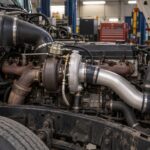
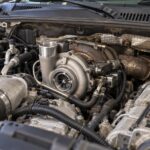
This Construction Equipment Turbocharger Guide covers the three brands that dominate job sites across North America: Caterpillar, Komatsu, and John Deere. Whether you’re running an excavator, wheel loader, dozer, or backhoe, the turbocharger is the single most stressed component on your diesel, and knowing exactly what’s bolted to your engine saves downtime and money. PT Turbo has been rebuilding and supplying these units since 1978, and this reference is built from what we see cross our benches every week.
We’ll break down turbo families by manufacturer, list common part numbers, explain the difference between wastegated and variable-geometry designs, and show you where reman makes sense over new. Prices and part numbers referenced here are current PT Turbo stock.
How Construction Turbochargers Differ From On-Highway Units
Construction equipment runs hard at sustained high load, often at low road speed with poor cooling airflow. That combination cooks turbos faster than highway trucking does. Heat soak, dust ingestion, and duty cycles near 100 percent are the norm.
Most modern construction diesels in the 4 to 13 liter range use one of two turbo types. Older Tier 2 and Tier 3 engines lean on simple wastegated turbos. Tier 4 Interim and Tier 4 Final engines added variable-geometry turbochargers (VGT) and electronic, pneumatic or (on Komatsu) hydraulic actuators to manage boost across the rev range while feeding the EGR and DPF systems.
If you want the fundamentals on how these units work, the variable-geometry turbocharger overview is a solid primer. On the equipment side, the actuator is what fails most often, not the cartridge itself.
Caterpillar Turbocharger Reference
Caterpillar sells turbos under its own name and sources them from Garrett and BorgWarner depending on platform. The most common families you’ll encounter on mid-size CAT iron are the C4.4, C6.6 and C7.1, C7, C9, and the heavier C13, C15 and C18.
Most Cat machine engines use a single turbocharger. The C4.4 and C7.1 come with a single turbo or, on higher ratings, two turbos in series with an electronically controlled wastegate. Among the truck engines, the C13 and C15 ACERT use two turbos in series, and only the 2007 and later C7 and C9 have a variable-vane turbo. On a series system, check the wastegate and for actuator failure first when boost codes appear.
| CAT Engine | Typical Application | Turbo Type | Displacement |
|---|---|---|---|
| C4.4 | Backhoe loaders, small excavators, small wheel loaders | Wastegated single turbo; series turbos on higher ratings | 4.4L |
| C6.6 / C7.1 | Mid-size excavators, wheel loaders | Wastegated single turbo; series turbos on higher C7.1 ratings | 6.6 / 7.0L |
| C9 | Wheel loaders, 330-class excavators | Single turbo | 8.8L |
| C13 / C15 | Large loaders, off-highway trucks | Single turbo on most machine ratings; series turbos on ACERT truck engines | 12.5 / 15.2L |
| C18 | Large dozers, gensets, mining | Single turbo, or twin turbos on higher ratings | 18.1L |
For a deep dive on the biggest of these, read our Caterpillar C18 turbocharger guide. It covers the twin-turbo layout and generator applications in detail.
Many Garrett-supplied CAT units use pneumatic wastegate actuators that are serviceable separately. Replacing a failed actuator instead of the whole turbo is often the smart call when the cartridge still spins clean.
Komatsu Turbocharger Reference
Komatsu runs a mix of its own engines and Cummins-based ones. The S6D102 is the Cummins 6BT, the SAA6D107 is essentially a Komatsu-badged Cummins QSB6.7, and the SAA6D114 shares its design with the Cummins 8.3 and 8.9 liter engines. That matters because turbo parts often cross-reference between Komatsu and Cummins catalogs.
On the Cummins-based engines the turbos are Holset, the Cummins turbo brand. Komatsu’s own larger engines carry Komatsu’s KTR-series turbos, and Tier 4 machines use what Komatsu calls the KVGT, its variable geometry turbocharger. For the older 95, 108 and 125 series engines, BorgWarner S2 and S3 frame turbos are common replacements.
- S4D102 / S6D102 (Cummins 4BT / 6BT) – Excavators and loaders, Holset HX30 / HX35
- SAA6D107 (QSB6.7) – PC200/PC210 class, Holset turbos, variable geometry on Tier 4 engines
- SAA6D114 – PC300 class, Holset turbos on earlier engines, Komatsu KVGT on Tier 4 engines
- S6D108 / SA6D108 – PC300 class, BorgWarner S2B replacements
- SAA6D125 – PC400 class, larger dozers and loaders, Komatsu KTR-series turbos; BorgWarner S3A replacements for earlier 125-series engines
On the smaller engines with compact wastegated turbos, the wastegate actuator is a frequent wear item.
Because the SAA6D107 is a rebadged Cummins, our Cummins QSB turbocharger guide is directly relevant for Komatsu PC200-class owners chasing the right Holset part number.
John Deere Turbocharger Reference
John Deere’s PowerTech line powers a huge slice of the construction and ag market. The 4045 (4.5L) and 6068 (6.8L) are the workhorses, found in everything from 310 backhoes to 200-class excavators and skid steers.
On the PowerTech engines Deere mostly fits BorgWarner turbochargers: fixed geometry S200 and S300 units on earlier engines, and the variable geometry S300BV with an electronic actuator on later ones. Garrett units appear on some 4045 and 6068 versions. The 6068 especially is one of the most common engines we service.
| John Deere Engine | Displacement | Common Turbo | Application |
|---|---|---|---|
| PowerTech 4045 | 4.5L | BorgWarner S1B / S2A; Garrett on some versions | Backhoes, compact loaders |
| PowerTech 6068 | 6.8L | BorgWarner S200, S300 and S300BV (variable geometry) | Excavators, motor graders |
| PowerTech 6090 | 9.0L | BorgWarner S300BV (variable geometry) | Large loaders, feller bunchers |
For engine-specific detail, our John Deere 6068 turbocharger guide breaks down part numbers across the PowerTech generations.
Deere’s variable geometry units use an electronic actuator that is matched to the turbo. Match the actuator by turbo part number, not engine model, because Deere ran multiple turbo revisions on the same engine.
Isuzu-powered Deere and CASE machines are also common. If you’re working on that platform, see our Isuzu 4HK1 turbocharger guide.
Symptoms and Diagnosis in This Construction Equipment Turbocharger Guide
Turbo problems on construction iron usually announce themselves through power loss, smoke, and boost codes. Reading the symptom by severity tells you whether you can patch it with an actuator or whether the cartridge is done.
| Symptom | Likely Cause | Severity | Typical Fix |
|---|---|---|---|
| Slow boost, low-power derate code | Sticking VGT vanes or failed actuator | Moderate | Actuator or cartridge service |
| Blue smoke, oil in intake | Worn seals, bearing wear | High | Rebuild or replace |
| Whine or grinding on spool | Bearing failure, shaft play | Critical | Replace immediately |
| Overboost fault | Stuck wastegate or bad actuator | Moderate | Replace actuator |
Always check shaft play before condemning a turbo. A little side-to-side play is normal on a journal-bearing turbo, but in-and-out play you can feel, or a wheel that touches the housing, means the bearings are gone. When the compressor or turbine wheel shows contact damage, dust ingestion is usually the root cause, so inspect the air filter and intake boots before installing a replacement.
Once you’ve confirmed the cartridge is worn, the reman decision comes down to how the wheels and shaft look. A unit with clean wheels and only a bad actuator is a quick parts swap. A turbo with bearing failure or wheel contact damage earns a full rebuild or replacement, because patching one worn component on a tired core just buys you another breakdown.
Whichever brand you’re running, match replacement parts by the turbo’s own part number stamped on the housing, not the engine model. Equipment makers revise turbos mid-production, and the same machine can leave the factory with more than one configuration. Get the number off the unit in your hands before you order.
Frequently Asked Questions
Which brands does this turbocharger guide cover?
This guide covers the three brands that dominate North American job sites: Caterpillar, Komatsu, and John Deere. It applies to excavators, wheel loaders, dozers, and backhoes.
Why is the turbocharger the most stressed component on a diesel engine?
The turbocharger endures extreme heat, high rotational speeds, and constant pressure cycles, making it the single most stressed component on your diesel. Knowing your exact turbo model helps prevent costly downtime.
Can a construction equipment turbocharger be rebuilt instead of replaced?
Yes, many turbochargers can be professionally rebuilt to restore performance at a fraction of the cost of a new unit. PT Turbo specializes in rebuilding turbos for CAT, Komatsu, and John Deere equipment.
PT Turbo rebuilds turbochargers for CAT, Komatsu and John Deere equipment. See our turbo rebuild service.
Need a Turbocharger?
PT Turbo has rebuilt and sold turbochargers since 1978. We stock remanufactured units for Cummins, Duramax, Power Stroke, Detroit Diesel, and more — backed by a 12-month unlimited mileage warranty and same-week shipping from San Bernardino, CA.
📞 (909) 824-1020 · 346 S I St. #3, San Bernardino, CA 92410 · [email protected]