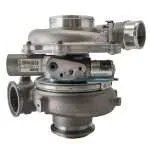
John Deere 6068 Turbocharger Guide: PowerTech Agricultural & Construction Applications
The John Deere 6068 turbocharger sits on one of the most widely deployed diesel engines on the planet. If you run a tractor, a wheel loader, a backhoe, a generator set, or a marine auxiliary, chances are good there is a 6.8L PowerTech burning fuel underneath you, and a turbo feeding it air. When that turbo starts to smoke, whine, or lose boost, downtime costs money, and the wrong replacement part costs even more. This guide breaks down the 6068 turbocharger by application, walks through the actuators that actually fail, and tells you exactly what to check before you condemn a good housing.
Understanding the John Deere 6068 PowerTech Platform
The 6068 is a 6.8-liter inline-six diesel, the big brother to the 4-cylinder 4045. It has powered John Deere equipment across three major generations: the mechanical PowerTech and PowerTech M, the electronically controlled PowerTech E and PowerTech Plus (Tier 2/3), and the PowerTech PVX/PSX and Final Tier 4 platforms. Displacement stays at 6.8L across the board, but the turbocharging strategy changes dramatically depending on emissions tier and horsepower rating.
Here is why that matters for turbo selection: a Tier 2 6068 running an agricultural PTO application is a wastegated fixed-geometry setup, while a Final Tier 4 6068 in a construction machine may run a variable geometry turbo (VGT) with an electronic actuator, and in some higher-output ratings, a series turbo arrangement. You cannot cross-reference by engine family alone. You need the engine serial number and the OEM turbo part number off the compressor housing tag.
Common 6068 Applications by Segment
- Agricultural: 6000 and 7000 series tractors, self-propelled sprayers, combines, and forage harvesters
- Construction: mid-size excavators, wheel loaders, backhoe loaders, skidders, and motor graders
- Power generation: prime and standby gensets in the 100 to 200 kW range
- Marine and industrial: auxiliary engines, irrigation pumps, and OEM-integrated power units
Turbocharger Types Used on the 6068
Depending on the tier and rating, you will encounter three broad turbo configurations on the 6068. Knowing which one you have saves you from ordering the wrong core.
| Configuration | Typical Tier | Boost Control | Common Failure Point |
|---|---|---|---|
| Fixed geometry, wastegated | Tier 2 / Tier 3 | Pneumatic wastegate actuator | Actuator diaphragm, stuck wastegate |
| Variable geometry (VGT) | Tier 3 / Interim Tier 4 | Electronic actuator | Vane sticking from soot, actuator failure |
| Series / two-stage | Final Tier 4 (high output) | Combination wastegate + VGT | Low-pressure stage bearing wear |
Most field failures on the 6068 are not the CHRA (center housing rotating assembly) itself. They are actuator and boost-control problems. That is good news, because a failed actuator is far cheaper to replace than a full turbo, and it is a repair a competent mechanic can do in the field.
Actuators: The Part That Actually Fails
The pneumatic actuator is the number-one wear item on the wastegated turbos in this class. It uses boost pressure to move a rod that opens the wastegate. (The variable geometry turbos use an electronic actuator instead.) Over years of heat cycling, the internal diaphragm cracks, the spring weakens, or the rod seizes. The result is overboost, underboost, or a check engine light with a boost-pressure-out-of-range code.
Getting the right actuator matters because spring preload and rod travel are calibrated to a specific turbo and engine map.
Always match the actuator by turbo part number, not by engine model. If you are unsure which unit your 6068 turbo takes, send us the tag off the compressor housing through the PT Turbo contact page and we will cross it for you.
Diagnosing 6068 Turbocharger Problems
Before you pull the turbo, run the symptom against the likely cause. On the 6068, a lot of “bad turbo” calls turn out to be air leaks, plugged filters, or a sticking VGT mechanism that just needs cleaning.
| Symptom | Severity | Likely Cause |
|---|---|---|
| Low power, slow boost build | Moderate | Stuck VGT vanes, failed actuator, boost leak |
| Blue smoke, oil in intake | High | Worn seals, bearing wear, blocked drain |
| Whining or grinding noise | High | Shaft play, damaged wheel, bearing failure |
| Overboost / boost fault code | Moderate | Failed actuator diaphragm, stuck wastegate |
| Black smoke under load | Low to moderate | Underboost, plugged air filter, intake restriction |
Field Checks Before Condemning the Turbo
- Measure shaft radial and axial play. Any wheel-to-housing contact means the CHRA is done.
- Inspect the actuator rod. It should move freely with vacuum or pressure and return under spring load.
- Check the oil drain line for restriction. A blocked drain forces oil past the seals and mimics a failed turbo.
- On VGT units, pull the exhaust housing and check for soot-locked vanes. Carbon buildup is the most common cause of sluggish VGT response.
- Verify no intake or intercooler boot leaks. A loose clamp downstream reads as low boost every time.
Soot-related vane sticking is especially common on 6068 engines that idle for long stretches or work at light load, like standby gensets and some ag applications. A clean and reseat, plus a fresh actuator, often restores full function without a new turbo.
New vs Remanufactured: What Makes Sense for Your 6068
For a working machine, the decision usually comes down to lead time, budget, and how long you plan to keep the equipment. A quality remanufactured turbo built to OEM tolerances performs identically to new for a fraction of the cost.
| Factor | New OEM | Remanufactured |
|---|---|---|
| Cost | Highest | Lower than new |
| Availability | Can involve backorder | Often in stock |
| Balancing | Factory VSR balanced | VSR balanced to same spec |
| Warranty | OEM terms | Supplier warranty |
PT Turbo has been rebuilding and supplying turbochargers since 1978, more than 45 years of hands-on experience across agricultural, construction, and industrial diesels. We stock both new and remanufactured turbochargers, and every reman unit is VSR balanced and bench-tested before it ships. If you have a good core and want it rebuilt to spec, our turbocharger rebuild service restores it with new bearings, seals, and a balanced rotating assembly. You can also browse the full turbo catalog if you are cross-referencing by part number.
Frequently Asked Questions
What engine uses the John Deere 6068 turbocharger?
The 6068 turbocharger is fitted to John Deere’s 6.8L PowerTech diesel engine, one of the most widely used engines across agricultural, construction, generator, and marine applications.
What are the signs of a failing John Deere 6068 turbocharger?
Common warning signs include excessive smoke, whining or whistling noises, and a noticeable loss of boost pressure. These symptoms often point to a worn or damaged turbo that needs attention.
Why does choosing the correct 6068 turbocharger replacement matter?
Installing the wrong replacement part can cause poor performance, repeat failures, and extended downtime that costs money. Matching the exact turbo to your PowerTech application ensures reliable operation.
Further reading: Learn more about turbocharger technology.
Need a Turbocharger?
PT Turbo has rebuilt and sold turbochargers since 1978. We stock remanufactured units for Cummins, Duramax, Power Stroke, Detroit Diesel, and more — backed by a 12-month unlimited mileage warranty. Units in stock at our shop in San Bernardino, CA ship the same day when ordered before 2 PM Pacific, Monday through Friday.
📞 (909) 824-1020 · 346 S I St. #3, San Bernardino, CA 92410 · [email protected]
More From PT Turbo
 Duramax LLY Turbocharger: Symptoms, Garrett GT3788VA Replacement & Cost (2004-2005)
- Cummins ISB 6.7L Turbocharger Guide: Variable Geometry Operation & Common Failures
- PACCAR MX-11 Turbocharger Guide: Replacement Cost & Kenworth/Peterbilt Fitment
- Detroit DD13 Turbocharger: Failure Symptoms, EGR Interaction & Replacement Options