Standby Generator Turbocharger Guide: Cummins, Cat & Kohler Diesel Applications
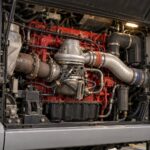
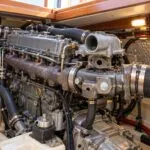
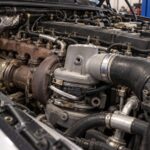
This standby generator turbocharger guide covers the fixed-geometry and wastegated turbochargers found on the Cummins, Caterpillar, and Kohler diesel engines that power backup and prime gensets, and it explains how to match, service, and replace them correctly. Standby power is different from on-highway work: the engine runs at a locked speed, it may sit for months between runs, and a turbo failure almost always shows up during the one event you bought the generator for. Knowing which turbo your genset carries, and why it failed, saves you a scramble when the grid is down. For how standby, prime and continuous duty wear a turbo differently, see our generator turbocharger guide.
PT Turbo has been rebuilding turbochargers since 1978, more than 45 years of hands-on work, and we stock both new and remanufactured turbochargers for the industrial Cummins, Cat, and John Deere based engines under most gensets. The biggest mistake on a generator job is ordering by the engine name instead of the number stamped on the turbo’s data plate. Industrial engines are built in many tiers and ratings, and the turbo changes with them.
Why standby generator turbochargers are usually fixed geometry
A standby genset for 60 Hz power turns a fixed 1,800 rpm (1,500 rpm for 50 Hz) under governor control. Because the engine does not sweep across a wide rev range the way a truck does, most genset engines never needed variable-geometry turbos to build low-speed boost. That is why the turbo on your generator is most often a fixed-geometry or wastegated unit, not a VGT with an actuator to calibrate.
Later Tier 4 industrial engines did adopt variable-geometry and wastegated electronic turbos for emissions reasons, so the newer your genset, the more likely it carries a sliding-nozzle Holset or an electronically actuated BorgWarner. If you want the background on how both styles work, Wikipedia keeps a solid primer on the turbocharger and a separate one on the variable-geometry turbocharger.
Cummins genset turbochargers
Cummins supplies more standby and prime engines than any other builder, from the small 4BT and 6BT through the QSB, QSC, QSL9, and the big QSX15 and QSK families. Their turbos are Holset (Cummins Turbo Technologies), which lets you cross-reference by the Holset assembly number on the compressor housing tag.
On the smaller B-series industrial engines you will find a HX30W or HX35W. The industrial QSB6.7 is listed with a wastegated HX35W on Tier 3 and a single sliding-nozzle variable-geometry turbo, either the HE300VG or the HE341VE, on Tier 4. The larger 8.3 and 8.9 liter engines (6CT, QSC, QSL9) are commonly listed with a HX40W, and the EGR-era ISL/QSL moved to a Holset variable-geometry turbo with an electronic actuator.
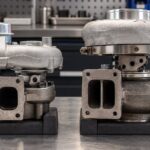
Step up to the M11, ISM, and QSM11 and you are into HX55 territory; the pre-EGR ISX and QSX15 used fixed-geometry HX55W or HX60 units with a wastegate. These are rugged, serviceable turbos, which is why so many of them come across our bench for rebuild rather than replacement.
Crossing a Cummins generator turbo number
Holset assembly numbers describe nothing by themselves and one casting serves many turbos, so never order off the casting number cast into the housing. Read the part number on the data plate, and if you can, confirm it against the compressor wheel size and the turbine housing A/R. If the number is painted over or gone, send us the turbo and we will identify it from the wheels and housings.
Turbos we list for the HX35W, S300 and S200
Listings for the turbo models named in this guide that can be ordered online today. Several part numbers can fit one engine by year and rating, so match the number on your turbo’s tag, or call (909) 824-1020 and we will match it for you.
Caterpillar genset turbochargers
Caterpillar does not build its own turbos; Garrett and BorgWarner supply them, so you will see both names on a Cat genset. On machine and generator ratings, most Cat engines run a single turbo rather than the series (two-turbo) arrangement found on the ACERT on-highway C13 and C15.
- C4.4 and C7.1: a single wastegated turbo, or two turbos in series on higher ratings.
- C9 / C9.3: single turbo, commonly from the BorgWarner S300 and S310 family; some ratings carry an S200-class unit. Go by the part number.
- C13 / C15: single turbo on most machine and genset ratings; the on-highway ACERT truck engines are the ones that use series turbos.
- C18: single turbo up to roughly 630 hp; series twin turbos on the 700 to 800 hp ratings.
Because Cat uses the same engine block across so many ratings and emission levels, the turbo part number is the only reliable guide. BorgWarner’s industrial and commercial turbo range is documented on the BorgWarner site, and Garrett’s on garrettmotion.com, but neither replaces the tag on the turbo you are holding.
Kohler genset turbochargers
Kohler builds the generator, not the engine under every model. Many Kohler diesel gensets are powered by John Deere PowerTech engines (4045, 6068, 6090) and others by Cat or Kohler’s own diesels, so the turbo follows whatever engine is installed.
John Deere PowerTech engines are mostly BorgWarner: a fixed-geometry S200 or S300 on earlier builds, and a variable-geometry S300BV with an electronic actuator on later ones. The 4045 also appears with an S1B or S2A, and some versions carry Garrett TA34, TA38, or T300 turbos. Identify the engine model and serial first, then the turbo number, because a PowerTech M (mechanical fuel system) and a PowerTech Plus (variable-geometry turbo) of similar displacement do not share a turbo.
How standby turbos fail: storage, varnish, and oil supply
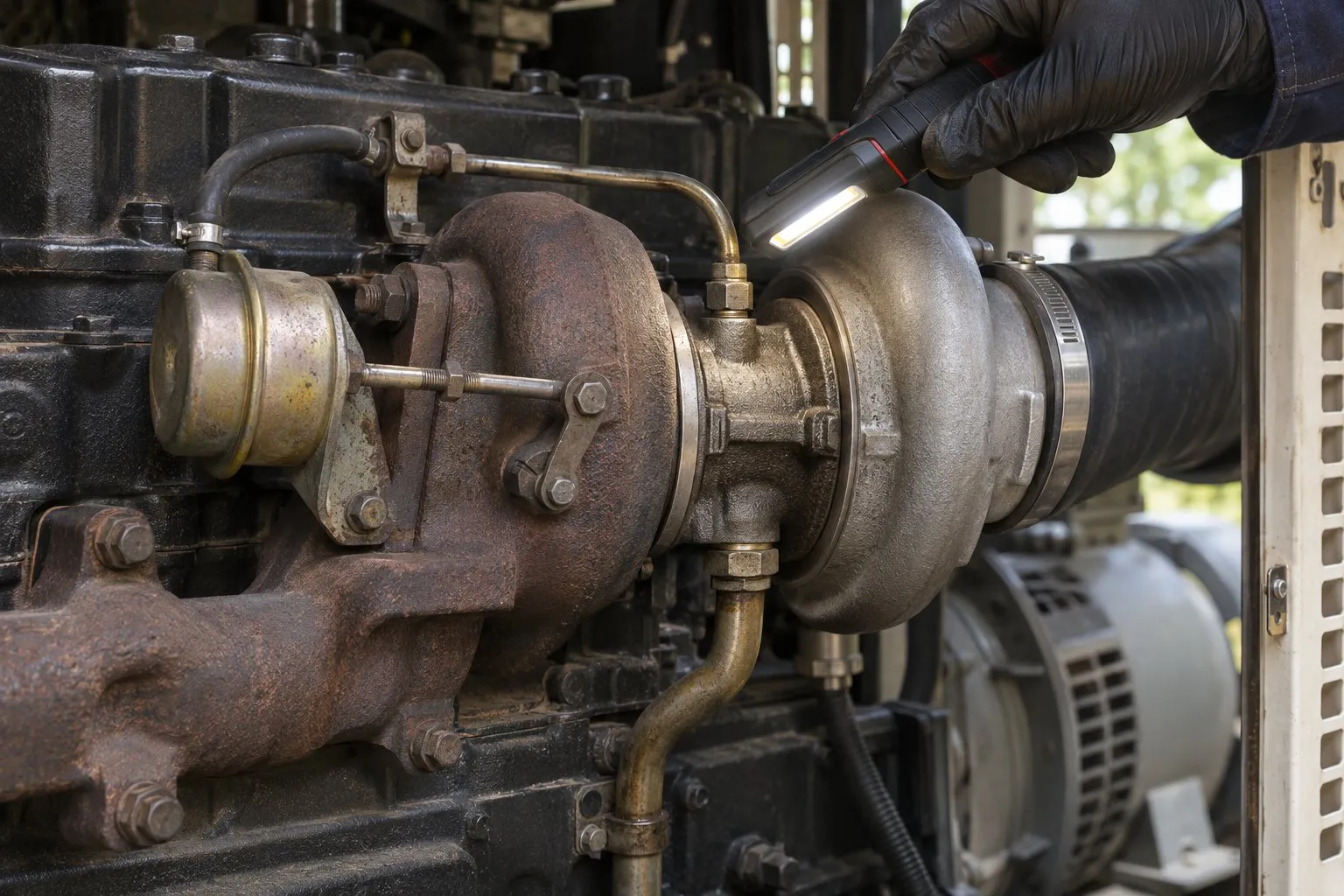
Most turbo failures trace back to the oil supply, and that is especially true on standby equipment that sits idle. When a genset runs only for a monthly exercise cycle or an outage, oil drains out of the bearing system, additives settle, and varnish can form in the center housing. On a variable-geometry Tier 4 unit, the sliding nozzle sits on the exhaust side, where carbon and soot can restrict its movement and set a boost control code.
| Symptom | Likely cause on a standby genset | What to check first |
|---|---|---|
| Low power / won’t reach rated kW | Low boost from a leaking wastegate, stuck nozzle, or exhaust leak before the turbine | Wastegate linkage, VGT movement, manifold and up-pipe joints |
| Blue-gray smoke at the stack | Oil past a bearing seal, often after long storage | Breather, air filter, oil level, and the oil drain before the turbo |
| Grinding or whistle, excess play | Bearing wear from poor oil supply or infrequent runs | Shaft play within the maker’s limits, no wheel contact |
| Boost control fault code (VGT units) | Carbon or soot on the sliding nozzle, or a failed actuator | Actuator function and nozzle movement per the maker’s tool |
A few points worth remembering on generator engines: oil in the charge piping is only a turbo problem if it passed the compressor-side seal, so check the crankcase ventilation and oil level before condemning the turbo. A leak in the exhaust manifold or up-pipe lets gas escape before the turbine and shows up as low boost and slow response, not high backpressure. And after any bearing failure, replace the oil feed line rather than reusing it, so old debris does not kill the new turbo.
New vs remanufactured for genset turbos
You have two sound paths back to service: a new turbo or a quality reman of your exact unit. For a standby generator that must start reliably, both are good; the choice usually comes down to availability and the condition of your core.
| Consideration | New turbo | Remanufactured turbo |
|---|---|---|
| Internals | All-new components | New bearings, seals, and thrust parts; balanced cartridge |
| Core | None required | Core return within 30 days, customer pays return shipping |
| Fit | Exact OE match by part number | Built back to your original number |
| Warranty | 12 months, unlimited mileage | 12 months, unlimited mileage |
| Turnaround | In-stock units ship same day when ordered before 2 PM Pacific | Most rebuilds ship in 3 days or less |
If your genset turbo is a serviceable fixed-geometry or wastegated Holset, our in-house turbocharger rebuild service is often the fastest route, since we remanufacture to the original number and balance the cartridge on a vibration sorting rig. For what a rebuild runs on your specific model, see our turbo rebuild price list rather than guessing from a generic figure. Fleet and facility customers who keep common cores on the shelf can arrange priority turnaround and stocking by phone.
Getting the right part the first time
The wrong turbo on a standby generator is worse than no turbo, because you discover it during an outage. Pull the data plate number, note the engine model and serial, and confirm the wheels and housings if you can. If anything is unclear, contact PT Turbo or call (909) 824-1020 and we will identify the unit, or browse everything we stock in our store.
Frequently Asked Questions
Does my standby generator have a variable-geometry turbo?
It depends on the engine’s emissions tier, not the generator brand. Older and Tier 3 industrial engines typically run fixed-geometry or wastegated turbos, while many Tier 4 engines use a sliding-nozzle Holset or an electronically actuated BorgWarner. Read the number on the turbo’s data plate to be sure.
Why did my generator turbo fail if the engine has low hours?
Low total hours with long storage is actually hard on a turbo. Oil drains out of the bearing system between runs and varnish can form, which wears bearings. On a variable-geometry unit, carbon and soot can also stiffen the nozzle. Most failures still trace back to the oil supply, so check the feed and drain condition when you replace the unit.
Can I order a genset turbo by the engine model alone?
No. Industrial Cummins, Cat, and John Deere based engines are built in many ratings and emission levels, and the turbo changes with them. Order by the part number on the turbo’s tag, and if it is missing, send us the turbo so we can identify it from the wheels and housings.
Need a Turbocharger?
PT Turbo has rebuilt and sold turbochargers since 1978. We stock remanufactured units for Cummins, Duramax, Power Stroke, Detroit Diesel, and more — backed by a 12-month unlimited mileage warranty. Units in stock at our shop in San Bernardino, CA ship the same day when ordered before 2 PM Pacific, Monday through Friday.
📞 (909) 824-1020 · 346 S I St. #3, San Bernardino, CA 92410 · info@ptturbo.com