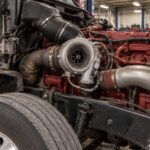
Compound Turbo Systems for Diesel represent one of the most effective ways to make serious, reliable power from a diesel engine without pushing a single turbocharger past its efficiency limits. Instead of relying on one big charger to do everything, a compound setup stacks two turbos in series, letting each unit do the job it does best. The result is broad, usable boost from just off idle all the way to redline.
At PT Turbo, we have spent 45+ years building, rebuilding, and troubleshooting turbochargers for everything from Cummins-powered work trucks to heavy equipment. Compound systems come across our bench regularly, and the failures almost always trace back to one thing: builders misunderstanding how the two turbos are supposed to work together. Let’s fix that.
How Compound Turbocharging Actually Works
A compound system uses two turbochargers plumbed in series, not parallel. A large low-pressure turbo feeds a smaller high-pressure turbo, and the two compress intake air in stages. Think of it like a two-stage air compressor: each stage handles part of the total pressure ratio.
The small high-pressure turbo spools almost instantly because it has low rotating inertia. That kills turbo lag down low. As RPM and exhaust volume climb, the large low-pressure turbo comes alive and does the heavy lifting up top, feeding pre-compressed air into the small turbo.
Because each turbo only needs to produce a portion of the total boost, both stay inside their efficiency islands. That means cooler charge air, less drive pressure, and far less stress on the wheels and bearings than you would see from a single turbo choked at 60+ psi.
If you want the underlying physics, the general turbocharger fundamentals are worth a refresher, but the practical takeaway is simple: two turbos sharing the workload run cooler and last longer than one turbo doing it all.
When Compound Turbo Systems for Diesel Make Sense
Compounds are not the right answer for every truck. They shine in specific use cases where a single turbo forces a compromise you cannot live with.
- High horsepower with drivability: If you want 600+ rear-wheel horsepower but still need the truck to tow and drive daily, compounds give you spool and top-end together.
- Heavy towing and hauling: The instant low-end response keeps exhaust gas temps (EGTs) in check when you are dragging a loaded trailer up a grade.
- Sled pulling and competition: Massive airflow at high RPM without lighting the fuse late.
- Altitude operation: Two-stage compression compensates for thin air far better than a single charger.
Where compounds do not make sense: a stock or lightly tuned truck. If you are making under 450 horsepower, a properly sized single or a quality VGT will do the job with less plumbing, less weight, and less cost.
Single Turbo vs Compound: The Real Trade-Offs
Here is how the two approaches stack up when you are deciding what to build. These numbers reflect typical medium-duty diesel builds in the 500 to 800 horsepower range.
| Factor | Single Turbo | Compound System |
|---|---|---|
| Spool / low-end response | Slower, especially with a large frame | Excellent, near-instant off idle |
| Peak airflow | Limited by single compressor map | Very high, two stages combined |
| Drive pressure / EGT control | Higher at extreme boost | Lower, work is shared |
| Installation complexity | Moderate | High (piping, oil, packaging) |
| Typical cost | $1,500 – $3,500 | $4,000 – $8,000+ |
| Best use | Street, moderate power | Towing, high power, competition |
Price ranges in this article are general estimates to help with budgeting, not PT Turbo quotes. Our current prices are on each product listing, and our rebuild prices are on the turbo rebuild price list.
The cost gap is real, and it is why we tell customers to be honest about their goals. A compound system that is oversized for a daily driver is money spent on complexity you will never use.
Sizing and Matching the Two Turbos
The single biggest mistake in compound builds is mismatched turbos. The high-pressure (small) turbo and low-pressure (large) turbo have to be sized so the small one hands off cleanly to the big one without choking drive pressure or overspeeding either wheel.
A good starting rule for a street-and-tow compound is a small high-pressure charger in the 58 to 64 mm compressor range feeding a large low-pressure unit in the 72 to 88 mm range. The exact combination depends on displacement, target power, and whether you prioritize spool or top-end.
Drive Pressure Balance
You want the high-pressure turbo’s drive pressure staying reasonably close to its boost pressure. When drive pressure runs way ahead of boost, you are heating the intake charge, spiking EGTs, and stressing the head gaskets. Correct sizing and a properly set wastegate keep that ratio sane.
Wastegate and Actuator Control
Most compound setups use a wastegate on the high-pressure turbo to control how much exhaust bypasses it and drives the big turbo instead. That actuator is a wear item, and a weak or leaking one throws the whole balance off. Boost creep, overspeed, and inconsistent spool almost always come back to a tired actuator.
Installation Realities Most Builders Underestimate
Compound systems ask a lot from the surrounding hardware. The bearing systems, in particular, work hard because the large low-pressure turbo can windmill and load bearings even when it is not producing much boost.
Oil supply and drainage matter more than on a single-turbo truck. Both turbos need adequate feed pressure and unrestricted drains back to the pan. A restricted drain pushes oil past the seals and shows up as smoke and shaft play in short order.
Bearing choice affects longevity too. On high-RPM compound builds, some shops move the high-pressure turbo to a ball bearing center section for faster spool and better durability. We break down the trade-offs in our guide on ceramic ball bearing vs journal bearing turbos if you are weighing the upgrade.
Emissions equipment also complicates plumbing. If your truck still runs EGR and a diesel particulate filter, the compound piping has to work around that hardware and keep exhaust flow clean to the aftertreatment. Plan the routing before you buy parts.
New, Remanufactured, or Rebuilt: Sourcing Your Turbos
Compound systems double your exposure to turbo cost, so where you source the units matters. You have three real paths.
| Option | Cost | Best For |
|---|---|---|
| New OEM/aftermarket | Highest | New builds, latest wheel designs |
| Remanufactured | 30-50% less than new | Proven value, most builds |
| Rebuild your existing unit | Lowest with a good core | Keeping a matched, known turbo |
A quality remanufactured turbocharger is built to the same tolerances as new, with fresh bearings, seals, and balanced rotating assemblies. For most compound builds, reman is the smart money.
If you already have a healthy large-frame turbo and just need the small one refreshed, our turbocharger rebuild service can bring it back to spec. And if you are deciding whether to replace the whole unit or just the cartridge, our breakdown of CHRA vs full turbocharger replacement will save you money.
We stock both new and remanufactured turbos and parts, and after 45+ years we can tell you quickly whether a given combination will actually work together. If you are not sure what to pair, contact PT Turbo before you buy, or browse our full turbo lineup to see what is in stock.
Frequently Asked Questions
What is a compound turbo system for diesel?
A compound turbo system uses two turbochargers arranged in series, where a larger turbo feeds a smaller one. This lets each unit operate in its most efficient range for broad, reliable boost.
Why are two turbos better than one for a diesel engine?
Two turbos in series eliminate the trade-off between low-end response and top-end airflow. The small turbo spools quickly for instant boost while the large turbo supplies high volume at higher RPM.
Does a compound turbo setup reduce turbo lag?
Yes, the smaller high-pressure turbo spools almost immediately off idle, greatly reducing lag. This provides usable boost across a much wider RPM range than a single large turbo.
Need a Turbocharger?
PT Turbo has rebuilt and sold turbochargers since 1978. We stock remanufactured units for Cummins, Duramax, Power Stroke, Detroit Diesel, and more — backed by a 12-month unlimited mileage warranty and same-week shipping from San Bernardino, CA.
📞 (909) 824-1020 · 346 S I St. #3, San Bernardino, CA 92410 · [email protected]
More From PT Turbo
- How to Avoid Buying a Bad Remanufactured Turbocharger: Red Flags to Watch For
- Remanufactured Turbocharger Buying Guide: What to Look for and What to Avoid
 Semi Truck Turbocharger Replacement Cost: Cummins ISX, DD15 & PACCAR MX-13
- School Bus Turbocharger Guide: International DT466 & Cummins B-Series Replacement