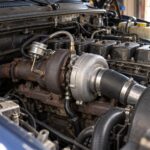
This School Bus Turbocharger Guide covers the two workhorse engines that move most of North America’s yellow fleet: the International DT466 and the Cummins B-Series (5.9L and 6.7L ISB). If you run, maintain, or repair school buses, you already know these engines are built to log a million miles, but the turbocharger bolted to the exhaust manifold rarely goes the full distance without attention. Knowing how these turbos work, how they fail, and what a correct replacement looks like keeps your buses on the road and your route sheets covered.
PT Turbo has been rebuilding and supplying diesel turbochargers since 1978, more than 45 years of hands-on experience with exactly the units you’ll find on these platforms. We stock both new and remanufactured turbos and the actuators that keep them working, so this guide is written from the bench, not from a spec sheet.
The Two Engines Behind Most School Buses
The International DT466 has powered Type C conventional buses for decades. Depending on model year, you’ll see it wearing a BorgWarner or Garrett fixed geometry turbo, and the EGR engines of 2004 to 2009 run a BorgWarner variable geometry turbo with an electronic actuator.
The Cummins B-Series is the other giant in this space. The 5.9L ISB and the later 6.7L ISB show up in both Type C and Type D buses, with Holset turbos: wastegated on most 5.9L engines, variable geometry on the 6.7L. If you want a deep dive on the 6.7L variable geometry hardware, our Cummins ISB 6.7L Turbocharger Guide breaks down operation and common failures in detail.
Here’s how the common turbo configurations line up across model years and applications.
| Engine | Typical Bus Type | Turbo Style | Actuation |
|---|---|---|---|
| DT466 (pre-EGR) | Type C conventional | BorgWarner or Garrett, fixed geometry | Wastegate on most |
| DT466 (2004 to 2006) and MaxxForce DT | Type C conventional | BorgWarner variable geometry to 2009; two turbos in series from 2010 | Electronic actuator on the variable geometry turbo |
| Cummins 5.9L ISB | Type C / Type D | Holset HX35W, HY35W or HE351CW, wastegated | Pneumatic wastegate actuator |
| Cummins 6.7L ISB | Type C / Type D | Holset HE351VE or HE300VG, variable geometry | Electronic (VGT actuator) |
How These Turbochargers Actually Work
A turbocharger recovers energy from exhaust gas to spin a compressor and force more air into the cylinders. More air means more fuel can be burned cleanly, which is why a healthy turbo is the difference between a bus that pulls a full load up a grade and one that coughs black smoke and lags. The basics are covered well in this turbocharger overview if you want the fundamentals.
Fixed geometry turbos on older DT466 engines rely on a wastegate to limit boost. Once emissions regulations tightened, both platforms moved to variable geometry turbochargers that change the turbine nozzle (pivoting vanes on the BorgWarner units, a sliding nozzle on the Holset ones) to control exhaust flow across the whole RPM range.
Variable geometry is also tied directly to emissions hardware. On EGR-equipped engines the turbo works alongside exhaust gas recirculation and, on newer buses, a diesel particulate filter. That’s why a sticking VGT often throws DPF regen and EGR-related codes at the same time.
Common Failure Symptoms in Bus Turbos
School buses run a brutal duty cycle: cold starts, short stop-and-go routes, long idle times, and heavy loads twice a day. That pattern is hard on turbos, and it shows up in predictable ways.
Use this severity chart to triage what you’re seeing before you pull anything apart.
| Severity | Symptom | Likely Cause |
|---|---|---|
| Early | Slight power loss, hesitation off idle | Sticking VGT vanes or lazy actuator |
| Moderate | Black smoke, low boost codes, whistle | Actuator failure, boost leak, worn vanes |
| Serious | Blue smoke, oil in intake, rising oil use | Failed seals, worn bearings |
| Critical | Grinding/whine, no boost, metal in oil | Bearing failure, shaft play, wheel contact |
The most common driver of “check engine” complaints on these buses is not the turbo cartridge at all. It’s the actuator that positions the vanes or the wastegate. Carbon buildup, corrosion, and worn diaphragms make an actuator sluggish long before the turbo itself wears out.
Actuators: The Part That Fails First in This School Bus Turbocharger Guide
Because the actuator does so much of the work on a variable geometry or wastegated turbo, replacing a failed actuator often restores full performance without touching the turbo center section. This is the single most cost-effective repair on the list, and it’s why we stock a wide range of pneumatic actuators.
One important note: an electronic actuator must be calibrated to the specific turbo with a service tool, while a pneumatic wastegate actuator is set by its rod and tested with a pump. Bolting on an uncalibrated actuator will get you running, but boost control will be off and you may still throw codes. If you’re not sure which part matches your unit, send us the turbo part number through our contact page and we’ll confirm the correct actuator.
New vs Remanufactured: What Makes Sense for a Fleet
When the turbo cartridge itself is worn out, you have three real options: a new unit, a quality remanufactured unit, or a rebuild of your existing core. For a school bus fleet, the decision usually comes down to cost per bus and downtime tolerance.
A properly remanufactured turbo is disassembled, cleaned, inspected, and rebuilt with new bearings, seals, and a balanced rotating assembly to OEM tolerances. A good reman performs identically to new at a lower price, which is why fleets lean on them heavily.
| Option | Typical Cost Range | Best For |
|---|---|---|
| New OEM turbo | $610 to $1,475 (6 listings) at PT Turbo for the DT466 | Latest model buses under warranty |
| Remanufactured turbo | $1,448 to $2,353 (7 listings) at PT Turbo for the DT466 | Most fleet replacements |
| Rebuild your core | $450 to $975 for most turbos at PT Turbo (price list) | Keeping a known-good matched unit |
| Actuator only | see actuator prices | Boost/code issues, healthy cartridge |
Price ranges in this article are general estimates to help with budgeting, not PT Turbo quotes. Our current prices are on each product listing, and our rebuild prices are on the turbo rebuild price list.
PT Turbo carries a full line of remanufactured turbochargers for both DT466 and Cummins B-Series engines. If you’d rather keep your original matched unit, our turbo rebuild service restores your core to spec with a full balance and inspection.
For a fleet running multiple buses on the same engine, the smart move is often keeping a remanufactured unit or two on the shelf so a turbo swap never idles a route. You pull the bad unit, bolt on the reman, and send the core back for credit instead of waiting on a repair turnaround.
Whichever route you pick, verify the actuator and VGT are matched to your engine’s calibration before the bus goes back in service. A correct turbo with the wrong boost control will still cost you codes and a second trip into the shop.
Frequently Asked Questions
What are the signs of a failing turbocharger on a DT466 or Cummins B-Series?
Common symptoms include loss of power, excessive black or blue smoke, whining noises, and increased oil consumption. A boost pressure drop is often the clearest early warning sign.
How long does a school bus turbocharger typically last?
Most turbochargers last between 100,000 and 200,000 miles, though maintenance quality, oil condition, and driving conditions can significantly shorten or extend that lifespan.
Can I replace a school bus turbocharger myself?
Experienced mechanics can replace a DT466 or Cummins B-Series turbo, but it requires proper tools, torque specs, and clean oil supply lines. Always prime the turbo with oil before startup to prevent immediate failure.
Need a Turbocharger?
PT Turbo has rebuilt and sold turbochargers since 1978. We stock remanufactured units for Cummins, Duramax, Power Stroke, Detroit Diesel, and more — backed by a 12-month unlimited mileage warranty and same-week shipping from San Bernardino, CA.
📞 (909) 824-1020 · 346 S I St. #3, San Bernardino, CA 92410 · [email protected]
More From PT Turbo
- New Turbocharger vs Rebuilt vs Remanufactured: What Is the Actual Difference?
- Turbocharger Oil Leaks: Causes, Diagnosis & When to Replace vs Reseal
 Remanufactured vs Rebuilt Turbocharger: Real Cost Difference Explained
- Fleet Diesel Turbocharger Maintenance Program: Best Practices for Commercial Operations