Military Vehicle Diesel Turbocharger Guide: HMMWV, LMTV & Heavy Tactical Trucks
In this military vehicle diesel turbocharger guide, we focus on something that matters more on tactical trucks than almost any civilian platform: the right part has to be matched to the engine and the data plate, not to the name painted on the bumper. HMMWVs, the FMTV family (LMTV and MTV), and heavy tactical trucks like the HEMTT, PLS and MTVR all ran commercial-derived diesels, and those engines changed over production and by rating. Get the turbo wrong and you have downtime at best and a scrapped core at worst. PT Turbo has been rebuilding turbochargers since 1978, and in more than 45 years of family-owned work the one rule that never changes is this: read the tag first.
Why you match a military turbo by the nameplate, never the vehicle name
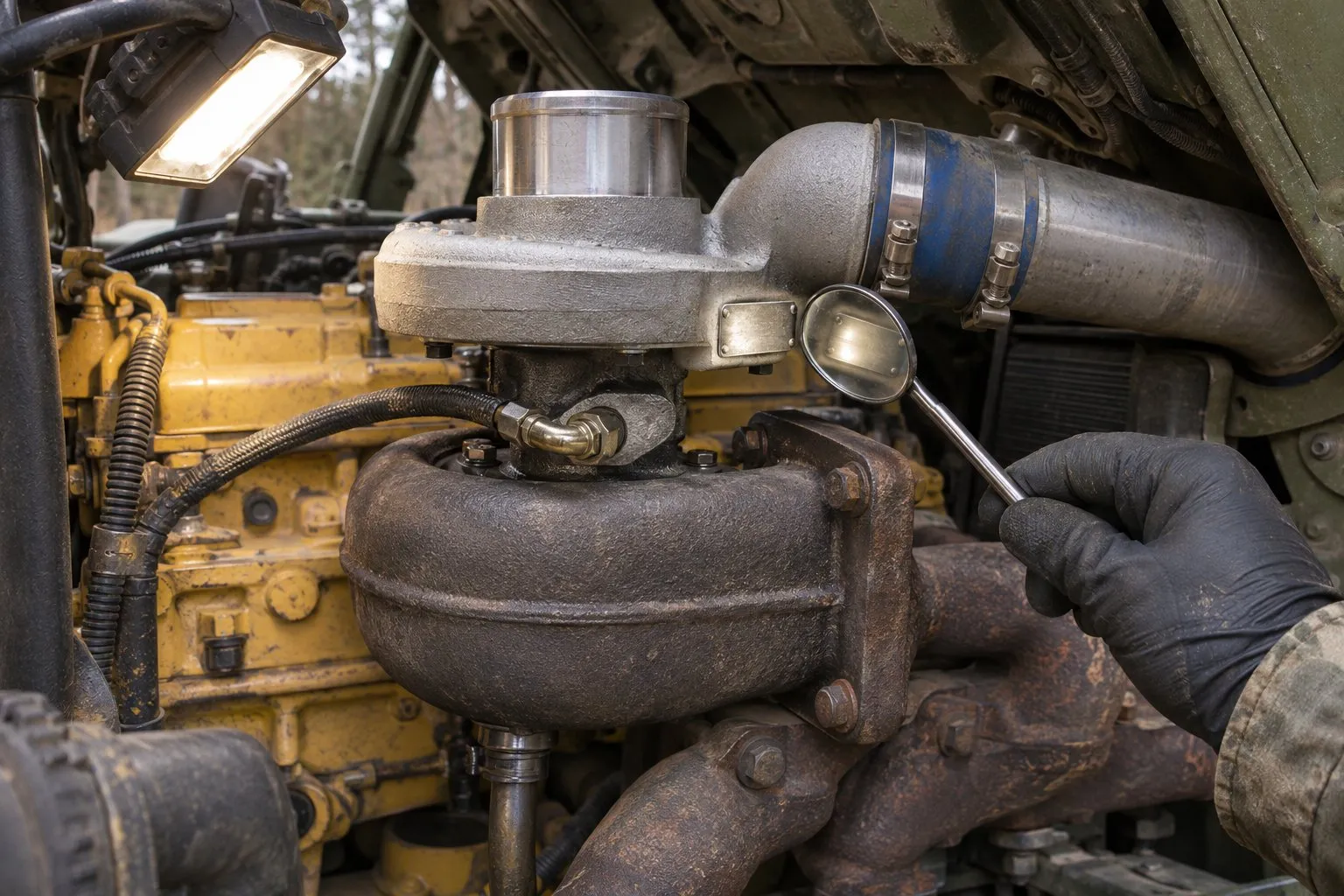
Tactical trucks use diesels sourced from Caterpillar, Detroit Diesel and Cummins, and the same chassis designation can carry different engines across model years, overhauls and reset programs. A unit that was rebuilt or remanufactured during its service life may not carry the turbo it left the factory with.
Because of that, the vehicle name alone will not tell you the correct turbocharger. The turbo’s own data plate (the stamped part number on a housing) and the engine’s identifier are what point you to the right unit. If a turbo has been swapped at depot level, only that tag is reliable.
When you request a turbo, have the number off the compressor housing plate and the engine’s build identifier in front of you. Casting numbers on the housings only narrow the search; one casting serves many turbos, so they confirm nothing on their own. Wheel sizes and housing A/R finish the identification.
Turbocharger families found on tactical truck engines
The engines under these trucks come from well-known commercial families, and the turbos follow those engines rather than the military platform. Caterpillar did not build its own turbos; Garrett and BorgWarner supplied them. Detroit and Cummins platforms mix Garrett, BorgWarner and Holset units depending on generation and emissions level.
Here is how the common engine families line up with the turbo families PT Turbo stocks. Confirm your exact unit by the tag before ordering any of these.
| Engine family (commercial) | Turbo families seen | Geometry / control |
|---|---|---|
| Cat 3116 / 3126 / C7 ratings | BorgWarner S200 / S200G on most; S300 (for example S300AG072) on 3126B/3126E and some C7 | Fixed geometry on most; 2007-on C7 truck engines use a variable-vane turbo |
| Cat C15 single-turbo (6NZ, MBN) | Garrett GTA4702 or BorgWarner S410G by rating | Fixed geometry, wastegate by rating |
| Cat C15 ACERT (BXS, MXS, NXS, SDP) | Series turbos; low-pressure Garrett GTA5518B | Two turbos in series, wastegate on the high-pressure turbo |
| Cat C18 | Single turbo on most ratings; series twin turbos on higher ratings | Fixed geometry |
| Detroit Series 60 | Garrett GTA4294 (fixed), GTA4502V and Holset HE531VE on EGR engines; S400 replacement | Fixed on pre-EGR; variable-geometry on EGR engines |
| Cummins B / C-series (ISB, ISC) | Holset HX35W, HX40W, later HE351VE / HE431VE | Wastegated fixed on earlier; variable-geometry with electronic actuator on later |
Smaller platforms like the HMMWV ran GM-based 6.2L and 6.5L diesels, with the turbocharged 6.5L carrying a compact single turbo. We do not publish a model guess for those here; identify the turbo by the plate on the unit and the engine build. For the medium and heavy platforms, our Cummins ISC turbocharger guide and Caterpillar C18 guide go deeper on those engine families.
How these turbos fail in military service
Tactical trucks live a hard life: long idling, dust, heavy loads, convoy stop-and-go, and storage between missions. Most turbo failures still trace back to the oil supply, not the turbo itself, so the feed line, oil condition and the drain deserve attention before you condemn a unit.
The most common failure we see on any diesel turbo starts with contaminated or interrupted oil reaching the bearings. Coked oil from hot shutdowns, a restricted drain backing oil up past the seals, or dirt through a cracked inlet boot all take out the center section. A few minutes of idle after a hard pull or towing protects the bearings far more than people expect.
- Oil in the charge pipes: check the breather, air filter, oil level and drain before blaming the compressor seal. A light oil film from crankcase ventilation is normal; pooled oil is not.
- Low boost with dark smoke: look for exhaust leaks in the up-pipes or manifold that let exhaust escape ahead of the turbine, a leaking wastegate, or a variable nozzle stuck open.
- Overboost and high drive pressure: usually a variable nozzle stuck closed, or a boost-opened wastegate opening late from a leaking diaphragm.
- Felt in-and-out play or wheel contact: condemn the turbo. Some side-to-side rock is normal on a journal-bearing unit with no oil pressure.
If a compressor wheel shed metal into the charge air cooler, replace the cooler and inspect the charge piping. Metal in the fins cannot be reliably flushed out, and charge air carries it on into the engine intake on first start.
Fixed geometry versus variable geometry on tactical trucks
Older and off-highway ratings tend to run fixed-geometry turbos, often with a wastegate. Newer, emissions-controlled ratings move to variable-geometry turbochargers, which change exhaust flow across the turbine to build boost sooner and control drive pressure.
How the vanes or nozzle are moved matters for service. Holset variable turbos use a sliding nozzle. On VE and VG models (HE431VE, HE551VE, HE400VG and the like) an electronic actuator moves it and must be calibrated to its own turbo with a service tool; models ending in V with no E (HE431V, HE531V, HE551V) use an air-operated actuator. The Detroit Series 60 EGR Garrett VNT is also moved by air, not an electronic actuator. Never force an electronic actuator’s arm by hand; the gears are self-locking and break.
On fixed-geometry units the wastegate is the part to check: a flapper that does not seat lets exhaust past the turbine and gives low boost and slow spool. Pneumatic actuators are tested with a vacuum or pressure pump and have a rod to set; electronic actuators are calibrated, not pumped. Mixing those two procedures up sends you to the wrong part.
New, remanufactured, or rebuilt: keeping a fleet moving
For a fleet, the question is usually availability and turnaround, not just the unit itself. PT Turbo stocks new turbos and remanufactures in-house, so there is normally more than one way to get a truck back on the road.
| Option | What you get | Best when |
|---|---|---|
| New turbo | Factory-fresh unit, no core | No serviceable core, or you want to keep the old one as a spare |
| Remanufactured turbo | Balanced, tested unit off the shelf; core returned within 30 days | You need a running unit quickly and have a core to exchange |
| Rebuild your own core | Your exact unit rebuilt with new bearings, seals and thrust parts | You want the numbers-matching turbo back; most rebuilds ship in 3 days or less |
Rebuild pricing is model-specific and confirmed after inspection and before any work starts, so instead of a guess, check our turbo rebuild price list for your unit. Every rebuilt and remanufactured turbo carries a 12-month, unlimited-mileage warranty, and fleet customers can arrange priority turnaround and have common cores stocked by phone.
Whichever route you take, follow the maker’s first-start steps: fill the oil inlet with clean engine oil, turn the wheel by hand, then crank or idle a few minutes before load. There is no break-in mileage schedule or first-miles boost limit to worry about.
How to order the right turbo for a military vehicle
Start with the number stamped on the turbo’s data plate and the engine build identifier. Those two together are what let us confirm the exact unit, cross-reference it and tell you whether it is in stock, available new, or best handled as a rebuild of your core.
If the old plate is unreadable, send the compressor and turbine wheel measurements and the housing A/R, and photos of the actuator or wastegate. Those details separate near-identical models that do not interchange. When in doubt, send the turbo number to the shop and let us verify before anything ships. Reach us through the contact page or call (909) 824-1020.
Frequently Asked Questions
Can I identify a tactical truck turbo from the vehicle model alone?
No. The same chassis designation carried different engines across production and reset programs, and turbos get swapped at depot level. Use the part number on the turbo’s data plate and the engine build identifier, and confirm with wheel sizes and housing A/R if the plate is worn.
Do military variable-geometry turbos need the actuator calibrated after replacement?
Holset electronic actuators are calibrated to their own turbo with a service tool, so a replacement actuator must be set up to that unit. Air-operated units, like the Detroit Series 60 EGR Garrett VNT, are not calibrated that way; they are tested and adjusted on the pneumatic side. Match the procedure to the actuator type, not to the engine name.
Is a remanufactured turbo reliable enough for a work fleet?
Yes. A remanufactured unit is rebuilt with new bearings, seals and thrust parts, balanced and tested, and it carries a 12-month unlimited-mileage warranty. For a fleet, an off-the-shelf reman with a 30-day core return often gets a truck running faster than rebuilding your own core, and both keep the correct turbo on the engine.
Need a Turbocharger?
PT Turbo has rebuilt and sold turbochargers since 1978. We stock remanufactured units for Cummins, Duramax, Power Stroke, Detroit Diesel, and more — backed by a 12-month unlimited mileage warranty. Units in stock at our shop in San Bernardino, CA ship the same day when ordered before 2 PM Pacific, Monday through Friday.
📞 (909) 824-1020 · 346 S I St. #3, San Bernardino, CA 92410 · info@ptturbo.com
More From PT Turbo
 How to Read a Turbocharger Compressor Map: Guide for Diesel Owners
- Coach and Tour Bus Turbocharger Guide: Detroit DD13 & Cummins ISX Applications
- AGCO & Fendt Turbocharger Guide: Agricultural Equipment Diesel Applications
- Turbocharger Replacement Cost by Engine: Price Guide for Diesel Trucks & Equipment