Coach and Tour Bus Turbocharger Guide: Detroit DD13 & Cummins ISX Applications
Keep this Coach and Tour Bus Turbocharger Guide handy whenever you are diagnosing a charge-air problem on a Detroit DD13 or a Cummins ISX, because these two engine families power most of the motorcoach fleet on the road and their turbochargers work in completely different ways. One is a fixed-geometry turbo (wastegated on GHG14 engines, with no wastegate on GHG17 engines), the other is a Holset variable-geometry unit with a sliding nozzle. Get the two confused and you will chase the wrong part, the wrong fault code, and the wrong repair. PT Turbo has been rebuilding turbochargers since 1978, and this walkthrough is built from how these units actually operate and how they actually fail.
How to use this Coach and Tour Bus Turbocharger Guide
The single most important rule for any coach turbo is to go by the number on the data plate, not by the engine name. Both Detroit and Cummins changed turbo designs across emissions tiers, and a casting number on the housing will not tell you which unit you have. The part number is stamped on the nameplate on the compressor housing, and the engine’s CPL lives on the engine dataplate.
Heavy coach engines report faults as SPN and FMI numbers through the J1939 bus, not as the generic P-codes you see on a pickup. When a tech quotes you a “P0299” on a DD13 or ISX, treat it with suspicion; those engines speak in SPN/FMI. Match the fault to the manufacturer’s service tool before you pull anything.
Detroit DD13: Asymmetric Fixed Geometry, No Vanes
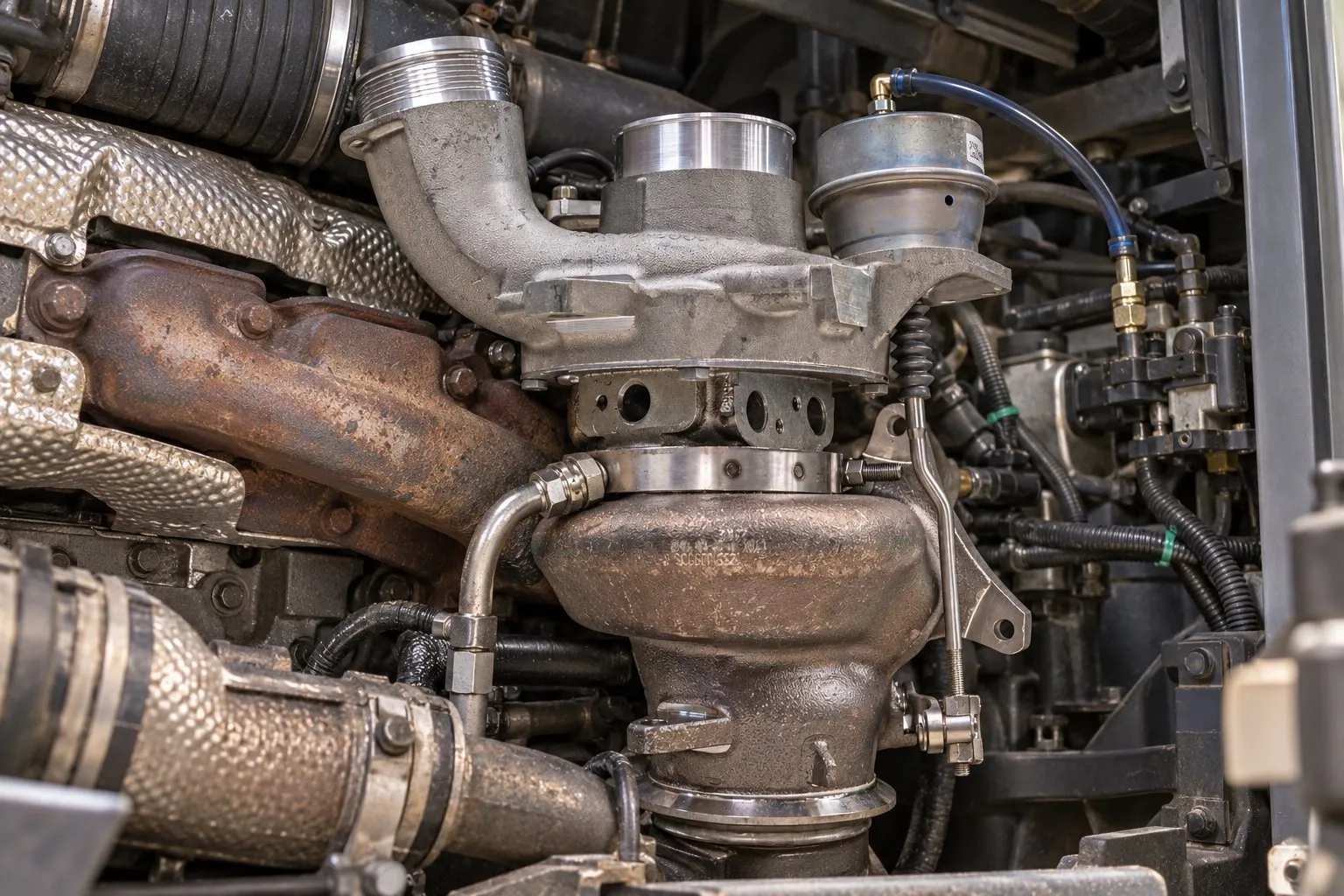
The Detroit DD13 is a 12.8L inline-six, currently rated roughly 370 to 525 hp and 1,250 to 1,850 lb-ft. Since its launch in 2009 it has used an asymmetric fixed-geometry turbo from the BorgWarner B3G family. There are no vanes, no unison ring, and no VGT actuator on this turbo. If a shop tells you a DD13 turbo “has sticking vanes,” they are describing the wrong engine.
Boost on the DD13 is managed by a wastegate. Through roughly model year 2016 (GHG14 era), that wastegate is air-operated and controlled by a solenoid using truck air. From GHG17 onward, the asymmetric turbo runs with no wastegate at all. You can explore what we stock for the BorgWarner B03G turbochargers on the model page.
Because the DD13 turbo has no variable nozzle, a boost complaint almost always traces to the air side or the wastegate circuit rather than to internal vanes. Detroit’s low-boost diagnostics commonly surface as SPN 102 FMI 18 on GHG14 engines and SPN 3563 on GHG17 engines. There is also a known wastegate-solenoid air-leak bulletin that can set codes 2631/1 (low air flow) and 3711/31. Check the air line, the solenoid, and the wastegate linkage before condemning the turbo.
Cummins ISX: Fixed Geometry to Holset VGT by Generation
The ISX, now the 14.9L ISX15 and X15, moved through several turbo designs as emissions rules tightened. This is where coach techs get tripped up, because the actuator type and whether the turbo even has a nozzle depend entirely on the generation.
- Pre-EGR ISX (to 2002): fixed geometry with a wastegate, either the Holset HX55W or the HX60W.
- 2003-2007 (CM870 controls): the Holset HE551V, a variable-geometry turbo with an air-operated actuator. Truck air passes through a turbocharger control valve; there is no electronic actuator and no actuator calibration on this one.
- 2007 emissions engines to 2010 (CM871): the HE561VE, and the HE551VE on some ratings, both with an electronic actuator.
- ISX15 from 2010 (CM2250, CM2350) and X15: the HE451VE or the HE400VG, both with an electronic actuator. On the ISX the HE451VE sits between the HE561VE and the HE400VG; later engines carry the HE400VG.
The two later VGTs look alike but do not interchange; the compressor cover and actuator differ. The HE500VG shows up as a later replacement model covering several earlier numbers. Confirm the exact unit by the tag, not by eyeballing the housing.
How the Holset VGT Actually Works
A Holset variable-geometry turbocharger uses a sliding nozzle ring, not pivoting vanes on a unison ring like a Garrett VGT. The ring slides to change the effective area at the turbine, building drive pressure at low speed for quick spool and opening up at high flow. On a coach pulling a grade loaded with passengers, that sliding nozzle is doing constant work.
The actuator type follows the Holset naming. A model ending in V with no E, such as the HE551V, is air-operated. Models ending in VE or VG carry an electronic actuator. That is why the 2003-2007 ISX turbo is controlled by truck air while the 2010-on ISX15 and X15 units are controlled electronically. The VGT models have coolant lines for the actuator, which the earlier wastegated units do not.
| Engine / generation | Turbo type | Boost control | Actuator |
|---|---|---|---|
| ISX pre-EGR (to 2002) | Fixed geometry, wastegated | Wastegate | HX55W / HX60W |
| ISX 2003-2007 (CM870) | Variable geometry, sliding nozzle | Air-operated | HE551V |
| ISX 2007-2010 (CM871) | Variable geometry, sliding nozzle | Electronic | HE561VE / HE551VE |
| ISX15 / X15 (2010 on) | Variable geometry, sliding nozzle | Electronic | HE451VE / HE400VG |
| DD13 (2009 on, GHG14) | Asymmetric fixed geometry | Air-operated wastegate + solenoid | None (wastegate only) |
| DD13 (GHG17 on) | Asymmetric fixed geometry | No wastegate | None |
Electronic Actuator Service on ISX VGTs
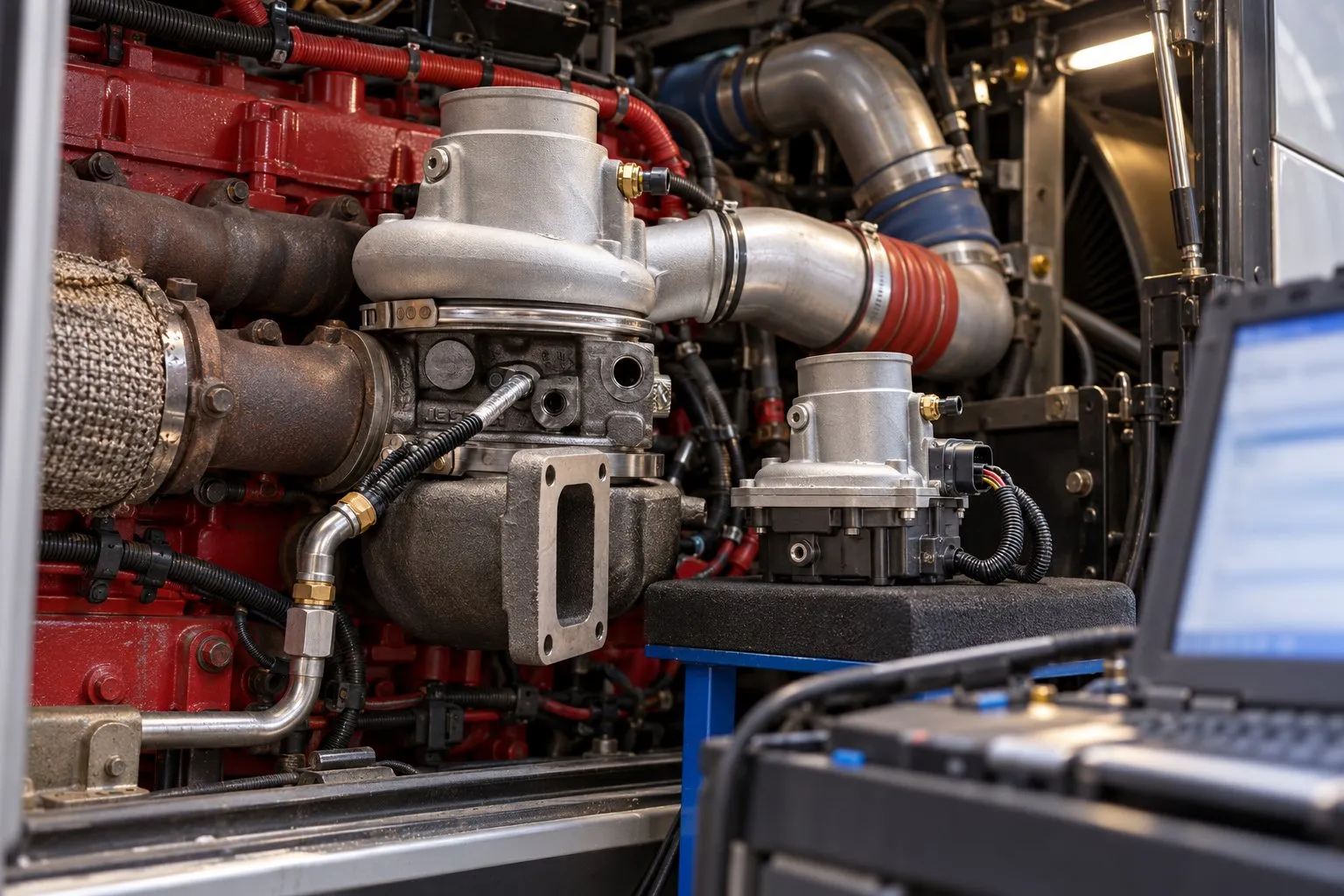
Never move the arm of a Holset electronic actuator by hand; the self-locking gears break. When you replace a Cummins actuator, run the INSITE install routine with the new actuator plugged in but not yet bolted to the turbo, then mount it and calibrate without cycling the key. Skip that sequence and you will fight calibration faults.
Typical VGT faults on the electronic ISX turbos show as Cummins codes such as 2387 (SPN 641 FMI 7), 2449, and 2634. A failed actuator position learn also sets a Cummins fault code; look up the exact code in Cummins service information. A sliding nozzle that is sticking from soot will usually set boost and position codes rather than an electrical circuit fault. These coaches run high-pressure EGR, so exhaust gas is routed to the intake after the compressor; carbon fouls the nozzle through extra soot in the exhaust, it does not “migrate back” through the turbine.
Common Failures on Coach Turbos
Most turbo failures on any coach trace back to the oil supply. Coked or contaminated oil wipes out the bearings, and a restricted drain backs oil up past the seals. After any bearing failure, replace the oil feed line rather than reusing it, and flush the system before the new turbo goes on.
| Symptom | Likely cause | Check first |
|---|---|---|
| Low boost, slow spool, high EGT | Exhaust leak before the turbine, or wastegate not seating (DD13) | Manifold, up-pipes, wastegate linkage |
| Overboost / high drive pressure (ISX VGT) | Sliding nozzle stuck closed, soot fouling | Actuator movement, nozzle condition |
| Low boost (ISX VGT) | Nozzle stuck open, actuator calibration | INSITE actuator test, calibration |
| Blue-gray smoke, oil in charge pipes | Crankcase vapor, drain restriction, seal | Breather, oil level, drain, air filter |
| Boost / position fault codes | Electronic actuator or wiring (VE/VG only) | SPN/FMI, actuator, harness |
Some side-to-side shaft play is normal on a journal-bearing turbo with no oil pressure. Condemn a unit for in-and-out play you can feel, for wheel contact with the housing, or for play beyond the maker’s limit, never for any movement at all. If the compressor wheel shed metal, replace the charge air cooler; metal in the fins cannot be reliably flushed out and will go straight into the engine.
Coach work rewards a disciplined cooldown. After a hard pull or a loaded grade, let the engine idle a few minutes before shutdown so the turbo bearing can shed heat instead of coking the oil.
New, Remanufactured, and Rebuild Options
PT Turbo stocks both new turbochargers and remanufactured turbochargers for these coach applications, and the shop remanufactures in-house. A remanufactured unit built on a sound core is a strong value for a DD13 or ISX turbo, and our in-house turbo rebuild service covers the Holset VGTs and the BorgWarner fixed-geometry units.
For pricing, see the real figures on our turbo rebuild price list; the rebuild price is confirmed after inspection and before any work starts. Most rebuilds ship in three days or less, every unit carries a 12-month unlimited-mileage warranty, and the core return window is 30 days. Fleet operators can arrange priority turnaround and core stocking by phone at (909) 824-1020, or through our contact page. With more than 45 years behind the bench, PT Turbo can match your coach turbo by its tag number and get you back in service.
If your fleet also runs Ram-based support trucks, the Holset VGT principles here carry over directly; see our Cummins ISB 6.7L turbocharger guide for a closer look at sliding-nozzle operation and failures.
Turbos we list for the HE400VG, HE451VE and HE551V
Listings for the turbo models named in this guide that can be ordered online today. Several part numbers can fit one engine by year and rating, so match the number on your turbo’s tag, or call (909) 824-1020 and we will match it for you.
All HE400VG listings · All HE451VE listings · All HE551V listings
Frequently Asked Questions
Does the Detroit DD13 use a variable-geometry turbo?
No. The DD13 has used an asymmetric fixed-geometry turbo from the BorgWarner B3G family since 2009, with no vanes and no VGT actuator. GHG14-era engines control boost with an air-operated wastegate and solenoid, while GHG17 engines run the asymmetric turbo with no wastegate at all.
Why do the ISX VGT turbos look the same but not interchange?
The HE451VE and HE400VG on the ISX15 and X15 share a similar outline but use a different compressor cover and a different actuator, so they do not swap directly. Always match the unit by the part number on the compressor-housing nameplate rather than by appearance or by the engine name alone.
What should I do after replacing a Cummins ISX electronic actuator?
Run the INSITE install routine with the new actuator plugged in but not yet bolted to the turbo, then mount it and calibrate without cycling the key. Never move the actuator arm by hand, because the self-locking gears break. A failed position learn sets a Cummins SPN/FMI fault code; look up the exact code in Cummins service information.
Need a Turbocharger?
PT Turbo has rebuilt and sold turbochargers since 1978. We stock remanufactured units for Cummins, Duramax, Power Stroke, Detroit Diesel, and more — backed by a 12-month unlimited mileage warranty. Units in stock at our shop in San Bernardino, CA ship the same day when ordered before 2 PM Pacific, Monday through Friday.
📞 (909) 824-1020 · 346 S I St. #3, San Bernardino, CA 92410 · [email protected]
More From PT Turbo
 Turbocharger Sizing Basics: How Engineers Match Turbos to Diesel Engines
- How Long Does a Turbocharger Rebuild Take? Realistic Timelines Explained
- Turbocharger Housing Types: Divided, Undivided, T3, T4 & V-Band Flanges Explained
- Electronic Actuator Failure on Diesel Trucks: Symptoms, Diagnosis & Replacement Cost