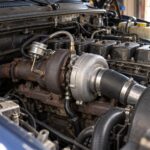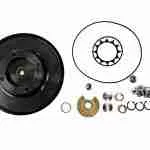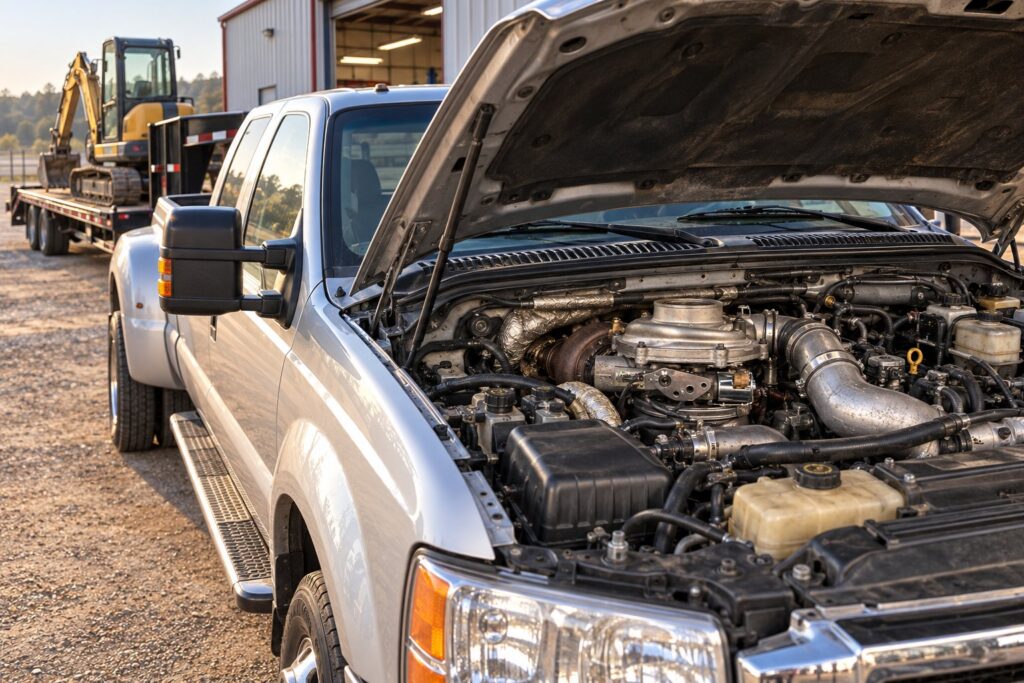
Choosing the Best Turbocharger Upgrade for Towing starts with understanding what a loaded trailer actually does to your engine. Pulling 20,000 pounds up a grade is a completely different demand than daily driving, and the turbo that works fine empty can run out of airflow, overheat the exhaust, and cook its own bearings when you hook up heavy. Before you spend a dollar, you need to match the turbo to the real load, duty cycle, and exhaust temperatures you run.
At PT Turbo we have been building, rebuilding, and spec’ing turbochargers since 1978, more than 45 years helping owner-operators and fleets pick parts that survive. Below is the straight technical guidance we give customers who call asking the same question: what should I actually buy to tow better without blowing up my engine?
Why Towing Punishes a Turbocharger
Under load, your engine burns more fuel, which means more exhaust energy spinning the turbine and more boost on the compressor side. That is exactly what you want, until it exceeds the turbo’s efficiency range. Push past it and you get rising exhaust gas temperature (EGT), compressor surge, and heat soak into the center housing.
The three failure drivers we see most on towing rigs are sustained high EGT, poor oil drainage from long WOT pulls, and overspeeding a stock turbo that is simply too small for the airflow demanded. A turbo spinning past its speed limit will shed blades or fail the bearing in short order.
Heat is the enemy. A healthy diesel turbo likes EGTs under about 1,250°F pre-turbo for continuous towing. The right upgrade moves more air at lower drive pressure, which pulls EGTs down and gives you margin on the long climbs.
- More airflow at lower RPM for earlier spool when you are loaded.
- Lower exhaust backpressure to cut EGTs and reduce pumping losses.
- A compressor map that keeps your tow boost inside the efficiency islands, not off the edge.
Matching the Turbo to Your Real Towing Load
The biggest mistake towers make is buying the biggest turbo they can find. A huge compressor makes great dyno numbers but spools late, which is useless when you are leaving a weigh station fully loaded. For towing you want a turbo that comes alive low in the rev range and holds boost through the mid-range where you actually drive.
Start with honest numbers: gross combined weight, the grades you run, and whether you want stock-like fuel or added fueling. A stock or near-stock tune pulling a trailer usually benefits from a drop-in or mild upgrade sized close to factory, not a race unit.
Variable Geometry vs Fixed Geometry for Towing
Modern diesels use a variable-geometry turbocharger (VGT) for a reason. The movable vanes let the turbo act small for fast spool when you dig into a load, then open up for airflow at speed. For a tow rig, a properly functioning VGT is hard to beat because it delivers both response and top-end flow.
Fixed-geometry turbos are simpler and cheaper to maintain, and they can still tow well if sized right, but you give up the self-adjusting behavior. On many light and medium-duty diesels, keeping the OEM VGT architecture and refreshing it is the smartest towing move.
| Factor | Variable Geometry (VGT) | Fixed Geometry |
|---|---|---|
| Low-end spool under load | Excellent | Depends on sizing |
| EGT control towing | Very good | Good with correct A/R |
| Mechanical complexity | Higher (vanes, actuator) | Lower |
| Soot/carbon sensitivity | Vanes can stick | Minimal |
| Best towing use | Stock to moderate builds | High-fuel or simple reliability |
The Actuator: The Part Most Towing Failures Start With
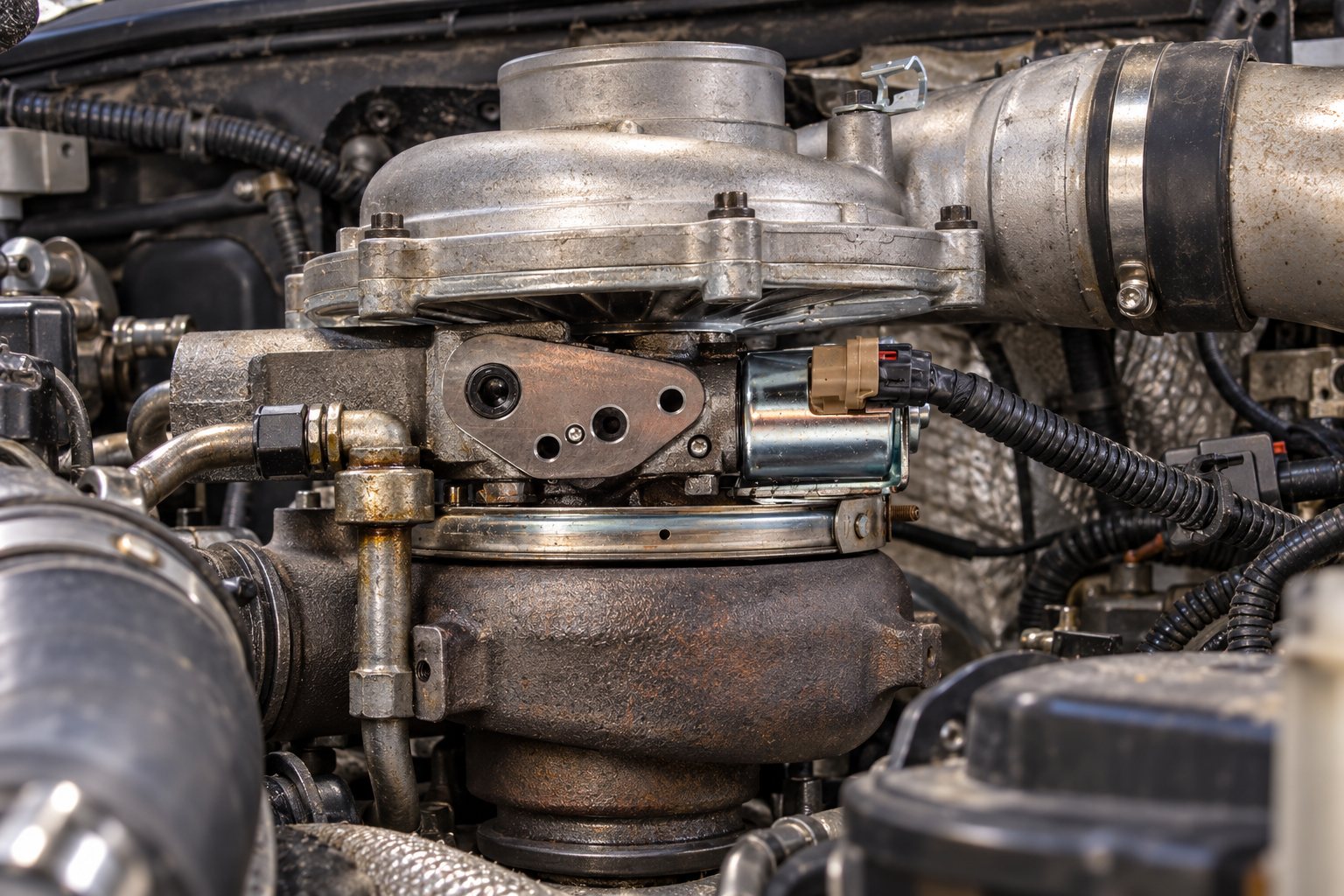
Here is what a lot of guys miss. A huge share of “turbo problems” on tow trucks are actually actuator problems. The actuator is what moves the wastegate or VGT vanes, and when it drifts, sticks, or leaks, your boost control goes out the window right when you are loaded and need it most.
Symptoms of a failing actuator include overboost codes, underboost on grades, surging, and a turbo that cannot hold commanded boost. Before you condemn a whole turbo, check the actuator. Replacing it is a fraction of the cost and labor.
PT Turbo stocks pneumatic actuators for common Garrett and Mitsubishi units. For Garrett VNT applications, the Garrett Pneumatic Actuator 757979-5102 is available for $240.94, and the heavier-duty Garrett Pneumatic Actuator 445963-0040 is $465.52 for larger frame turbos.
On the Mitsubishi side, the Mitsubishi TD03 Pneumatic Actuator 49S3118761 runs $104.33, and the Mitsubishi Pneumatic Actuator 4918918935 is $83.99. Matching the exact part number to your turbo’s calibration matters, because a mis-sprung actuator will give you the wrong boost curve even when everything else is perfect. If you are unsure which one fits, contact PT Turbo with your turbo’s part number.
New vs Remanufactured: What to Buy for a Tow Rig
You do not always need a brand-new turbo to tow well. A quality remanufactured turbocharger built to OEM tolerances will perform identically to new on a towing application, and it saves real money. The key is who rebuilt it and what parts went in.
A proper reman replaces the bearings, seals, thrust components, and balances the rotating assembly to spec. A bad “rebuild” just cleans the unit and resells it. That difference shows up fast under towing load. Our turbocharger rebuild service uses balanced CHRAs and new wear parts, which is why our reman units hold up on heavy haul.
| Consideration | New Turbo | Quality Reman |
|---|---|---|
| Performance for towing | Full OEM spec | Matches OEM spec |
| Availability on older engines | Can be discontinued | Often available |
| Core charge | None | Usually refundable core |
| Cost | Highest | Lower |
For current pricing on specific new and reman turbos, check the product page or call us at (909) 824-1020, because availability moves and we would rather quote you the real number than have you guess.
The Best Turbocharger Upgrade for Towing by Engine Type
The right answer depends on your platform. Light-duty diesels in the 100 to 150 horsepower range respond well to a clean, correctly calibrated VGT with a fresh actuator. If you are chasing symptoms on one of these engines, our 105HP turbocharger guide, 121HP turbocharger guide, and 150HP turbocharger guide walk through exact part fitment and failure signs.
On the Ford 6.0L Powerstroke, towing is where the stock Garrett GT37VA shows its weak points, especially carboned vanes and a tired actuator. If you run a 6.0L, read our full breakdown on the 6.0L Powerstroke turbocharger before you buy, because cleaning and calibration often matter more than going bigger.
Heavy-duty and commercial applications usually come down to keeping the OEM-size VGT healthy and your EGR and DPF systems flowing. A clogged aftertreatment system raises backpressure and makes any turbo work harder on a grade. Fix the whole airflow path, not just the turbo.
Supporting Mods That Make the Upgrade Work
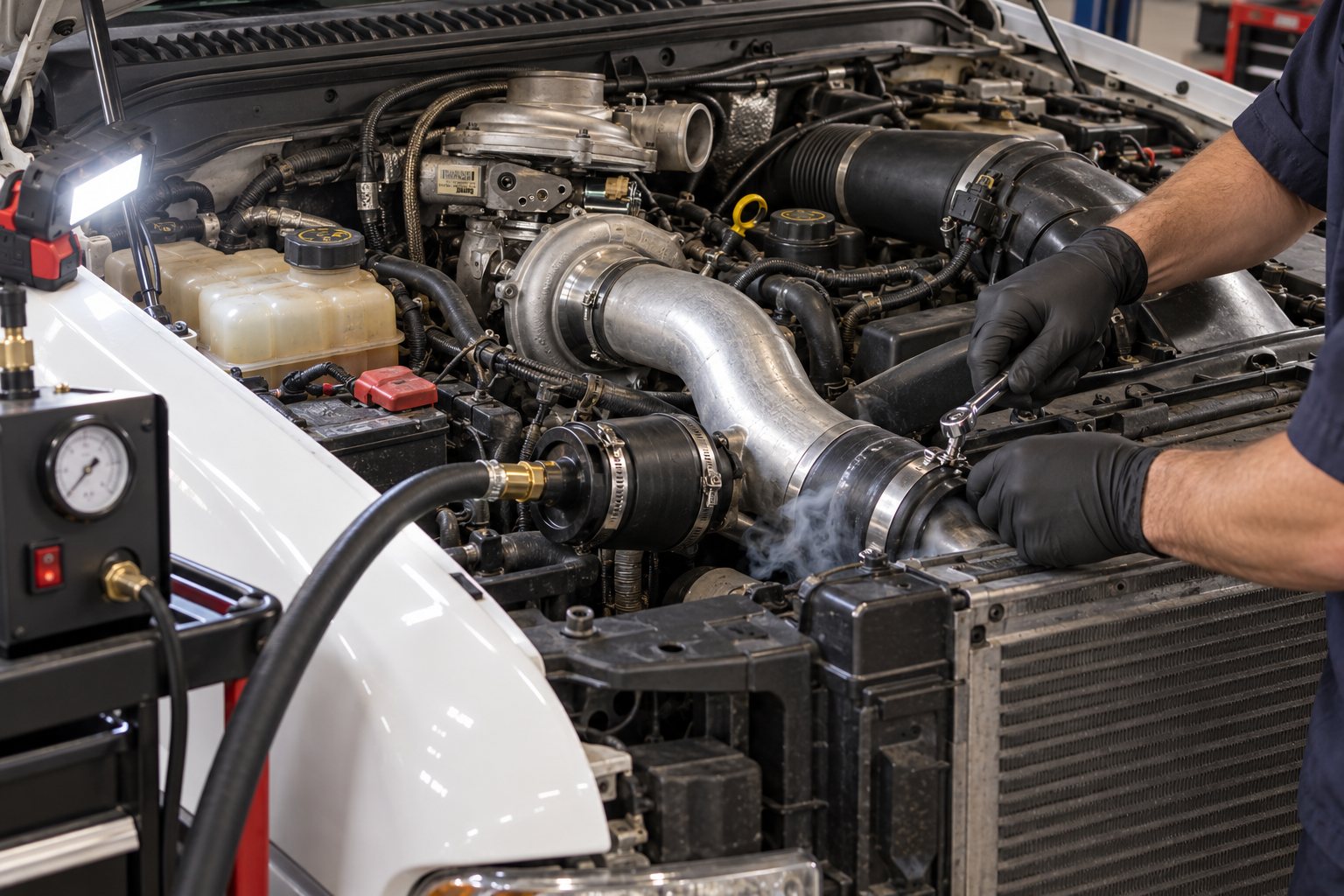
A turbo upgrade is only as good as the system around it. Towing reliably means managing heat and airflow end to end. Skip these and even the best turbo will disappoint you loaded.
- EGT gauge: Non-negotiable for towing. You cannot manage what you cannot see.
- Clean intake and intercooler: Charge-air cooling drops intake temps and protects the compressor.
- Healthy fuel system: Lean conditions spike EGTs under load.
- Correct oil and drain: Long WOT pulls demand good oil flow and clean return to the pan.
- Boost leak check: Loaded, a cracked boot or loose clamp will cost you spool and EGT margin.
Browse the full lineup at the PT Turbo store to match a unit to your engine, or lean on manufacturer data from Garrett and BorgWarner when you are comparing compressor maps. For the fundamentals of how these units work, this turbocharger overview is a solid reference.
Frequently Asked Questions
Do I need a bigger turbo to tow, or just a healthy stock one?
Most towing complaints come from a worn or carboned stock turbo and a tired actuator, not an undersized one. For stock-to-mild fueling, a clean OEM-spec VGT with a correct actuator usually tows better than an oversized aftermarket unit that spools late. Only step up in size if you have added significant fuel and verified EGTs demand more airflow.
How do I know if my actuator is the problem and not the whole turbo?
Look for overboost or underboost codes, boost that will not hold on grades, and surging under load, while the shaft still spins free with no play and no oil in the housing. Those symptoms point at the actuator or vane control rather than a mechanically failed turbo. Replacing the actuator first is far cheaper, and PT Turbo stocks exact-match Garrett and Mitsubishi units.
Is a remanufactured turbo reliable enough for heavy towing?
Yes, when it is built to OEM tolerances with new bearings, seals, and a balanced rotating assembly. A proper reman performs the same as new under load, which is why we build ours that way. A cleaned-and-resold “rebuild” is the one to avoid, so buy from a shop that documents what went into the unit.
Cross-Reference & Superseded Part Numbers
The turbochargers covered in this article match or supersede the following OEM and manufacturer part numbers. If you are searching by part number, these are the units stocked by PT Turbo for this application:
812080-0001 • 836026-5006S • 911984-5003S • 951205-5001S • 953223-5001S • GTX2867R+Bolt-on+Turbo • GTX3071R+Bolt-on+Turbo • PTT-C30-025 • PTT-FIAT-004 • PTT-FIE-004 • PTT-FIE-006 • PTT-FIE-007 • PTT-FIE-008 • PTT-FIE-009 • PTT-FIE-017 • PTT-FIE-021 • PTT-FIE-025 • PTT-FIE-026 • PTT-FOC-010 • PTT-FOC-011 • PTT-FOC-012 • PTT-FOC-013 • PTT-FOC-020 • PTT-FOC-030 • PTT-FOC-033 • PTT-FOC-036 • PTT-FOC-050 • PTT-FOC-051 • PTT-FOC-052 • PTT-FOC-056 • PTT-FOC-064 • PTT-FOC-071 • PTT-FOC-076 • PTT-FOC-086 • PTT-FOC-B11 • PTT-FOC-B12 • PTT-FOC-B16 • PTT-FOC-B22 • PTT-FOC-B24 • PTT-HGC-004 • PTT-HGC-069 • PTT-HSG-405 • PTT-MS3-002 • PTT-MS3-003 • PTT-MS3-012 • PTT-MS3-022 • PTT-MS3-037 • PTT-RB2-002 • PTT-S60-002 • PTT-SUB-096 • PTT-SUB-100 • PTT-SUB-105 • PTT-TBO-003 • PTT-TBO-022 • PTT-TBO-023 • PTT-TBO-024 • PTT-TBO-025 • PTT-TBO-036 • PTT-TBO-066 • PTT-TBO-067 • PTT-TBO-345 • PTT-TBO-607 • PTT-TBO-614 • PTT-TBO-617 • PTT-TBO-618 • PTT-TBO-620 • PTT-TBO-763 • PTT-TBO-770 • PTT-TBO-890 • PTT-TBO-898 • PTT-TBO-899 • PTT-TBO-911 • PTT-TBO-C16 • PTT-TBO-F83 • PTT-TBO-G27 • PTT-TBO-J22 • PTT-TBO-J23 • PTT-TBO-J24 • PTT-TBO-J25 • PTT-TBO-J27 • PTT-TBO-J28 • PTT-TBO-J55 • PTT-TBO-N21 • PTT-TBO-N23 • PTT-TBO-N24 • PTT-VEVO-008 • PTT-VEVO-026 • PTT-VEVO-028 • PTT-VEVO-158 • PTT-VEVO-159 • PTT-VEVO-189 • PTT-VSRT-007 • PTT-VVW-042 • PTT-VVW-047 • PTT-VVW-200 • PTT-VVW-292 • PTT-WGT-037 • PTT-WGT-108 • PTT-WGT-109 • T04-TRB-CRB-SL • TIL-BOV-007 • stock+location+fsi/tsi+option+3
Can’t find your number above? Contact PT Turbo — our team has been matching part numbers since 1978.
Need a Turbocharger?
PT Turbo has rebuilt and sold turbochargers since 1978. We stock remanufactured units for Cummins, Duramax, Power Stroke, Detroit Diesel, and more — backed by a 12-month unlimited mileage warranty and same-week shipping from San Bernardino, CA.
📞 (909) 824-1020 · 346 S I St. #3, San Bernardino, CA 92410 · [email protected]