Cummins QSB & QSM Marine Turbocharger Guide: Replacement & Saltwater Considerations
This Cummins QSB & QSM marine turbocharger guide is written for boat owners, marine mechanics, and repower shops who need to match the right fixed-geometry Holset to a saltwater engine and keep it alive in a corrosive environment. These are not the variable-geometry turbos you find on an on-highway Ram or an ISX truck. Marine Cummins B and M engines run fixed geometry or wastegated Holset chargers, and that difference changes how you diagnose, source, and replace them.
PT Turbo has been rebuilding turbochargers since 1978, more than 45 years, and we stock both new and remanufactured Holset units for these engines. Below is how to identify what you have, what fails in a marine setting, and how to make the replacement last.
What Turbo Is on Your Cummins QSB or QSM Marine Engine
The first rule with any marine Cummins is to go by the number on the turbo’s data plate, not by the engine name alone. The plate sits on the compressor housing and carries the Holset assembly number plus the Cummins customer number. Ratings within one engine family use different turbos, so the horsepower on your rating plate matters as much as the block.
As a starting point, here is how the common marine ratings line up. Confirm against the tag before you order.
| Engine | Typical rating range | Holset turbo listed | Geometry |
|---|---|---|---|
| QSB 5.9 | 230 to 480 hp | HX40 on most ratings; HX55WM on the top 480 hp rating | Fixed / wastegated |
| QSB 6.7 | up to 550 hp | Holset B-series (go by the tag) | Fixed / wastegated |
| QSM11 | Higher marine ratings | HX55 family | Fixed / wastegated |
Notice the split inside the QSB 5.9 alone. A lower-rated QSB wears an HX40-class charger, while the hottest 480 hp rating steps up to the larger HX55WM. Earlier B and C marine blocks (6BTA, 6CTA) and some ratings carried smaller Holsets such as the H1C, H1E, or H2D. None of these marine units are variable geometry.
Fixed Geometry, Not VGT: Why It Matters
On the truck side, Cummins moved to sliding-nozzle variable geometry turbos with electronic actuators, like the HE351VE and HE300VG on the 6.7L Ram. Marine QSB and QSM engines did not follow that path. That means there is no electronic actuator to calibrate, no vane position sensor, and no nozzle ring to foul with soot.
What you do have is a wastegate on the W-suffix models. In Holset naming the W marks a wastegated housing, not water cooling. The wastegate caps boost by bleeding exhaust around the turbine once target pressure is reached. If the flapper does not seat, you lose boost and spool slowly; if the actuator diaphragm leaks on a boost-opened gate, the gate opens late and you can see overboost. For background on how these machines move air, this overview of turbocharger operation is a clean primer.
Because the marine turbo is mechanically simpler than a VGT, most of what goes wrong traces back to two things: the oil supply and the salt-air environment it lives in.
Turbos we list for the HX55WM and HX40
Listings for the turbo models named in this guide that can be ordered online today. Several part numbers can fit one engine by year and rating, so match the number on your turbo’s tag, or call (909) 824-1020 and we will match it for you.
Saltwater and Corrosion: The Real Enemy of a Marine Turbo
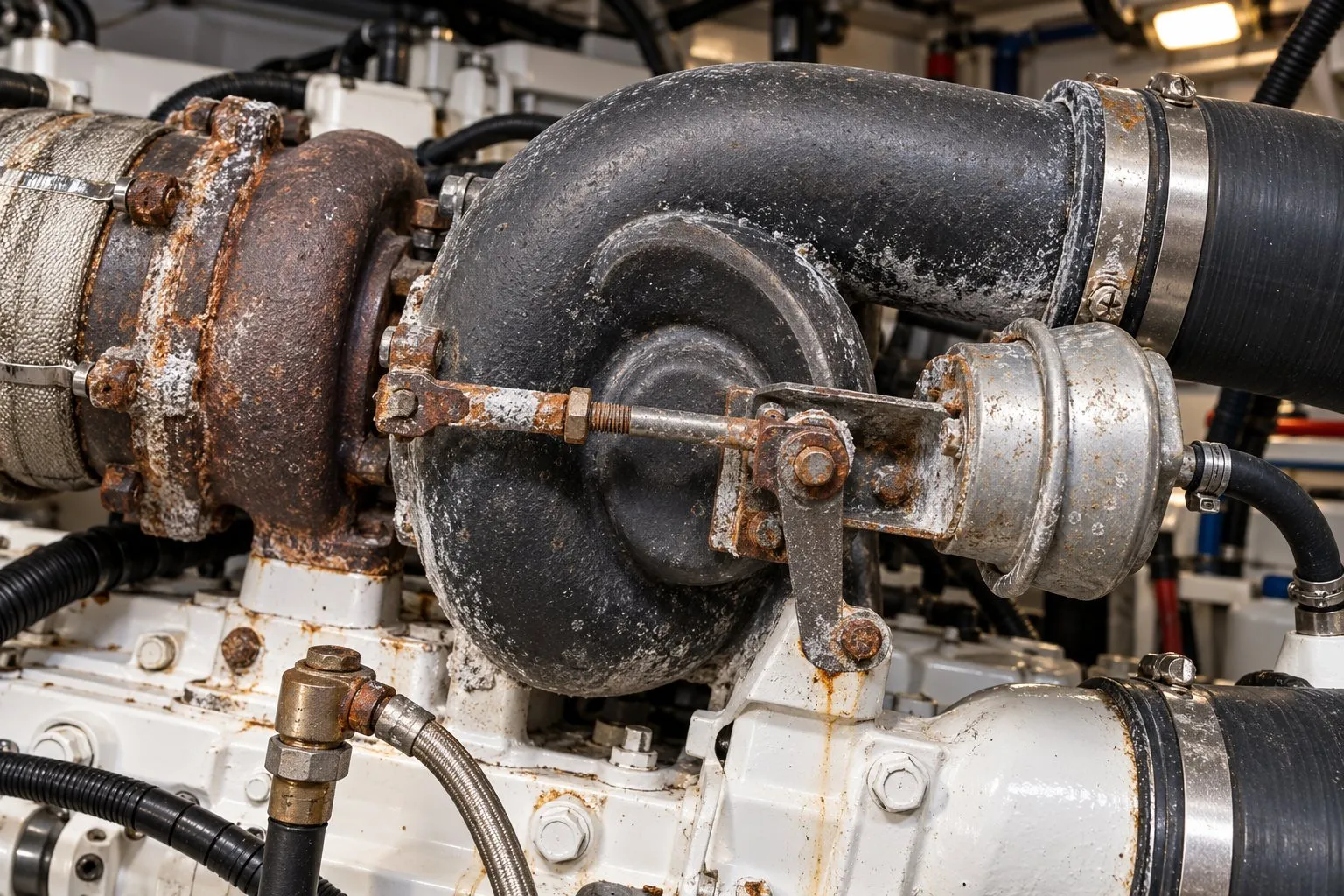
A marine turbo spends its life in a humid, salt-laden engine room. That environment attacks the parts a truck turbo never has to worry about. The compressor wheel and housing, the actuator linkage, the wastegate hardware, and every exposed fastener all see salt mist and condensation.
Watch for these failure paths that are specific to, or accelerated by, the marine setting:
- Compressor housing and wheel corrosion. Salt mist drawn through the air intake pits the aluminum compressor side over time, roughening the wheel and throwing off balance.
- Seized wastegate linkage. Corrosion locks the actuator rod and flapper. A gate stuck shut drives overboost and high drive pressure; stuck open gives low boost and slow spool.
- Fastener and clamp corrosion. V-band clamps and mounting hardware seize or weaken, making removal harder and risking exhaust leaks.
- Cooldown-related coking. Shutting down hot after a hard run, common on a boat coming off plane into a slip, coke-hardens oil in the center section.
Give the engine a few minutes of idle after towing-equivalent work or a long hard pull before shutdown. That protects the bearing oil at the turbine end, where heat soak is worst.
Diagnosing a Failing Marine Cummins Turbo
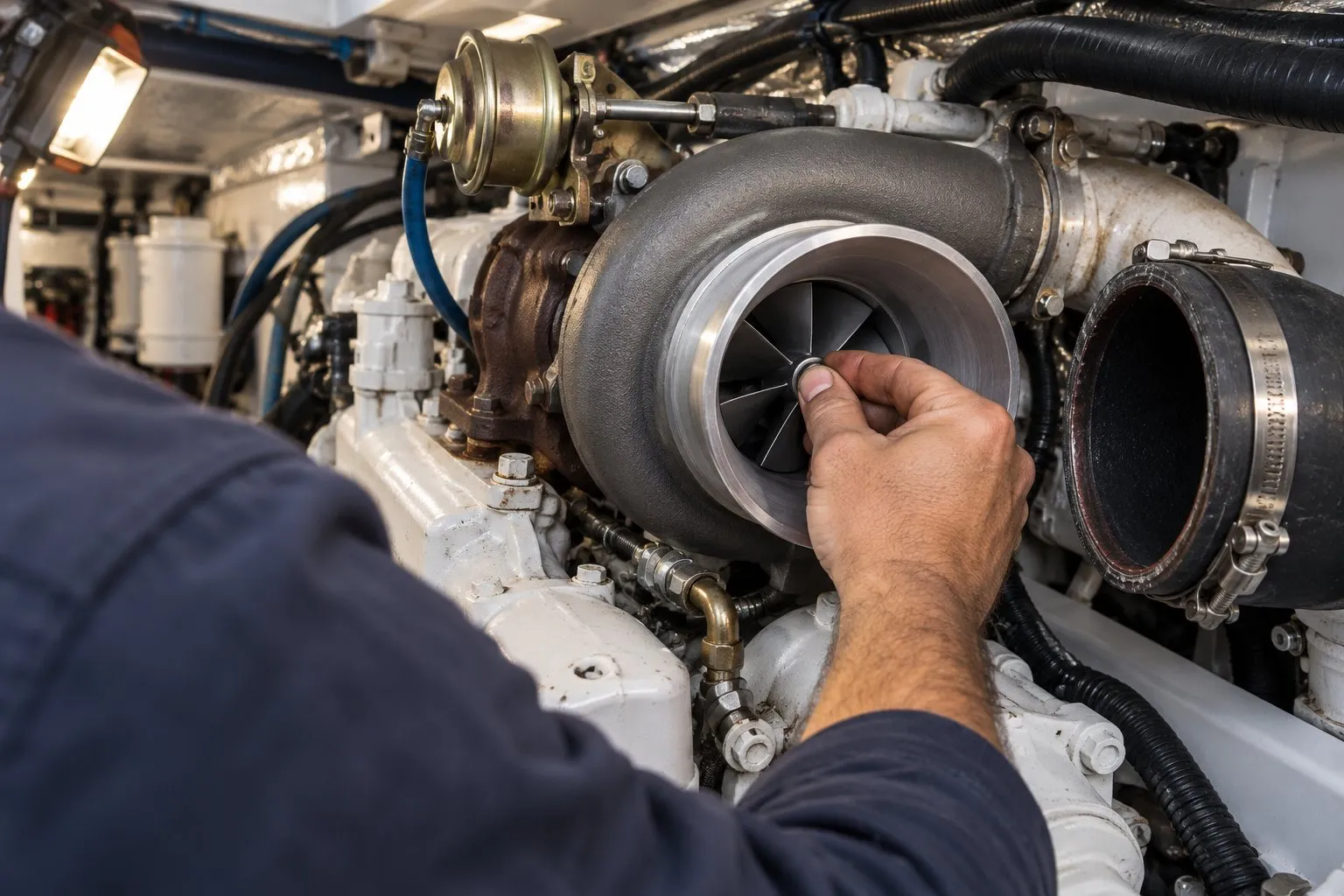
Symptoms on a boat read the same as on any diesel, but you have to rule out the easy stuff first because marine air systems are long and salty. Before you condemn the turbo, check the air filter, intake ducting, charge piping, and the oil level and drain.
| Symptom | Likely causes to check | What it usually is not |
|---|---|---|
| Low boost, sluggish spool, dark exhaust smoke | Wastegate stuck open or not seating, exhaust leak before the turbine, plugged air filter | Not oil past the seals |
| Overboost, high drive pressure | Wastegate stuck closed, seized linkage, leaking boost-opened diaphragm | Not a fueling fault by itself |
| Blue-gray smoke, oil in charge pipes | Crankcase breather, oil level, restricted drain, then the seal | Not always a failed turbo seal |
| Noise that rises with boost under load | Bearing wear, wheel contact, loose hardware | Not normal spool whistle |
Check shaft play by hand with the turbo cool and the oil drained. Some side-to-side rock is normal on a journal-bearing turbo. Condemn it for in-and-out play you can feel, for any wheel contact with the housing, or for play beyond the maker’s limit. Do not condemn a turbo just because the shaft moves.
Most marine turbo failures trace back to the oil supply, exactly as on land engines. A restricted drain backs oil up past the seals and shows as oil at both ends. A starved feed wipes the bearings. When you replace a turbo after a bearing failure or coked oil, fit a new oil feed line rather than reusing the old one.
Replacing a QSB or QSM Marine Turbo: New vs Remanufactured
You have two sound paths: a new Holset, or a remanufactured unit built to the same bearing and seal spec. Both are legitimate for a marine engine as long as the geometry and part number match your rating. The decision usually comes down to availability and budget.
| Consideration | New turbo | Remanufactured turbo |
|---|---|---|
| Core required | No | Yes (returned within 30 days) |
| Internals | All new | New bearings, seal rings, thrust parts; cleaned and balanced housings |
| Availability | Depends on model | Often broader across older marine ratings |
| Warranty at PT Turbo | 12 months, unlimited mileage | 12 months, unlimited mileage |
If you still have your original turbo and it is a core we can save, our in-house turbocharger rebuild service is often the cleanest option because you keep your exact matched unit. Most rebuilds ship in 3 days or less, and the rebuild price is confirmed after inspection and before any work starts. For what a given Holset runs, see our turbo rebuild price list rather than a guessed figure.
Prefer a ready-to-bolt unit? Browse our remanufactured turbochargers. For any marine Holset, send us the number off the data plate so we match geometry, wheel sizes, and A/R exactly. For the HX55WM, our supplier records also list an installation kit (D&W 172-784-0426) for that turbo family; other models should be matched to their own listing.
Making the Replacement Last in a Marine Setting
Follow the maker’s first-start steps before you load the new turbo. Fill the oil inlet with clean engine oil, turn the wheel by hand, then crank or idle a few minutes before putting the engine to work. There is no break-in mileage schedule on a turbo; prime it and protect the bearings on that first start.
A few marine-specific habits extend turbo life:
- Service the air intake and any sea-air pre-filtering on schedule to keep salt and debris off the compressor wheel.
- Keep oil on a tight change interval using the category Cummins specifies for your engine; corroded, salty environments are hard on oil.
- Idle down before shutdown after hard running to prevent oil coking at the turbine end.
- Inspect and clean or replace charge piping if the old turbo shed metal; debris left in the system goes straight into the engine.
- Replace the aftercooler or intercooler after a compressor-wheel failure, because metal in the fins cannot be reliably flushed out.
If you are cross-shopping a marine Holset against the on-highway Cummins turbos, our Cummins ISB 6.7L turbocharger guide explains how the truck VGT differs from these fixed-geometry marine units, and our Cummins QSB turbocharger guide covers the same block in loaders, lifts and other equipment. When you are ready to match a part number, contact PT Turbo or call (909) 824-1020.
Frequently Asked Questions
Does a marine Cummins QSB or QSM turbo use variable geometry?
No. Marine QSB, QSM, and the related B and C engines run fixed geometry or wastegated Holset turbos, not the sliding-nozzle VGTs used on the on-highway 6.7L and ISX. There is no electronic actuator to calibrate and no vane position sensor on these marine units.
How do I find the exact turbo for my boat’s engine?
Go by the part number on the data plate on the compressor housing, not the engine name alone. Ratings within one family differ, so a lower QSB 5.9 rating uses an HX40-class charger while the top 480 hp rating steps up to the HX55WM. Send that number to us and we match geometry, wheel sizes, and A/R.
Is a remanufactured marine turbo reliable in saltwater service?
Yes, when it is built to the correct geometry and spec with new bearings, seal rings, and thrust parts. The bigger factors in a marine setting are keeping salt off the compressor, staying on top of oil changes, and idling down before shutdown. Pricing is on the product page or by calling (909) 824-1020.
Need a Turbocharger?
PT Turbo has rebuilt and sold turbochargers since 1978. We stock remanufactured units for Cummins, Duramax, Power Stroke, Detroit Diesel, and more — backed by a 12-month unlimited mileage warranty. Units in stock at our shop in San Bernardino, CA ship the same day when ordered before 2 PM Pacific, Monday through Friday.
📞 (909) 824-1020 · 346 S I St. #3, San Bernardino, CA 92410 · info@ptturbo.com