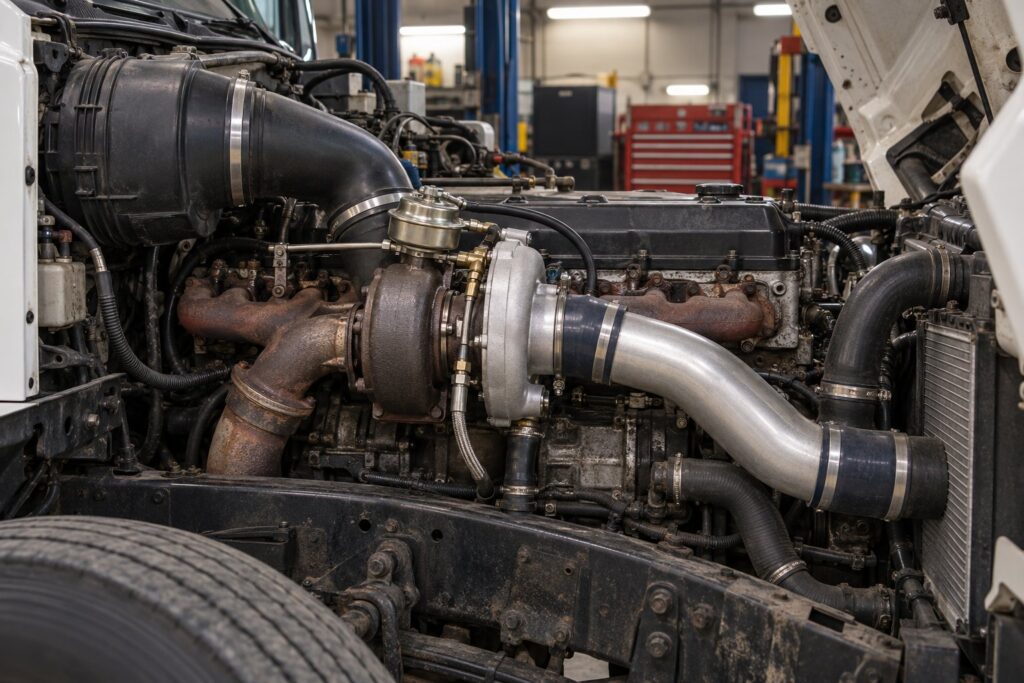
Understanding Stage 1 vs Stage 2 Turbocharger Upgrades for Diesel Trucks is the difference between spending money that actually returns power and reliability, and throwing parts at a truck that ends up hotter, laggier, and no faster than stock. At PT Turbo, we have been building and rebuilding turbos since 1978, and over 45 years of watching customers chase horsepower we have seen every mistake in the book. This guide cuts through the marketing so you can pick the right path for your engine, your load, and your budget.
What “Stage 1” and “Stage 2” Actually Mean on a Diesel
Unlike the gasoline tuning world, there is no universal industry standard for diesel turbo “stages.” The terms describe how far you have moved from a stock airflow package, and how much supporting hardware you have added.
A Stage 1 upgrade is a bolt-on turbo swap or a mild drop-in wheel upgrade that works with your factory fueling, or a light tune. It targets a modest bump in boost and airflow while keeping drive pressure and exhaust gas temperature (EGT) in check. Think of it as optimizing what the engine already does.
A Stage 2 upgrade is a larger frame turbo, often paired with supporting mods: bigger injectors, a performance tune, upgraded fuel supply, sometimes intercooler and exhaust work. Stage 2 is built to move real air for towing heavy or making serious power, and it demands the rest of the drivetrain keep up.
If you want the engineering fundamentals behind compressor maps and wheel sizing, this turbocharger overview is a solid primer before you spend a dime.
Stage 1 vs Stage 2 Turbocharger Upgrades for Diesel Trucks: Side by Side
The clearest way to choose is to line the two paths up against real-world outcomes. Here is how they compare for a typical medium or heavy duty diesel.
| Factor | Stage 1 | Stage 2 |
|---|---|---|
| Typical power gain | 40-90 hp | 120-250+ hp |
| Supporting mods required | Minimal (tune optional) | Injectors, tune, fuel supply, often exhaust |
| Spool / low-end response | Near stock, sometimes better | Slightly more lag on larger frames |
| EGT under load | Lower or equal to stock | Higher; needs monitoring |
| Emissions compliance | Usually preserved | Depends on the build, not on the stage name |
| Best use case | Daily driver, work truck, moderate towing | Heavy tow, sled pull, high-output builds |
| Relative cost | Lower: one turbo and its supporting parts | Several times higher: turbo or turbos, fueling, transmission and tuning |
Notice the emissions row. Stage names are not a legal category, and neither stage requires removing emissions equipment, although many Stage 2 packages are sold that way. If your truck sees public roads, keep that in mind, because tampering with a diesel particulate filter or the EGR system carries legal and warranty consequences.
When Stage 1 Is the Smart Money
Most working trucks never need more than Stage 1. If you tow within your rated capacity, run a fleet where uptime matters more than trap speed, or simply want cooler EGTs on long grades, a Stage 1 turbo is the better financial decision.
A well-matched Stage 1 turbo often improves drivability. A slightly larger, more efficient compressor wheel can drop EGTs by 100 to 200 degrees at the same load, which directly extends the life of pistons, valves, and the head gasket.
Stage 1 is also where a properly remanufactured unit shines. A quality reman turbo restores factory performance and, in many cases, upgrades the wheel or bearing system without the cost of new. Browse our remanufactured turbochargers to see what fits your platform, or if you want your original unit brought back to spec, our turbo rebuild service handles it with balanced cores and new internals.
Common Stage 1 Platforms
- Cummins ISC medium duty trucks running the HX40, covered in our Cummins ISC turbocharger guide
- Cummins ISM on-highway trucks with the HX55 or HE531V, detailed in our ISM turbo guide
- Volvo D12 trucks, whose Holset and Garrett turbos are explained in our D12 turbocharger guide
When Stage 2 Makes Sense
Stage 2 earns its keep when the engine’s demand outgrows the factory turbo’s efficiency island. If you are constantly maxing out boost, seeing high drive pressure, and watching EGTs climb past safe limits under heavy load, the stock turbo is choking the engine and no tune will fix that.
Owner-operators pulling maximum gross weight through mountains, guys running competition builds, and anyone adding large injectors will hit that wall. A larger Stage 2 turbo moves the extra air that big fuel demands, keeping combustion cleaner and EGTs manageable at power levels a stock charger simply cannot support.
The trade-off is complexity. Stage 2 without matching fuel, intercooling, and exhaust is a recipe for lag and disappointment. Do it as a system, not a single part.
Variable Geometry Considerations
Many modern diesels run a variable geometry turbo (VGT) from the factory. Upgrading these is more involved because the actuator and vane control logic must be preserved or replaced correctly. If you are not familiar with how vane position affects spool and backpressure, read up on variable-geometry turbocharger operation before choosing a stage.
Don’t Overlook the Actuator
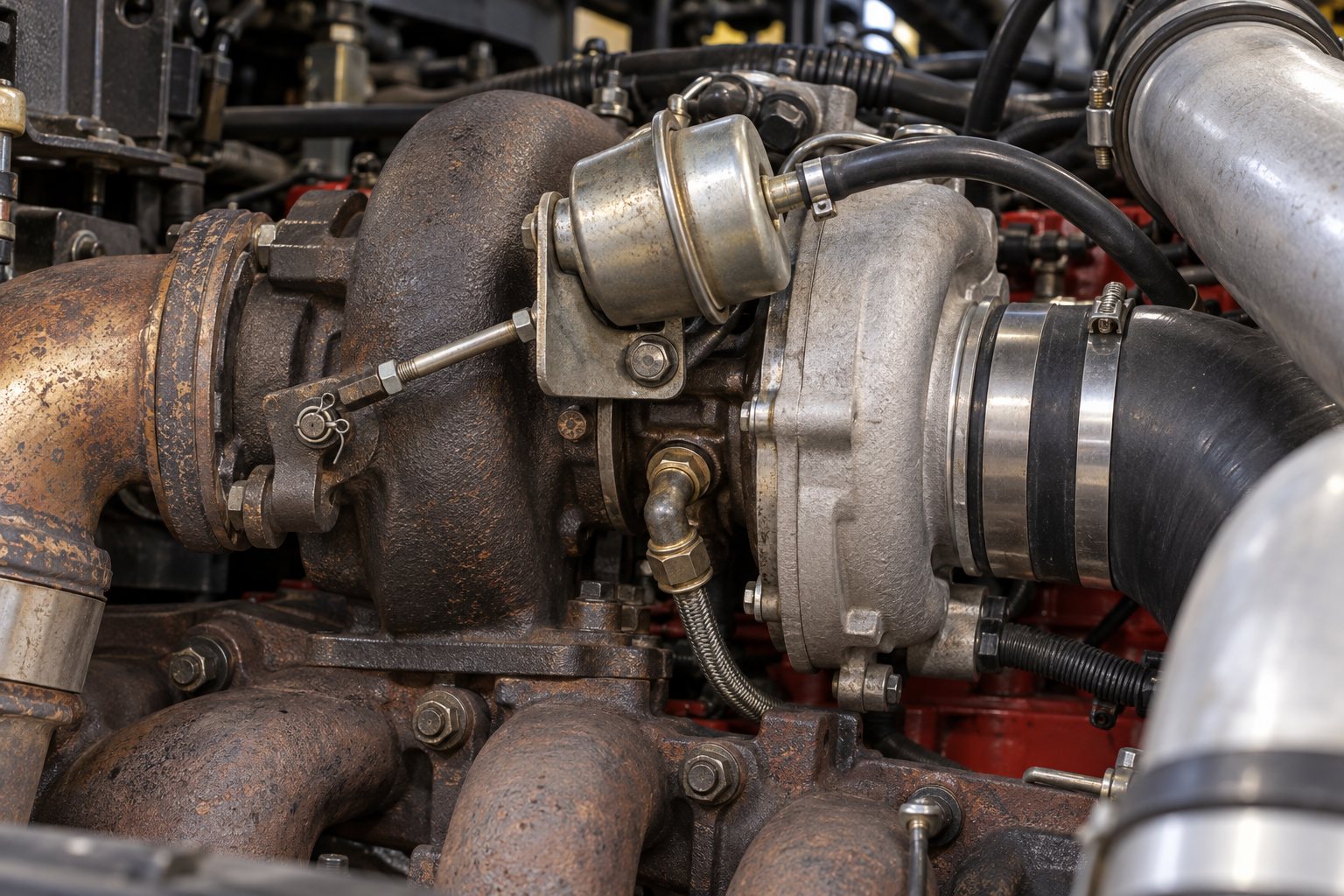
Whether you go Stage 1 or Stage 2, the actuator is the part that controls boost, and a worn or mismatched actuator will sabotage either build. On wastegated and VGT setups, a failing actuator throws inconsistent boost, sets fault codes, and can trigger the dreaded underboost condition. If you are chasing a code, our P0299 underboost diagnosis guide walks the whole process.
Send us the number on your turbo and we will check whether its actuator is available on its own. Matching the correct actuator to your turbo is critical: on a pneumatic wastegate actuator the spring rate and stroke determine the boost curve, and an electronic actuator has to be the one the turbo and the engine computer expect.
If you are unsure which actuator matches your turbo part number, send us the numbers off the compressor housing and CHRA. Our team has cross-referenced tens of thousands of these, and getting it right the first time saves a return trip up on the lift.
New vs Remanufactured for Your Upgrade
Both Stage 1 and Stage 2 builds can be done with new or reman hardware. The right call depends on availability, budget, and how the core market looks for your platform. Here is how we frame it for customers.
| Consideration | New Turbo | Remanufactured Turbo |
|---|---|---|
| Upfront cost | Highest | 20-50% less |
| Availability | Depends on OEM stock | Often faster, core-dependent |
| Performance to spec | Factory | Factory when built right |
| Warranty | Full manufacturer | Shop-backed (ask before buying) |
For most Stage 1 jobs, a quality reman unit is the smart buy. The core comes back balanced and spec-matched, you save real money, and the performance is indistinguishable from new when the build is done right. The one caveat is warranty: a manufacturer backs a new turbo, while a reman is only as good as the shop that built it, so ask who stands behind it before you hand over a core.
Stage 2 leans the other way more often. When you are pushing a larger frame turbo hard, availability of the specific upgraded wheel and housing combination tends to drive the decision, and new hardware is sometimes the only way to get exactly the compressor you need. Weigh what your platform’s core market actually looks like rather than defaulting to one answer.
Either way, the turbo is only as reliable as the install. Match the hardware to your fueling, confirm the actuator and oil feed are correct, and you get the full return on whichever path you pick.
Frequently Asked Questions
What is the difference between a Stage 1 and Stage 2 turbocharger upgrade?
A Stage 1 turbo is a bolt-on upgrade that adds moderate power while keeping stock reliability and drivability. A Stage 2 turbo pushes higher boost and horsepower but often requires supporting modifications like fueling, injectors, and cooling.
When does a Stage 2 turbo upgrade make sense for a diesel truck?
A Stage 2 upgrade makes sense when you have a built engine and supporting mods that can safely handle higher boost and power. Without those upgrades, a Stage 2 turbo can run hotter, laggier, and no faster than stock.
Will a Stage 1 turbo upgrade hurt my truck’s reliability?
No, a properly matched Stage 1 turbo is designed to add power while maintaining stock-level reliability and daily drivability. It’s the safest starting point for most diesel truck owners.
Need a Turbocharger?
PT Turbo has rebuilt and sold turbochargers since 1978. We stock remanufactured units for Cummins, Duramax, Power Stroke, Detroit Diesel, and more — backed by a 12-month unlimited mileage warranty and same-week shipping from San Bernardino, CA.
📞 (909) 824-1020 · 346 S I St. #3, San Bernardino, CA 92410 · [email protected]
More From PT Turbo
 Fleet Turbocharger Pricing: How Commercial Operators Can Reduce Per-Unit Cost
- Agricultural Equipment Turbocharger Buying Guide: John Deere, Case, Kubota & More
- Turbocharger Replacement Cost by Engine: Price Guide for Diesel Trucks & Equipment
- T04E Carbon Seal Conversion Kit: Step-by-Step Installation Instructions