Electronic Actuator Failure on Diesel Trucks: Symptoms, Diagnosis & Replacement Cost
Electronic actuator failure on diesel trucks is one of the most misdiagnosed problems we see come through our shop, and it costs owner-operators thousands in unnecessary turbo replacements every year. The actuator is the brain of a modern variable-geometry turbocharger, and when it fails, the truck often throws codes and limps into a shop where the whole turbo gets condemned. In many cases the cartridge is fine and only the actuator needs attention.
At PT Turbo we have been rebuilding and supplying turbochargers for over 45 years, and we stock both new and remanufactured actuators for Garrett, Mitsubishi, BorgWarner, and Holset units. This guide breaks down how these actuators fail, how to diagnose them correctly, and what a proper repair actually costs.
What the Actuator Actually Does
On a variable-geometry turbocharger, the actuator moves the vanes or the sliding nozzle ring that controls exhaust gas flow across the turbine wheel. This is how the turbo builds boost at low RPM and bleeds it off at high RPM without a wastegate.
There are two main types, plus oil-moved designs (the Ford 6.0L and 2011-2019 6.7L, the 2004.5-2016 Duramax), where a solenoid valve meters engine oil to a piston that moves the vanes instead of an electric motor or air actuator. Pneumatic actuators use engine or supply air pressure against a spring diaphragm, and electronic actuators use a DC motor with an internal position sensor that reports back to the ECM. Electronic units are more precise but carry more failure points because of the circuit board, motor, and gear train inside.
When the actuator cannot hit its commanded position, the ECM knows the vanes are wrong and reacts by cutting fuel, dropping the truck into a derate, or lighting the check engine and boost warning lamps.
Symptoms of Electronic Actuator Failure on Diesel Trucks
Actuator problems rarely announce themselves cleanly. They usually mimic a bad turbo, a boost leak, or a fueling issue, which is why so many good turbos get thrown away. Watch for these warning signs.
- Loss of power or derate: The most common complaint. The truck feels gutless, especially under load or on grades.
- Boost codes: P0234 (overboost), P0299 (underboost), P003A (boost control position), and manufacturer-specific actuator position faults.
- Actuator sweep failure at key-on: A healthy electronic actuator cycles the vanes through their full range at key-on or shutdown. A silent or partial sweep is a red flag.
- Sticking or hunting boost: Boost that surges up and down as carbon binds the vane mechanism.
- Whistling, hesitation, or excessive smoke: Vanes stuck open or closed change the exhaust flow and combustion balance.
Symptom Severity Guide
| Severity | Symptoms | What It Usually Means |
|---|---|---|
| Mild | Occasional check engine light, slight power loss | Early carbon buildup or intermittent sensor fault |
| Moderate | Repeated boost codes, hunting boost, reduced fuel economy | Motor or gear wear, partial vane binding |
| Severe | Full derate, no boost, actuator will not sweep | Failed actuator motor, board, or seized vane pack |
How to Diagnose an Actuator Correctly
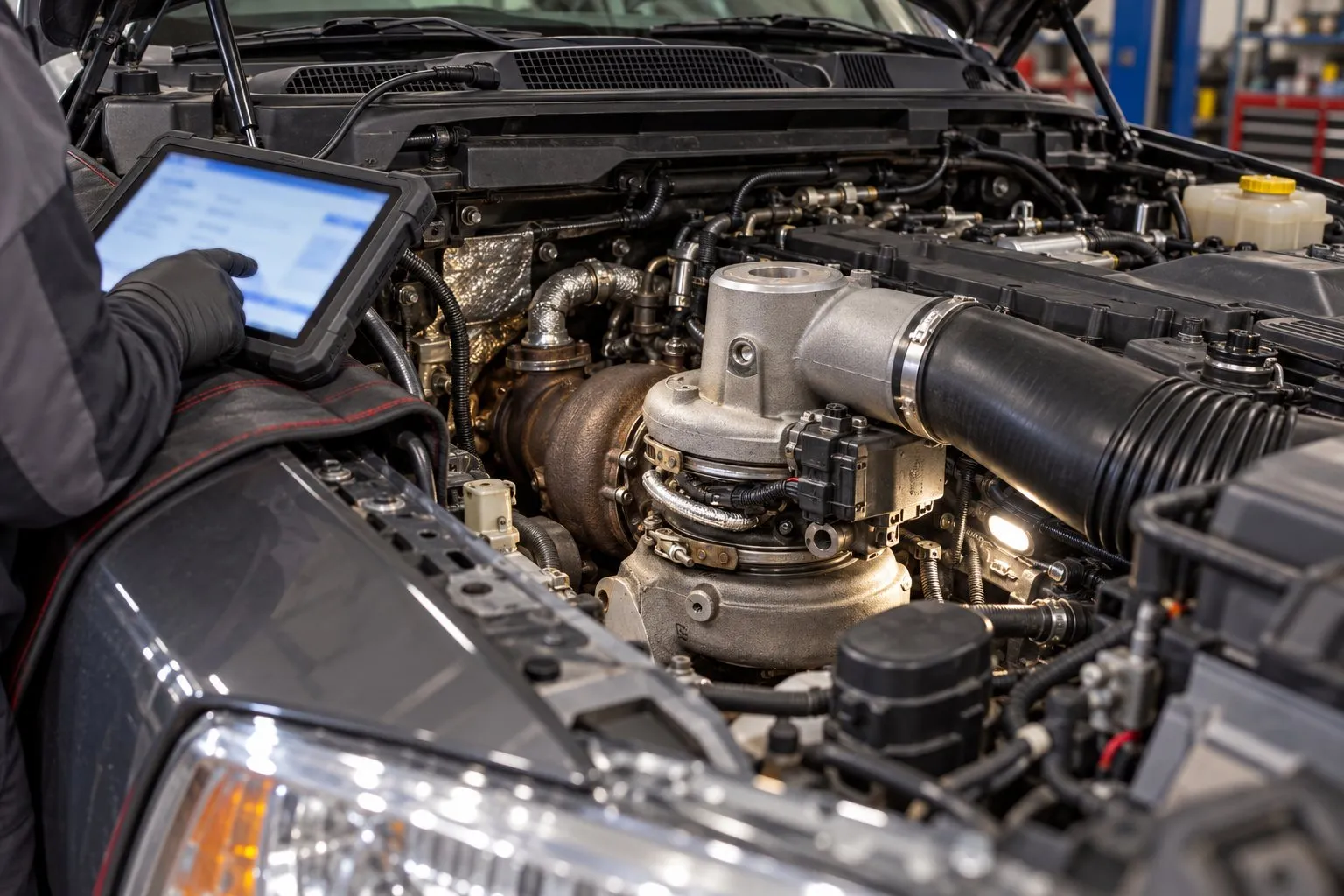
Do not condemn the turbo before you rule out the cheap stuff. A methodical process saves you from a needless replacement.
Step 1: Pull the codes and freeze frame
Read the exact fault, not just the lamp. An actuator position fault is very different from a shaft speed fault. Freeze-frame data tells you whether the fault happens hot, cold, under load, or at idle.
Step 2: Check the basics first
Inspect the connector for corrosion, the harness for chafing, and the power and ground for voltage drop. For pneumatic units, check the air supply line and vacuum or pressure source. A cracked line or a leaking diaphragm will mimic actuator failure exactly.
Step 3: Command the actuator with a scan tool
Use a bidirectional tool to command the actuator to 0 percent and 100 percent. A good unit moves smoothly and reports position that tracks the command. A unit that lags, sticks, or reads out of range is failing. On electronic Holset VGT units the calibration must also be intact.
Step 4: Inspect the vane pack for binding
With the actuator disconnected, move the mechanism by hand where accessible. Soot and coking from EGR flow, covered in our note on exhaust gas recirculation, is the number one cause of vanes that stick. If the vanes are seized, a new actuator alone will not fix the truck.
If you reach the point where the actuator is confirmed bad but the vane pack is clean and the cartridge is healthy, you are a good candidate for a direct actuator replacement rather than a full turbo swap.
Replacement Actuators and Real Pricing
Not every diesel turbo needs a thousand-dollar unit to get back on the road. Many pneumatic and electronic actuators are serviceable parts you can replace on their own.
Every actuator we sell is set up to match OEM spring rate and stroke, because a mismatched actuator will chase boost all day and never satisfy the ECM. If you are not sure which one fits your turbo, send us the turbo part number through our contact page and we will confirm it before you buy.
Actuator Only vs Full Turbo Replacement
The economics matter. Replacing just the actuator is often a fraction of a full turbo cost, but only when the cartridge and vane pack are healthy. Here is how the numbers compare.
| Repair Path | Typical Cost | Best When |
|---|---|---|
| Actuator only | see actuator prices | Cartridge and vanes are clean, actuator confirmed bad |
| Remanufactured turbo | $525 to $8,461 (259 listings) | Vane pack coked, shaft play, or repeated failures |
| New OEM turbo | $442 to $13,412 (1932 listings) | Warranty requirement or no reman core available |
Price ranges in this article are general estimates to help with budgeting, not PT Turbo quotes. Our current prices are on each product listing, and our rebuild prices are on the turbo rebuild price list.
When the vane pack is coked or the center cartridge has shaft play, put your money into a remanufactured turbocharger rather than a bare actuator. A reman unit gives you a fresh cartridge, balanced rotating assembly, and a calibrated actuator as a matched set. You can also send us your core for our turbocharger rebuild service if you want your original housing back.
If you are diagnosing a specific platform, our model guides go deeper. See the Ford 6.7L Powerstroke turbocharger guide, the Ram 6.7L Cummins HE351VE vs HE300VG guide, the Cummins ISC HX40 guide, and the Cummins ISM HX55 and HE531V guide.
How to Make a New Actuator Last
A replacement actuator will only last as long as the conditions that killed the first one. Address the root cause before you button it up.
- Clean the vane pack: Free up carbon so the new actuator does not fight a binding mechanism.
- Fix EGR and DPF issues: Excess soot loading accelerates coking on the vanes.
- Verify calibration: Electronic units must be calibrated to the turbo after replacement, or they will report position faults immediately.
- Let the turbo cool down: Idle a hot engine 2 to 3 minutes before shutdown to reduce heat soak on the actuator electronics and bearing.
Check your supply air and electrical first on every install: A new actuator mounted to a corroded connector or a weak pressure source inherits the same fault that masked the original problem. Confirm clean power, ground, and air supply before you trust the readings.
Do all of that and a quality actuator will run as long as the turbo it bolts to. The units that come back early are almost always the ones installed on a coked vane pack or an EGR system that was never addressed. Fix the cause, calibrate it right, and you get the service life you paid for.
Frequently Asked Questions
What are the symptoms of electronic actuator failure on a diesel truck?
Common signs include loss of power, limp mode, turbo-related fault codes, poor throttle response, and excessive smoke. The truck may also struggle to build proper boost pressure.
Can I replace just the actuator instead of the whole turbocharger?
Yes, in many cases only the electronic actuator has failed and the turbo itself is fine. On Holset units the actuator can be replaced and calibrated on the truck; Garrett electronic actuators are calibrated to their turbo at the factory and are not meant to be swapped on their own. Replacing just the actuator can save you thousands compared to a full turbo replacement.
How much does it cost to replace a diesel truck actuator?
Actuator replacement typically costs far less than a complete turbo, often a few hundred to just over a thousand dollars depending on the truck and whether calibration is required.
Need a Turbocharger?
PT Turbo has rebuilt and sold turbochargers since 1978. We stock remanufactured units for Cummins, Duramax, Power Stroke, Detroit Diesel, and more — backed by a 12-month unlimited mileage warranty. Units in stock at our shop in San Bernardino, CA ship the same day when ordered before 2 PM Pacific, Monday through Friday.
📞 (909) 824-1020 · 346 S I St. #3, San Bernardino, CA 92410 · [email protected]