Turbocharger Housing Types: Divided, Undivided, T3, T4 & V-Band Flanges Explained
Understanding turbocharger housing types is one of the most useful skills a diesel mechanic or builder can have, because the housing decides how a turbo bolts to your engine, how quickly it spools, and whether a replacement unit will even fit your exhaust. The term covers two separate things that often get mixed up: the shape of the turbine housing inside (divided versus undivided) and the flange that connects it to your manifold or downpipe (T3, T4, T6, or a V-band). Get either one wrong and a perfectly good turbo becomes a paperweight.
At PT Turbo we have been rebuilding and supplying turbochargers since 1978, more than 45 years, and we stock both new and remanufactured turbochargers across the Garrett, Holset, BorgWarner, IHI, and Mitsubishi lines. This guide walks through each housing style, what it controls, and how to make sure the one on your bench matches your truck.
Turbine Housing Versus Compressor Housing
Every turbo has two housings bolted to a center cartridge. The compressor housing sits on the cold, intake side and routes air from the filter into the compressor wheel, then out to the intercooler. The turbine housing sits on the hot, exhaust side and channels exhaust gas onto the turbine wheel that drives the shaft.
When people talk about turbocharger housing types and flanges, they are almost always talking about the turbine housing, because that is where exhaust flow shape and the mounting flange live. The center section, or CHRA, has no turbine housing and no A/R rating of its own. For a good overview of how the whole assembly works, the turbocharger reference on Wikipedia lays out the basics.
Divided Versus Undivided Turbine Housings
An undivided, or single-scroll, turbine housing has one spiral passage that feeds all the exhaust gas onto the turbine wheel. It is simple, common on passenger-car and light truck turbos, and works well when the exhaust is already merged into a single stream before it reaches the turbo.
A divided, or twin-scroll, turbine housing has two separate passages inside, each fed by a different group of cylinders. The idea is pulse charging: by keeping the exhaust pulses from paired cylinders apart until the last moment, you stop one cylinder’s blowdown pulse from interfering with another’s. The result is stronger low-speed energy at the turbine and quicker spool.
Divided housings are common on inline-six diesels where the exhaust manifold is already split into two runners feeding the turbo. If your manifold flange has two separate passages (a divided flange), you need a divided housing to match. Bolting a single-scroll housing to a divided manifold throws away the pulse-separation benefit.
- Undivided (single-scroll): one passage in the manifold flange, simplest to match, broad use on cars and light trucks.
- Divided (twin-scroll): two passages in one manifold flange, better spool and low-end response on pulse-charged diesels.
Turbocharger Housing Types by Turbine Flange
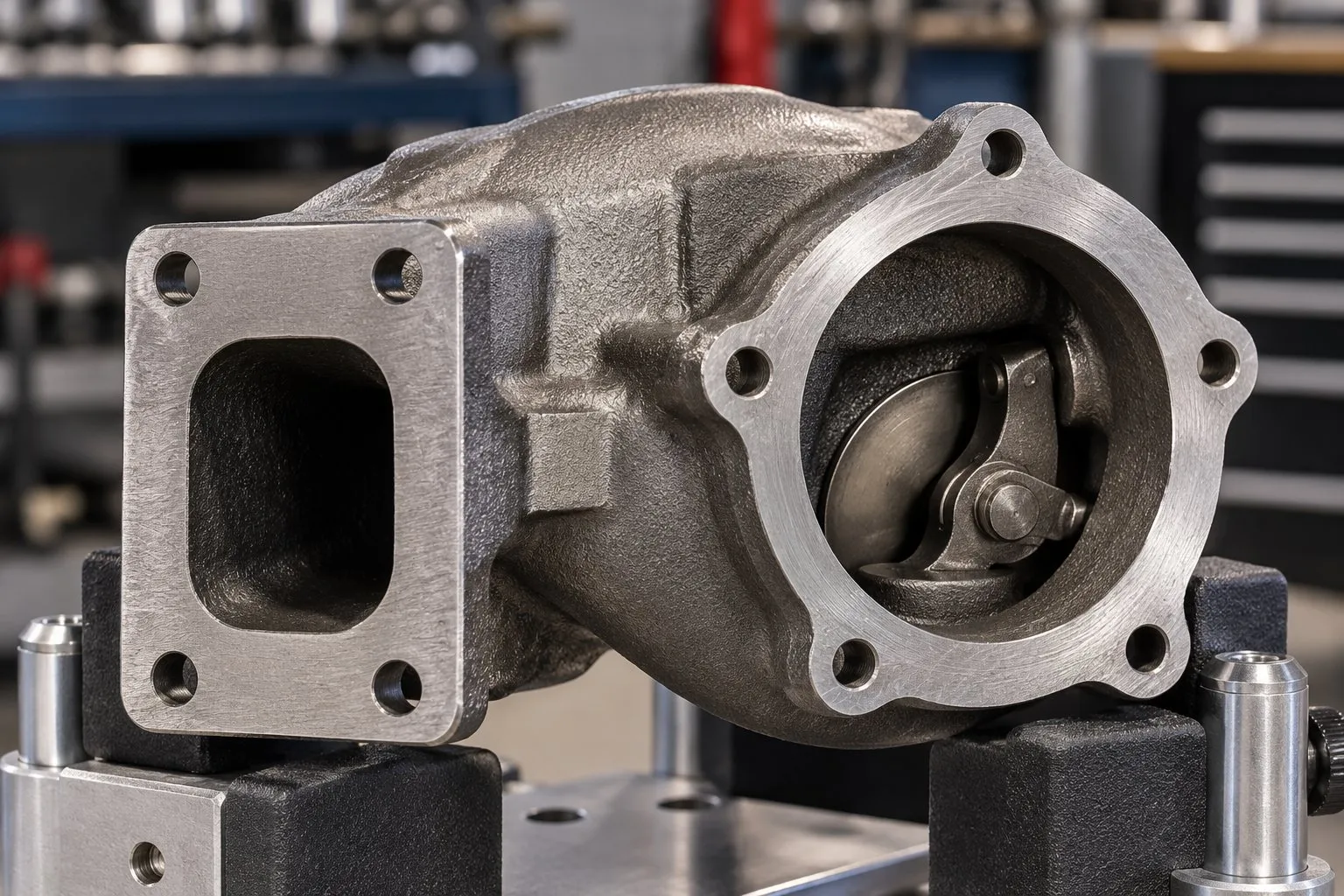
The flange is the bolt pattern where the turbine housing meets the exhaust. This is where most fitment mistakes happen, because two turbos with identical wheels can wear completely different flanges. Here are the ones you will see most.
T3 Flange
The T3 is a compact four-bolt flange used on a huge range of small to midsize turbos. Garrett’s GT30 turbine housings with a T3 inlet are offered in 0.63, 0.82 and 1.06 A/R, which lets you tune the same frame for spool or top end. The Garrett GT3071R and GT3582R are both available with a T3 inlet, and the GT3582R can also be had with a T4.
T4 Flange
The T4 is a larger four-bolt flange that handles more flow and higher exhaust pressure, which is why it shows up on bigger diesel and high-horsepower builds. BorgWarner’s S400 family uses a T4 inlet with a bolt spacing of 82.55 by 69.85 mm, or a T6 on the larger S400SX4 versions. If you are shopping an S400, confirm the flange, because T4 and T6 housings do not interchange.
T6 Flange
The T6 is a bigger flange again, used on the largest single turbos and compound setups where exhaust volume outgrows the T4. You see it on top-end S400 variants and larger frames. Its advantage is flow capacity and clamping strength on a big, heavy housing.
T25 Flange
The T25 is a small turbine inlet flange found on compact performance turbos; on Garrett’s GT28 housings it is paired with a separate five-bolt outlet. The Garrett GT2871R comes with a T25 or a V-band turbine inlet and has no T3 option, which catches a lot of first-time buyers off guard.
V-Band Flange
A V-band connection uses a round machined lip on the housing and a wedge-shaped clamp instead of bolts. It seals well, clocks to any angle, and installs fast, which is why so many modern performance turbos offer it. Garrett’s ball-bearing GT-R line, including the GT2871R, GT3071R, and GT3582R, all list V-band inlet options alongside their bolt flanges.
| Flange | Style | Typical Use | Notes |
|---|---|---|---|
| T25 | Small inlet (5-bolt outlet) | Compact performance turbos | GT2871R uses T25 or V-band, no T3 |
| T3 | 4-bolt, compact | Small to midsize turbos | Garrett GT30 T3 A/R 0.63, 0.82, 1.06 |
| T4 | 4-bolt, large | Big diesel, high-HP builds | S400 bolt spacing 82.55 x 69.85 mm |
| T6 | 4-bolt, largest | Top-end singles, compounds | On larger S400SX4 units |
| V-band | Clamp | Modern performance turbos | Clocks to any angle, fast install |
What A/R Actually Means
You cannot talk housing types without A/R. The A/R ratio compares the turbine housing’s cross-sectional area at a given point to the radius from the shaft center to that point. A smaller A/R speeds up the gas and spools the turbo earlier at the cost of top-end flow; a larger A/R flows more up top but lags down low.
The important point for fitment is that A/R is a turbine housing property, not a cartridge property. Two identical turbos can wear different A/R housings, and casting numbers stamped into a housing are not part numbers, because one casting serves many turbos. Always go by the data plate on the compressor housing, not by a casting mark.
Many Holset heavy-duty variable turbos sidestep fixed A/R entirely by using a sliding nozzle that varies effective flow area on the fly. If you want to understand that design, the variable-geometry turbocharger entry is a solid starting point.
Matching a Housing to Your Engine
The safe rule is simple: match the number on the turbo’s data plate, not the shape it looks like. A divided manifold needs a divided housing. A T4 manifold needs a T4 housing. A V-band downpipe needs a V-band turbine outlet or the right adapter. None of these mix without the correct hardware.
When you reuse or replace a V-band or T-bolt clamp, torque it to the clamp maker’s figure and do not overtighten, since a crushed clamp leaks and a loose one walks off. For bolt flanges, replace the gasket and use no sealant on a dry exhaust joint. If you are unsure which housing your engine left the factory with, send us the number on the tag and we will match it.
If you are rebuilding rather than replacing, our turbocharger rebuild service keeps your original housings, which guarantees the flange and A/R stay correct for your truck. Rebuild pricing is listed by model on our turbo rebuild price list, and most rebuilds ship in 3 days or less. For anything you cannot identify, contact PT Turbo or call (909) 824-1020.
Turbos we list for the GT2871R, S400 and GT3582R
Listings for the turbo models named in this guide that can be ordered online today. Several part numbers can fit one engine by year and rating, so match the number on your turbo’s tag, or call (909) 824-1020 and we will match it for you.
All GT2871R listings · All S400 listings · All GT3582R listings
Frequently Asked Questions
Can I bolt a T4 turbo to a T3 manifold?
Not directly. The bolt patterns and port shapes are different, so you need either a manifold with the matching flange or a T3-to-T4 adapter flange rated for exhaust heat. Mixing them without an adapter leaves you with exhaust leaks and no clamping surface.
Is a twin-scroll housing always better than single-scroll?
Only when your exhaust manifold is divided to feed it. A twin-scroll housing improves spool and low-end response by keeping exhaust pulses separate, but on a single-outlet manifold it offers no benefit. Match the housing to how the manifold routes exhaust.
How do I know which housing my turbo has?
Read the data plate on the compressor housing and go by that part number. Casting marks on the turbine housing are not part numbers, since one casting is shared across many turbos. If the plate is missing or unreadable, send us the turbo number or the old unit and we will identify it.
Need a Turbocharger?
PT Turbo has rebuilt and sold turbochargers since 1978. We stock remanufactured units for Cummins, Duramax, Power Stroke, Detroit Diesel, and more — backed by a 12-month unlimited mileage warranty. Units in stock at our shop in San Bernardino, CA ship the same day when ordered before 2 PM Pacific, Monday through Friday.
📞 (909) 824-1020 · 346 S I St. #3, San Bernardino, CA 92410 · [email protected]