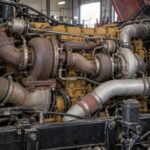
Understanding Turbocharger Sizing Basics is the difference between building a diesel engine that pulls hard from idle and one that either chokes at low RPM or runs out of breath up top. Every turbo is a compromise, and engineers spend a lot of time balancing spool-up, airflow, and backpressure to land in the sweet spot for a given engine. At PT Turbo, we have spent 45-plus years matching turbos to engines across on-highway trucks, ag equipment, and industrial diesels, so we see the results of good sizing and bad sizing every week.
This guide breaks down how the matching process actually works, what the numbers on a compressor map mean, and why the same displacement engine can call for wildly different turbos depending on its job.
Why Turbo Sizing Matters on a Diesel
A diesel is an air pump. Fuel is cheap to add, but power is limited by how much air you can cram into the cylinders to burn that fuel cleanly. The turbocharger’s job is to force more air in than atmospheric pressure alone would allow.
Size the turbo too small and it spools fast but restricts airflow up top, driving exhaust gas temperatures (EGT) sky high and choking peak power. Size it too big and you get sluggish low-end response, turbo lag, and a truck that feels dead until the tach climbs.
The goal is matching the compressor and turbine to the engine’s displacement, target boost, RPM range, and duty cycle. A long-haul truck cruising at 1,400 RPM needs something very different from a dyno-queen pickup chasing peak numbers. If you want a deeper primer on the fundamentals, the general turbocharger overview covers the core mechanics well.
The Core Variables Engineers Balance
Before anyone picks a part number, they define the operating window. These are the numbers that drive the whole decision.
- Engine displacement: Larger displacement moves more air and generally needs a larger compressor and turbine.
- Target boost (pressure ratio): How much manifold pressure you want above atmospheric. A pressure ratio of 2.5 to 3.0 is common on modern heavy-duty diesels.
- Airflow demand: Measured in pounds per minute (lb/min) of air, this is the real currency of turbo matching.
- RPM range: Where the engine spends most of its time. Torque-focused truck engines live down low; high-revving applications need airflow up top.
- Duty cycle: Constant heavy pulling, stop-and-go, or intermittent load all change the ideal match.
Get these right and the rest of the sizing exercise is math against a compressor map. Get them wrong and even a perfect part number will disappoint.
Reading a Compressor Map: Turbocharger Sizing Basics in Practice
The compressor map is where sizing gets real. It is a graph published by manufacturers like Garrett and BorgWarner that plots pressure ratio against airflow, with efficiency islands drawn inside.
The vertical axis is pressure ratio, which is absolute outlet pressure divided by absolute inlet pressure. The horizontal axis is airflow in lb/min. The concentric rings are efficiency islands, with the center island being the most efficient zone, often 76 to 78 percent on a modern diesel wheel.
Two lines bound the usable area. The surge line on the left marks where airflow is too low for the boost being demanded, causing the compressor to stall and bark. The choke line on the right is where the wheel simply cannot flow any more air, no matter how fast it spins.
The engineer plots the engine’s airflow needs across its RPM band and looks for a turbo that keeps those points inside the high-efficiency islands without crossing surge or choke. That single decision drives EGT, fuel economy, and response.
Estimating Airflow for a Diesel
A quick way to ballpark required airflow is to calculate engine airflow from displacement, RPM, volumetric efficiency, and boost, then convert to lb/min. Diesels run high volumetric efficiency thanks to no throttle plate, often 90 percent or better under boost.
As a rough rule, a diesel needs about 0.11 to 0.14 lb/min of airflow per horsepower, more than a gasoline engine because it runs leaner. So a 500 horsepower engine wants roughly 55 to 70 lb/min of air. That number tells you which compressor family is even in the running before you look at trim and A/R.
A/R Ratio, Trim, and the Turbine Side
The compressor gets a lot of attention, but the turbine housing controls how fast the whole assembly spools. The key spec is the A/R ratio, the area of the housing throat divided by the radius from the center to that area’s centroid.
A smaller A/R turbine housing speeds up exhaust gas, spools the turbo faster, and builds low-end boost, but it raises backpressure and EGT at high RPM. A larger A/R does the opposite, freeing up top-end power at the cost of lazier response.
Trim refers to the relationship between a wheel’s inducer and exducer diameters. A higher trim wheel flows more air for a given diameter. Engineers juggle trim and A/R together to shape the boost curve to the engine’s needs.
| Sizing Choice | Smaller Turbo / Small A/R | Larger Turbo / Large A/R |
|---|---|---|
| Spool-up / lag | Fast, strong low-end | Slower, more lag |
| Top-end power | Restricted, runs out of air | Strong, high airflow |
| Exhaust gas temp (EGT) | Higher under load | Lower at peak flow |
| Backpressure | High at RPM | Lower at RPM |
| Best use case | Towing, low-RPM torque | High horsepower, high RPM |
VGT and Wastegated Turbos: Sizing You Can Adjust
Fixed-geometry turbos force a single compromise. Modern diesels get around this with two technologies that let the effective turbo size change on the fly.
A variable-geometry turbocharger (VGT) uses movable vanes in the turbine housing to change the effective A/R. At low RPM the vanes close to speed up exhaust flow and spool quickly; at high RPM they open to reduce backpressure. That gives you small-turbo response and big-turbo top-end in one unit, which is why VGTs dominate on-highway diesels that also need to drive DPF regeneration and manage EGR flow.
Wastegated turbos take a simpler path. A smaller turbine is sized for fast spool, and a wastegate bleeds off excess exhaust once target boost is reached to keep the small turbine from overspeeding up top.
The Actuator’s Role in Sizing
Whether VGT or wastegated, the actuator is what translates the sizing strategy into real-world boost control. A worn or leaking actuator throws off the entire calibration, causing overboost, underboost, or limp mode.
Pneumatic actuators are still common across truck and equipment turbos.
Matching the correct actuator to the turbo is part of correct sizing. The spring rate and stroke are calibrated to the turbine housing and wastegate, so a generic substitute rarely holds the intended boost curve.
Matching a Replacement Turbo the Right Way
Most people reading this are not designing a turbo from scratch. They are replacing one and want the same match the engineer already dialed in. That means starting with the exact OEM part number.
When the part number tag is missing or unreadable, casting numbers on the compressor and turbine housings let you identify the unit. We walk through that process in our guide on matching a turbocharger replacement using cast numbers.
For popular platforms, we have model-specific breakdowns, like the John Deere PowerTech turbocharger replacement guide covering the 4045, 6068, and 6090 engines. Getting the frame, A/R, and actuator right the first time avoids the EGT and boost problems bad sizing creates.
New, Remanufactured, or Rebuild
Once you know the correct match, you have three ways to source it. Each has a place depending on budget, downtime, and availability.
A new OEM or aftermarket turbo gives you the longest service life and the tightest match to the original spec, which matters most on a truck that has to stay on the road. It costs the most up front, but you are getting fresh bearings, wheels, and housings with no wear history.
A remanufactured turbo is a used core torn down, inspected, and rebuilt to spec with new wear parts and balanced to tolerance. For most working trucks and equipment this is the sweet spot on cost and reliability, and it keeps the same frame and A/R the engine was built around.
A rebuild of your own core makes sense when the housings are good and you want to keep the exact unit on the engine. It is the cheapest route if the center section is the only thing worn, but it hinges on the core being clean and the shaft not being scored. Whichever path you take, the match itself does not change, so start from the correct part number and protect the sizing the engineer already got right.
Frequently Asked Questions
What happens if a turbocharger is sized too large for a diesel engine?
An oversized turbo spools slowly and can cause laggy, weak low-RPM performance. It may only make good power at high RPM, leaving the engine feeling breathless off idle.
How does turbocharger sizing affect spool-up and backpressure?
A smaller turbo spools faster for quick low-end response but creates more backpressure at high RPM. A larger turbo reduces backpressure up top but sacrifices low-RPM responsiveness.
Why is turbo sizing considered a compromise?
No single turbo optimizes both low-end spool and high-RPM airflow, so engineers balance these factors to hit the ideal performance sweet spot for a specific engine and application.
Already running a turbo that needs refreshing? PT Turbo’s turbo rebuild service restores worn units to specification.
Need a Turbocharger?
PT Turbo has rebuilt and sold turbochargers since 1978. We stock remanufactured units for Cummins, Duramax, Power Stroke, Detroit Diesel, and more — backed by a 12-month unlimited mileage warranty and same-week shipping from San Bernardino, CA.
📞 (909) 824-1020 · 346 S I St. #3, San Bernardino, CA 92410 · [email protected]
More From PT Turbo
- Electronic Actuator Failure on Diesel Trucks: Symptoms, Diagnosis & Replacement Cost
 Caterpillar C15 Turbocharger Replacement Cost: New, Reman & Rebuild Compared
- Turbocharger Warranty Guide: What Is Covered and What Voids Your Warranty
- High-Altitude Turbocharger Performance: What Changes Above 5,000 Feet