Volvo Penta Marine Diesel Turbocharger Guide: D4, D6 & D11 Applications
This Volvo Penta Marine Diesel Turbocharger Guide is built for boat owners, marine techs, and repower shops who need to identify the right charger, understand why it failed, and get back on the water without guessing. Volvo Penta has used several turbo families over the years, from the older KKK (BorgWarner) K-series units to the IHI turbos on the smaller engines, so the first job is always matching the exact unit on your block. Get that right and everything downstream, from parts to rebuild to install, gets easier.
PT Turbo has been rebuilding turbochargers since 1978, more than 45 years of family-owned work out of San Bernardino, California. We stock both new and remanufactured marine turbos and remanufacture cores in-house, which matters when a turbo for a boat engine is sitting on a backorder somewhere. Below is how Volvo Penta charges these engines and how to sort out what you actually have.
How Volvo Penta charges its marine diesels
Volvo Penta does not build its own turbochargers. Across the TMD, TAMD, KAD, and KAMD families, the factory turbos are KKK (BorgWarner) K-series units: the K26, K27, and K31. These are fixed geometry turbos, with or without a wastegate depending on the rating. KKK and 3K are the same company, now part of BorgWarner, so you will see those names used interchangeably on data plates and listings.
The KAD and KAMD engines add a belt-driven supercharger alongside the turbo. That two-stage arrangement builds low-speed boost mechanically and hands off to the turbo as exhaust energy comes up, which is why a running complaint on those engines is not always the turbo. Check the supercharger clutch and belt before you condemn the exhaust-side charger.
On the smaller end, the Volvo Penta D2-75 uses an IHI RHF4. That is a compact fixed geometry turbo, and like every unit here, the surest identification is the part number stamped on its data plate, not the engine badge on the hatch.
D4, D6, and D11: identify your turbo by the tag
The D4, D6, and D11 are Volvo Penta’s modern inboard and sterndrive diesels, and their turbochargers vary by model year, power rating, and emissions version. Rather than assume a model, pull the number off the turbo’s data plate (on the compressor housing) and the engine’s identification plate, then match both. A wrong turbo on a marine engine is worse than no turbo: it can cost you boost, spool, and exhaust temperature margin out on the water where you cannot pull over.
Casting numbers on the housings are not part numbers. One casting serves many turbos, so a casting number only narrows the search. Confirm the actual unit by the number on the tag, with wheel sizes and A/R to back it up. Send us those numbers and we will tell you exactly what you have.
If your D11 shares architecture with the on-highway Volvo D11 and Mack MP7 engines, note that those use variable geometry Holset chargers. On a marine engine, do not assume that carries over: go by the tag number on your unit. For the related Cummins marine engines you may see in the same fleet, our Cummins QSB turbocharger guide covers the Holset H1C, HX35, HX40, and HX55WM units those run.
Volvo Penta charging by engine family
This table compares the charging approach across the families we can verify. It does not assign a single turbo model to the D4, D6, or D11, because those depend on the exact rating and version. Match those by the number on the plate.
| Engine family | Charging approach | Factory turbo type |
|---|---|---|
| TMD / TAMD | Single turbocharger | KKK (BorgWarner) K26 / K27 / K31, fixed geometry |
| KAD / KAMD | Turbo plus belt-driven supercharger | KKK (BorgWarner) K-series, fixed geometry |
| D2-75 | Single turbocharger | IHI RHF4, fixed geometry |
| D4 / D6 / D11 | Turbocharger; some D4 and D6 versions also add a belt-driven supercharger (varies by rating and year) | Identify by the number on the turbo’s data plate |
What fails on a marine turbo and how to check it
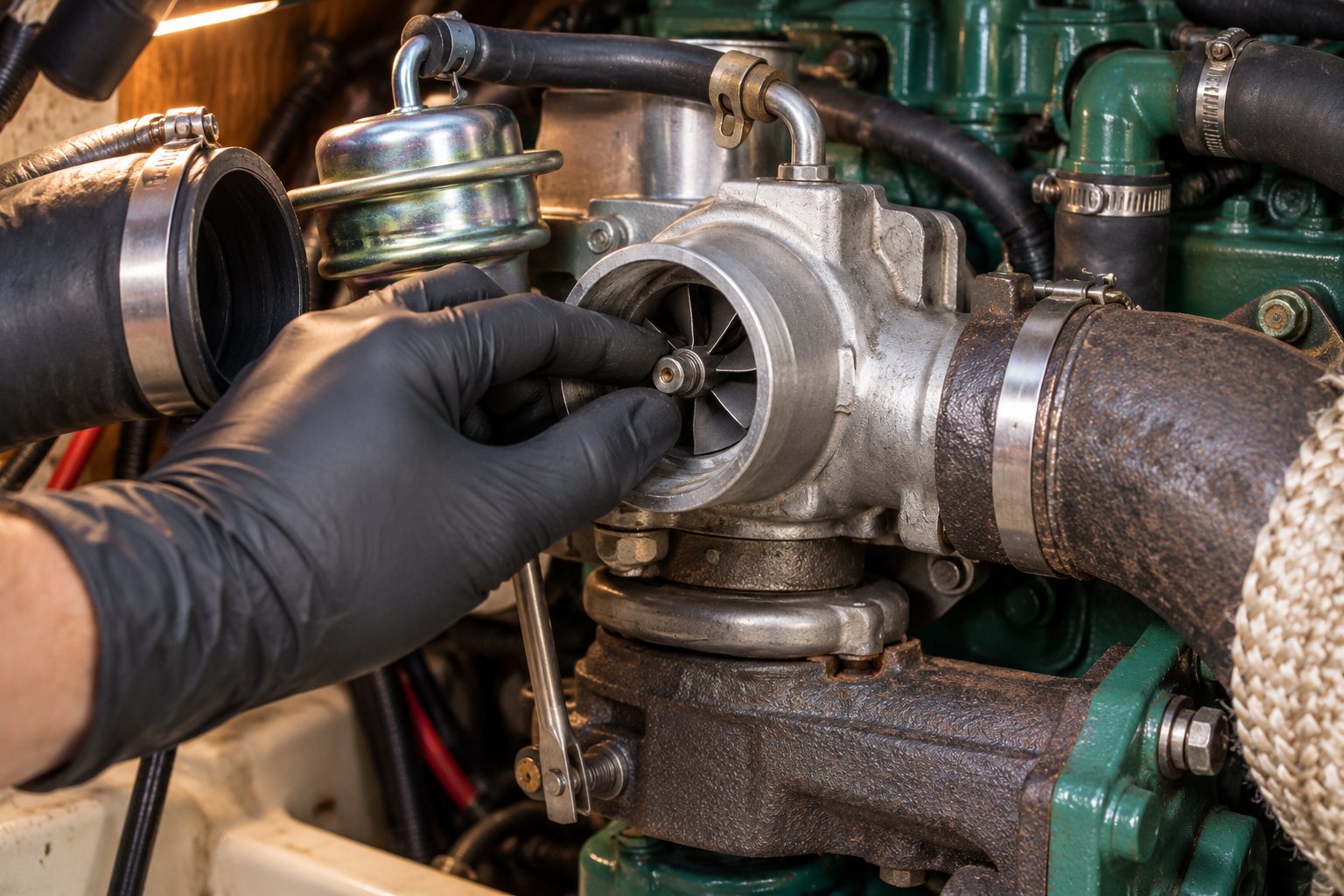
Most turbo failures trace back to the oil supply, not to the turbo being “worn out.” A marine engine that sits for weeks, then gets started cold and loaded quickly, is hard on bearings. Before you pull anything, check oil level and condition, the oil feed line, and the drain. A restricted drain backs oil up past the seals; a leaking drain gasket leaks oil externally. Those are two different problems with two different fixes.
Oil in the charge piping is not automatic proof of a bad turbo. A light oil film is normal from crankcase ventilation. Pooled oil is the warning sign. A turbo can only pass oil into the intake past its compressor-side seal and into the exhaust past its turbine-side seal, so rule out the breather, air filter, oil level, and drain first.
When you check shaft play on a fixed geometry K-series or RHF turbo, remember that some side-to-side rock at the wheel is normal on a journal-bearing turbo with no oil pressure. Condemn the unit for in-and-out (axial) play you can feel, for the wheel touching the housing, or for play beyond the maker’s limit, never for any movement at all.
- Low boost, slow spool, dark smoke: look for an exhaust leak in the manifold or up-pipes ahead of the turbine, a stuck or unseated wastegate, or a cracked charge boot. These let exhaust or boost escape before it does work.
- Blue-gray smoke: oil past a seal, but only after the drain, breather, and engine wear are ruled out.
- White smoke or steam: coolant, not a turbo fault. On a cold engine it can be unburned fuel.
- Overboost or high drive pressure: on a variable geometry unit, a nozzle stuck closed; on a wastegated unit, a gate that is not opening.
Marine duty also means heat management. Run the engine down to a few minutes of idle after a hard pull before shutdown so the center housing oil does not coke. For general background on how a turbo and a variable-geometry turbocharger work, that reference is a solid starting point.
New versus remanufactured for a marine turbo
You have two sound paths: a new unit or a quality remanufactured one. A remanufactured turbo is a complete unit, disassembled, cleaned, inspected, and rebuilt with new bearings, seal rings, and thrust parts, then balanced on a vibration sorting rig before it ships. For many Volvo Penta applications a reman is the faster and more sensible route, especially when a new factory part is on backorder.
| Option | What you get | Best when |
|---|---|---|
| New turbo | Factory-fresh complete unit | You want OE and it is in stock |
| Remanufactured turbo | Rebuilt and balanced complete unit, 30-day core return | Fast turnaround, value, or new is backordered |
| Rebuild your core | Your exact unit rebuilt and returned | You want to keep your original housings and tag |
We rebuild to the maker’s clearances and most rebuilds ship in 3 days or less, with the rebuild price confirmed after inspection and before any work starts. For what a rebuild runs on your specific model, see our turbo rebuild price list. Remanufactured units carry a 30-day core return and all our work is backed by a 12-month, unlimited-mileage warranty.
When you reinstall, follow the maker’s first-start steps: fill the oil inlet with clean engine oil, turn the wheel by hand, then crank or idle a few minutes before loading the engine. Use no sealant on the oil inlet or drain gaskets, and fit a new oil feed line rather than reusing one that has seen a bearing failure or coked oil.
Turbos we list for the RHF4
Listings for the turbo models named in this guide that can be ordered online today. Several part numbers can fit one engine by year and rating, so match the number on your turbo’s tag, or call (909) 824-1020 and we will match it for you.
Frequently Asked Questions
How do I identify the exact turbo on my Volvo Penta engine?
Read the part number stamped on the turbo’s data plate, which sits on the compressor housing, and record the engine identification number as well. Casting numbers on the housings are not part numbers, so use them only to narrow the search and confirm with the tag number plus the wheel sizes and A/R. Call us at (909) 824-1020 with those numbers and we will match it.
Can PT Turbo rebuild a Volvo Penta marine turbo?
Yes. We remanufacture K-series, IHI, and other Volvo Penta marine cores in-house with new bearings, seals, and thrust parts, then balance each one before it ships. Most rebuilds ship in 3 days or less and the price is confirmed after inspection and before work begins.
Is a remanufactured marine turbo as reliable as new?
A properly remanufactured turbo is rebuilt to the maker’s clearances and balanced on a vibration sorting rig, so it performs to the original specification. It ships with a 30-day core return and is covered by our 12-month unlimited-mileage warranty. For current pricing on new versus reman for your model, check the product page or call (909) 824-1020.
Need a Turbocharger?
PT Turbo has rebuilt and sold turbochargers since 1978. We stock remanufactured units for Cummins, Duramax, Power Stroke, Detroit Diesel, and more — backed by a 12-month unlimited mileage warranty. Units in stock at our shop in San Bernardino, CA ship the same day when ordered before 2 PM Pacific, Monday through Friday.
📞 (909) 824-1020 · 346 S I St. #3, San Bernardino, CA 92410 · [email protected]